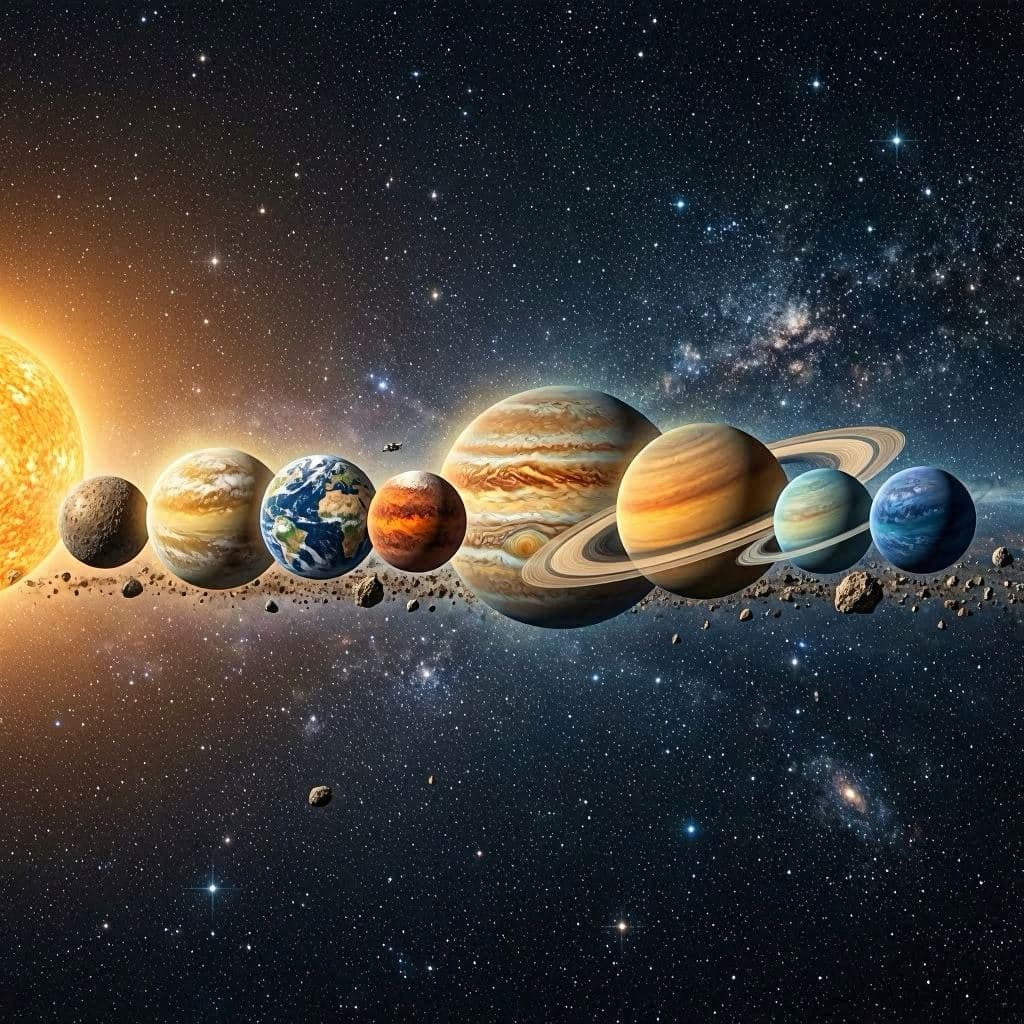
When the Declaration of Independence was signed in 1776, the known solar system was a modest affair, consisting of just six planets: Mercury, Venus, Earth, Mars, Jupiter, and Saturn. These celestial wanderers had been observed since antiquity, their movements charted by ancient astronomers who saw them as gods or omens. The idea that there could be more worlds beyond Saturn was scarcely considered, as the telescope had not yet revealed the true scale of our cosmic neighborhood.
The first expansion of this family came in 1781, when William Herschel discovered Uranus. This finding was a shock to the scientific community, doubling the known size of the solar system and challenging existing models of planetary formation. It was a reminder that our understanding of the universe is always provisional, subject to revision as new tools and techniques become available. Uranus was not just a new planet; it was a symbol of the unknown waiting to be explored.
Neptune followed in 1846, predicted mathematically before it was seen. Its discovery was a triumph of Newtonian physics, demonstrating the power of calculation to reveal hidden truths. For a time, the solar system seemed complete, with eight planets orbiting the sun in orderly fashion. But the story did not end there. In 1930, Pluto was discovered, adding a ninth member to the club and sparking decades of debate about what constitutes a planet.
The reclassification of Pluto in 2006 reduced the count back to eight, a decision that remains controversial among some astronomers and the public alike. This change reflected a deeper understanding of the Kuiper Belt, a region of icy bodies beyond Neptune. It highlighted that the solar system is not just a collection of large spheres but a complex ecosystem of diverse objects, each with its own history and characteristics.
Today, the question "Does it end there?" is more relevant than ever. With advances in telescope technology, astronomers are discovering thousands of exoplanets around other stars, suggesting that planetary systems are common in the galaxy. Within our own solar system, the search for "Planet Nine" continues, driven by gravitational anomalies in the orbits of distant objects. The possibility of another large planet lurking in the shadows keeps the spirit of discovery alive.
This evolving narrative teaches us humility. Just as our ancestors could not imagine Uranus, we may be blind to aspects of our own system that future generations will take for granted. The definition of a planet itself is a human construct, shaped by our desire to categorize and understand. As our knowledge grows, so too does our appreciation for the complexity and beauty of the cosmos.
The journey from six to eight planets is not just a historical footnote but a lesson in scientific progress. It shows how curiosity, combined with technology and rigorous inquiry, can expand our horizons. Each discovery adds a piece to the puzzle, revealing a picture that is far more intricate and wonderful than we initially imagined.
In the end, the solar system is not a static museum but a dynamic frontier. Whether there are nine planets, eight, or more, the true value lies in the quest for knowledge. As we look to the stars, we are reminded that the universe is vast and full of surprises, inviting us to keep looking, keep questioning, and keep wondering.
AI Image Disclaimer: The visual aids accompanying this article are created using artificial intelligence and are intended for conceptual illustration only, not as factual depictions of historical astronomical charts.
Sources: Space.com NASA
Published by Banx Network. This article is part of the Banx decentralized media programme, powered by the BXE token on the XRP Ledger.