
Key Highlights
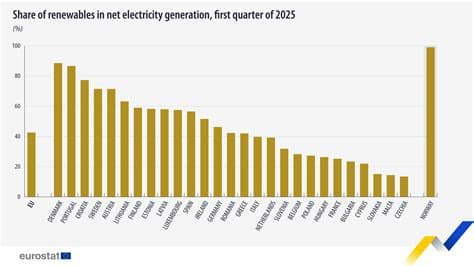
- Denmark, Portugal, and Lithuania lead the EU in renewable electricity consumption.
- Austria and Sweden show the highest shares, exceeding 90%.
- The EU overall is nearing a 50% share of electricity from renewable sources.
In a significant shift towards sustainability, Eurostat data reveals that renewable energy sources are increasingly dominating electricity consumption across the European Union. As of 2024, countries like Austria, Sweden, and Denmark have made remarkable strides, with over three-quarters of their electricity consumption sourced from renewables. Austria leads the pack with an impressive 90.1% share, followed closely by Sweden at 88.1% and Denmark at 79.7%. This trend underscores a growing commitment to green energy solutions within the EU.
Portugal also stands out with a renewable electricity share of 65.8%, reflecting its ongoing investments in solar and wind energy. Other EU nations are not far behind, with several countries surpassing the 50% mark. Spain, for instance, reports a 59.7% share, while Croatia, Latvia, Finland, Germany, Greece, and the Netherlands all boast shares ranging from 50.5% to 58.0%. These figures highlight a collective movement towards cleaner energy across the continent.
Conversely, some countries still lag in their renewable energy adoption. Malta, for example, has a mere 10.7% share of electricity from renewables, while Luxembourg and Slovakia report 20.5% and 24.9%, respectively. This disparity indicates that while many EU nations are making significant progress, others face challenges in transitioning to renewable energy sources.
The overall trend in the EU indicates a robust reliance on wind, hydro, and solar energy, with renewables approaching the 50% threshold in total electricity generation. This shift not only contributes to environmental sustainability but also aligns with the EU's broader climate goals aimed at reducing carbon emissions and combating climate change.
As the EU continues to invest in renewable technologies and infrastructure, the potential for further growth in this sector remains high. The commitment to achieving a greener future is evident, and as more countries adopt similar strategies, the EU could soon become a global leader in renewable energy consumption.
The data from Eurostat serves as a crucial benchmark for assessing the progress of EU nations in their energy transition. With ongoing efforts and investments, the future of renewable energy in Europe looks promising, paving the way for a more sustainable and environmentally friendly energy landscape.
Published by Banx Network. This article is part of the Banx decentralized media programme, powered by the BXE token on the XRP Ledger.



