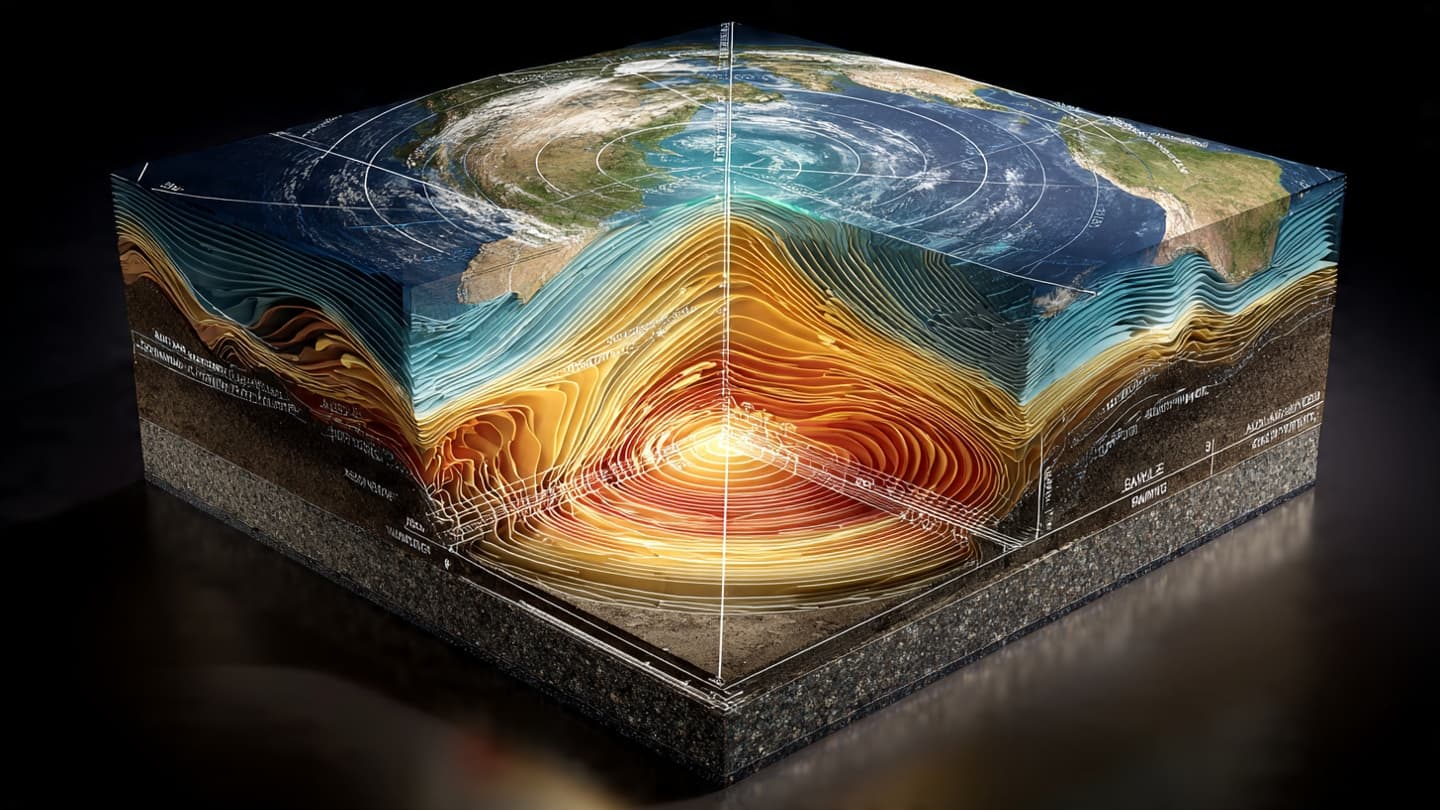
The surface of Earth often feels solid and familiar, yet beneath mountains, oceans, and cities lies a dynamic world that remains only partially understood. Like the unseen roots of a vast forest, geological processes deep within the planet quietly influence the landscape above. A recent scientific discovery has drawn attention to one of these hidden realms.
Researchers have identified evidence of an unusually deep earthquake occurring approximately 90 kilometers beneath the Earth's surface. The finding challenges some existing assumptions about how seismic activity behaves at significant depths and offers new insights into the planet's interior structure.
Earthquakes are typically associated with movements along faults closer to the surface. As depth increases, pressure and temperature conditions change dramatically, making certain forms of seismic activity less common and more difficult to explain.
Scientists study deep earthquakes because they provide valuable information about the behavior of rocks under extreme conditions. Understanding these processes helps researchers refine models of tectonic activity and improve knowledge of Earth's geological evolution.
The newly analyzed event was detected through advanced seismic monitoring systems capable of recording subtle movements occurring far below the surface. These technologies allow scientists to investigate regions that remain inaccessible through direct observation.
Geophysicists note that Earth's mantle plays a critical role in shaping long-term planetary processes. Heat transfer, tectonic movement, and the formation of geological features are all influenced by activity occurring within this vast layer beneath the crust.
Research into deep seismic events also contributes to broader efforts to understand natural hazards. While extremely deep earthquakes do not always produce significant surface effects, they provide important clues about the mechanics of the planet's interior.
The discovery demonstrates how advances in scientific instruments continue to improve humanity's ability to study complex geological systems. Each new dataset helps refine theories and reveal previously hidden aspects of Earth's behavior.
As investigations continue, researchers hope to learn more about the conditions that allow such deep earthquakes to occur. The findings add another piece to the ongoing effort to understand the remarkable planet beneath our feet.
AI Image Disclaimer This article contains an AI-generated illustration created to visualize geological processes discussed in the report.
Sources ScienceDaily, Nature Geoscience, American Geophysical Union, New Scientist
Published by Banx Network. This article is part of the Banx decentralized media programme, powered by the BXE token on the XRP Ledger.