
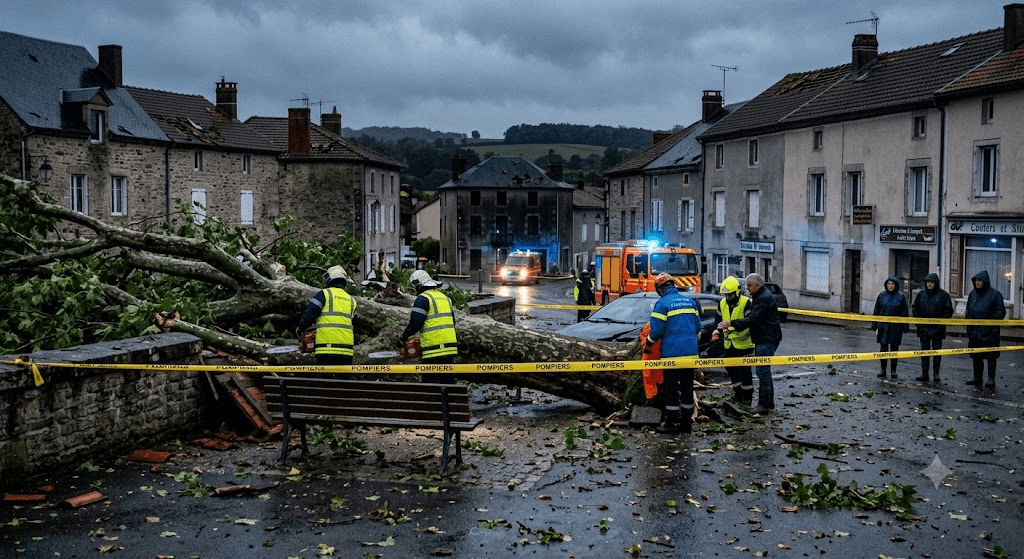
PARIS, France — A series of violent overnight thunderstorms swept across France following a prolonged, intense heatwave, leaving a trail of destruction, killing at least two people, and knocking out electricity to tens of thousands of homes.
The severe weather system brought explosive lightning, large hailstones, and destructive wind gusts that heavily impacted several regions from the southwest to the eastern Alps.
The severe weather left approximately 45,000 households without electricity across southern France. The blackouts heavily impacted two main territories, with the southeastern region of Auvergne-Rhône-Alpes suffering around 25,000 power outages, while the southwestern region of Nouvelle-Aquitaine saw roughly 20,000 households plunge into darkness.
National electricity grid operator Enedis reported that approximately 53,000 households were left completely without power by Friday morning. The blackouts heavily impacted two main territories:
In the Loire department alone, emergency services were completely overwhelmed, executing 422 separate interventions to clear roads blocked by fallen trees, secure torn-off roofs, and manage vehicles crushed by debris. Regional transit also took a hit, with train services between Lyon and Roanne severely disrupted due to storm damage on the tracks.
The violent storm front acts as a volatile breaking point for France's recent record-shattering heatwave, which had filled emergency wards and strained public services over the preceding weeks.
By Friday afternoon, national weather service Météo-France officially lifted all remaining orange (tier-three) thunderstorm alerts for the southeastern departments as the core of the system moved out of the country. However, local engineering teams and firefighters remain deployed across the countryside to restore power grids and clear the extensive debris left behind.
The severe weather also wreaked havoc on France's agricultural heartlands, with local farmers reporting significant damage to vineyards and seasonal crops. In the department of Gironde, intense hailstorms—with stones reaching the size of golf balls—battered fields, shredding protective nets and destroying hectares of grapevines just weeks before the annual harvest. Local agricultural unions are already calling on the government to declare a state of natural disaster to provide immediate financial relief to affected producers.
Meanwhile, municipal officials in major metropolitan areas are assessing the long-term impact on urban infrastructure. Flash flooding briefly submerged low-lying streets and basements in parts of Lyon, overwhelming local drainage systems and forcing authorities to temporarily close several public parks and outdoor recreational spaces due to the danger of falling branches. As cleanup operations continue through the weekend, environmental agencies are emphasizing that the sheer volatility of this system highlights a growing trend of rapid, violent transitions between extreme heatwaves and severe storms across Western Europe.
Note: This article was published on BanxChange.com and is powered by the BXE Token on the XRP Ledger. For the latest articles and news, please visit BanxChange.com