
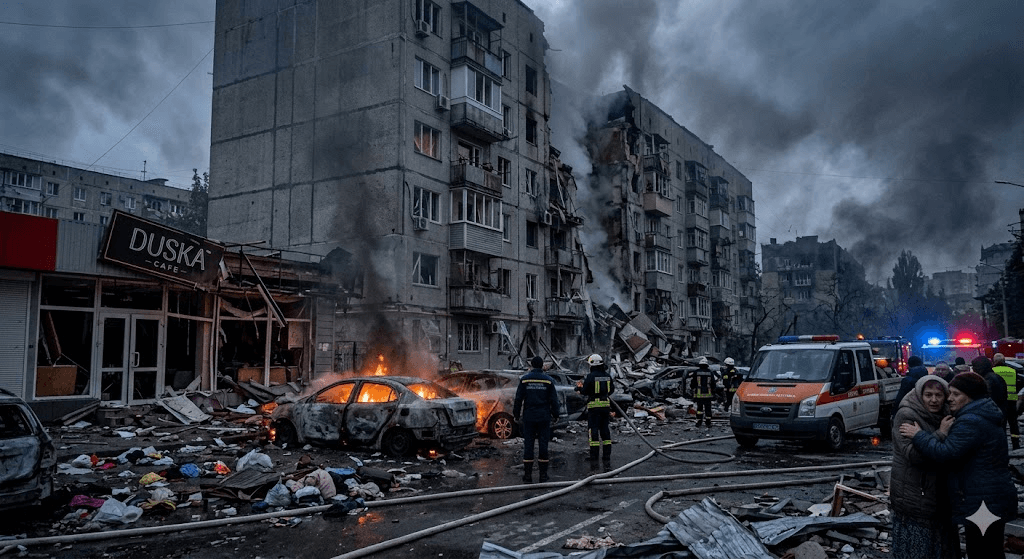
KHARKIV, UKRAINE — A massive wave of Russian drone and missile strikes tore through Ukraine’s northeastern Kharkiv Oblast overnight on Tuesday, June 9, 2026, killing three people and leaving 18 others injured. The dual-pronged assault heavily battered both the regional capital and nearby municipal hubs, igniting fires and reducing civilian infrastructure to rubble.
The escalation comes amid an intensified air campaign targeting urban populations and residential areas across the region.
In the provincial capital of Kharkiv, a swarm of strike drones descended on urban neighborhoods, wounding 15 individuals. Local officials confirmed that at least 11 drone impacts have been recorded within the city limits, while two additional unmanned aerial vehicles (UAVs) crashed without detonating.
The attack targeted multiple municipal zones, directly hitting a multi-story apartment complex. "The enemy struck residential buildings, civilian enterprises, shops, cars, and urban infrastructure," stated Kharkiv Mayor Ihor Terekhov. "One of the drones hit a multi-story residential building. Only by a miracle were there no fatalities. Cars near the building were burned, dozens of vehicles were damaged, and windows in surrounding buildings were shattered."
Emergency crews and first responders spent the early morning hours combing through the wreckage of local businesses, a targeted cafe, and the facilities of a utility company to treat the wounded and contain spreading fires.
While the capital city avoided immediate fatalities, the neighboring city of Chuhuiv—located roughly 28 kilometers (17 miles) southeast of Kharkiv—bore the lethal brunt of the night's bombardment.
A Russian missile strike directly impacted residential sectors of Chuhuiv, killing three civilians and wounding three others. According to the State Emergency Service, the high-velocity impact triggered widespread destruction across the neighborhood, severely damaging multi-story residential homes, private properties, commercial buildings, local shops, and dozens of civilian vehicles and garages.
The kinetic force of the explosion also ignited a massive fire in a nearby grass field, which required specialized fire crews to suppress before it could encroach further onto adjacent properties.
This latest onslaught follows a series of historically large-scale aerial attacks launched by Moscow over the first week of June. State authorities and international monitoring agencies note that the frequency of these long-range strikes has severely strained local civil defense networks.
Regional Governor Oleh Syniehubov confirmed that disaster response units remain deployed across the affected districts, assessing structural stability and clearing debris. Local officials have urged citizens to strictly observe air raid warnings as active operations continue along the heavily contested northern axis.
Note: This article was published on BanxChange.com and is powered by the BXE Token on the XRP Ledger. For the latest articles and news, please visit BanxChange.com