KUMAMOTO, Japan — A violent 7.1-magnitude earthquake struck Japan's southern island of Kyushu late on Tuesday afternoon, July 28, 2026, leaving a trail of destruction. The powerful tremor triggered temporary tsunami warnings, widespread blackouts, and major structural collapses, including a catastrophic incident at a regional shopping complex.
The Japan Meteorological Agency (JMA) reported that the earthquake struck Kumamoto Prefecture at 4:27 p.m. local time at a shallow depth of roughly 10 kilometers. The tremor registered a maximum 7 on the Japanese seismic intensity scale in Uki City and Hikawa—the absolute highest level, where moving without crawling becomes impossible.
Immediately following the mainshock, the JMA issued a tsunami advisory warning of waves up to 1 meter (3.3 feet) along the coastlines of the Ariake and Yatsushiro seas. Coastal residents were urged to evacuate to higher ground, though the advisory was fortunately lifted roughly two hours later after no major waves materialized.
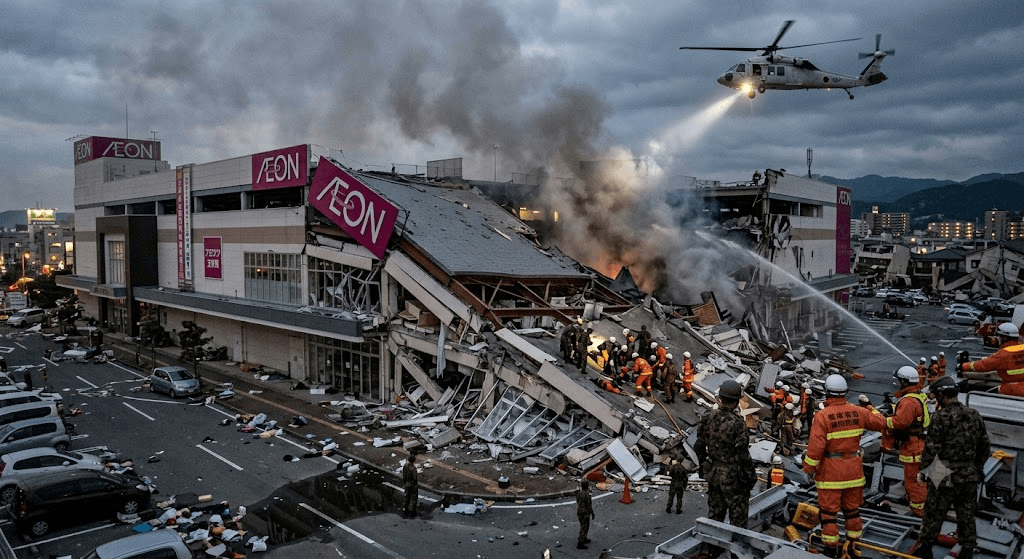
The most severe devastation centered on the town of Kashima, where the second floor of the prominent Aeon Mall Kumamoto completely collapsed. The collapse was immediately followed by what witnesses described as a large explosion and a plume of dark smoke, leaving a "considerable number" of shoppers and employees trapped or presumed dead inside.
Elsewhere in the prefecture, emergency services scrambled to respond to dozens of collapsed residential homes. In Yatsushiro, a factory chimney collapsed, trapping nine workers, and a cargo train derailed and overturned at Yatsushiro Station.
Even historical landmarks were not spared; centuries-old stone walls at the iconic Kumamoto Castle—which had been undergoing meticulous restoration since the 2016 quakes—crumbled once again, sending massive plumes of white dust into the air.
The earthquake caused immediate, widespread utility disruptions, knocking out power to nearly 48,000 households across Kumamoto. Transportation systems ground to a halt as JR Kyushu suspended all rail operations, including the high-speed Shinkansen bullet trains. Runways at Aso Kumamoto Airport were also temporarily closed for safety inspections.
Crucially, the region's vital semiconductor industry felt the shock. Tech giants including TSMC, Sony, and Fujifilm immediately evacuated workers from their local chip making facilities to inspect the high-precision machinery for physical damage. However, in a sigh of relief for utility officials, the Nuclear Regulation Authority confirmed no abnormalities or safety hazards at the nearby Sendai and Genkai nuclear power plants.
Japanese Prime Minister Sanae Takaichi quickly established an emergency task force at her office in Tokyo to coordinate relief operations.
"We will make every effort to carry out emergency disaster response measures, with rescue and lifesaving operations led by local police and fire departments as our top priority," Prime Minister Takaichi stated during a press briefing.
Self-Defense Forces have been deployed to Kumamoto to reinforce local rescue teams. As night falls, meteorologists have warned residents to brace for highly dangerous aftershocks over the coming week, as well as a severe risk of landslides triggered by the region's current high temperatures.
Note: This article was published on BanxChange.com and is powered by the BXE Token on the XRP Ledger. For the latest articles and news, please visit BanxChange.com