
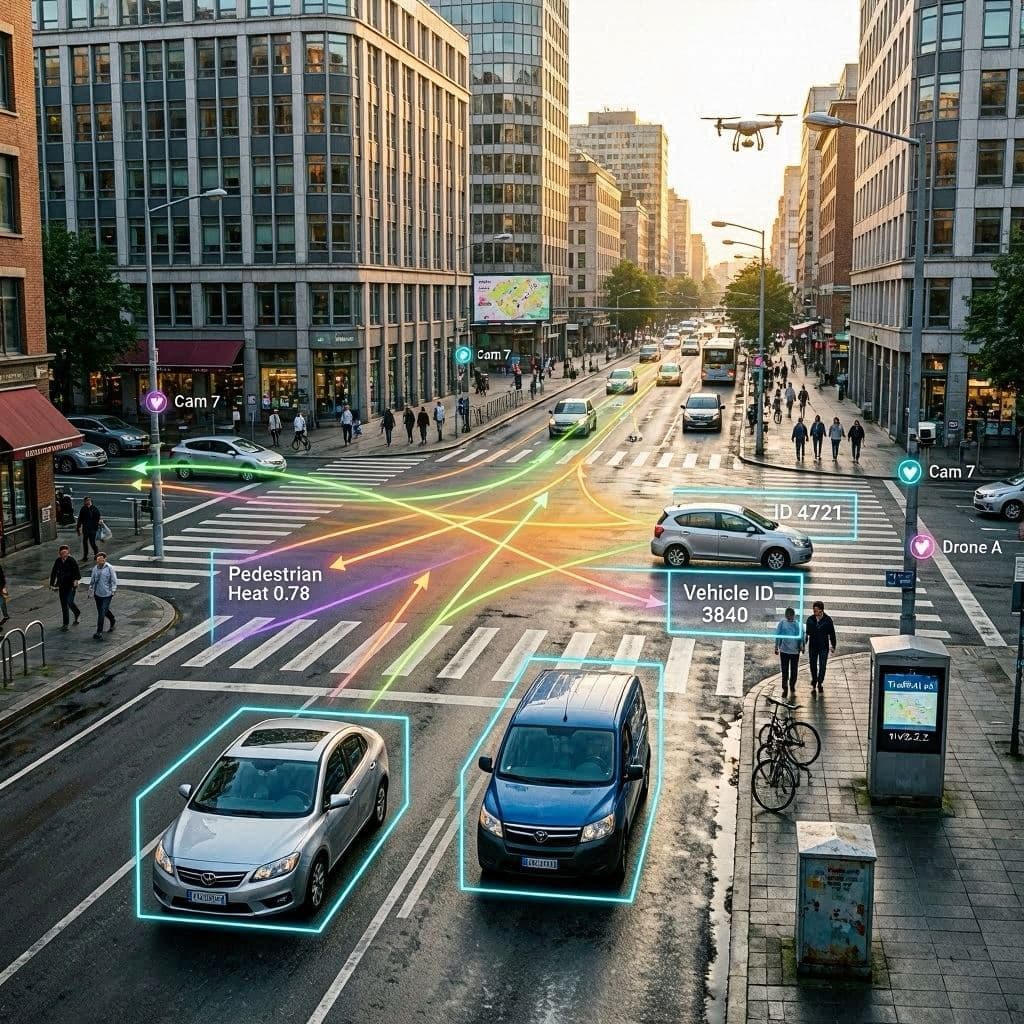
Cities move with rhythms that often appear ordinary until viewed from a broader perspective. Every traffic light, intersection, and roadway contributes to a complex system shaped by countless daily decisions. As artificial intelligence continues to evolve, researchers are discovering that these familiar patterns may reveal insights previously hidden within enormous volumes of data.
A recent scientific study has demonstrated that artificial intelligence can identify previously unknown patterns governing urban traffic behavior. Rather than relying solely on human-designed models, researchers allowed AI systems to analyze extensive transportation datasets and identify relationships independently.
The study examined information collected from multiple cities, including vehicle movement, traffic density, travel times, and road network characteristics. By processing these large datasets, the AI system identified mathematical relationships that consistently described traffic flow under varying conditions.
Researchers believe the findings could improve future transportation planning. Better predictive models may help city officials optimize traffic signal timing, reduce congestion, improve emergency response routes, and support more efficient public transportation systems.
The research also highlights how artificial intelligence can contribute to scientific discovery beyond automation. Instead of simply accelerating calculations, AI increasingly assists scientists by identifying meaningful patterns that may otherwise remain unnoticed within complex datasets.
Transportation experts caution that practical implementation will require extensive validation across different cities and infrastructure conditions. Urban environments vary considerably in geography, population density, driving behavior, and public transportation availability, making careful evaluation essential.
Future research will explore whether similar AI-driven approaches can improve energy efficiency, reduce vehicle emissions, and support the development of smart cities that respond dynamically to changing transportation demands.
The findings illustrate how artificial intelligence is becoming a collaborative scientific tool rather than merely a technological product. By uncovering hidden relationships within everyday systems, AI continues to expand opportunities for research that may ultimately improve urban life.
AI Image Disclaimer: Visuals included with this article were generated using AI to illustrate transportation research concepts and do not depict actual study locations.
Sources (verified media): arXiv, Nature Machine Intelligence, MIT Technology Review
Note: This article was published on BanxChange.com and is powered by the BXE Token on the XRP Ledger. For the latest articles and news, please visit BanxChange.com