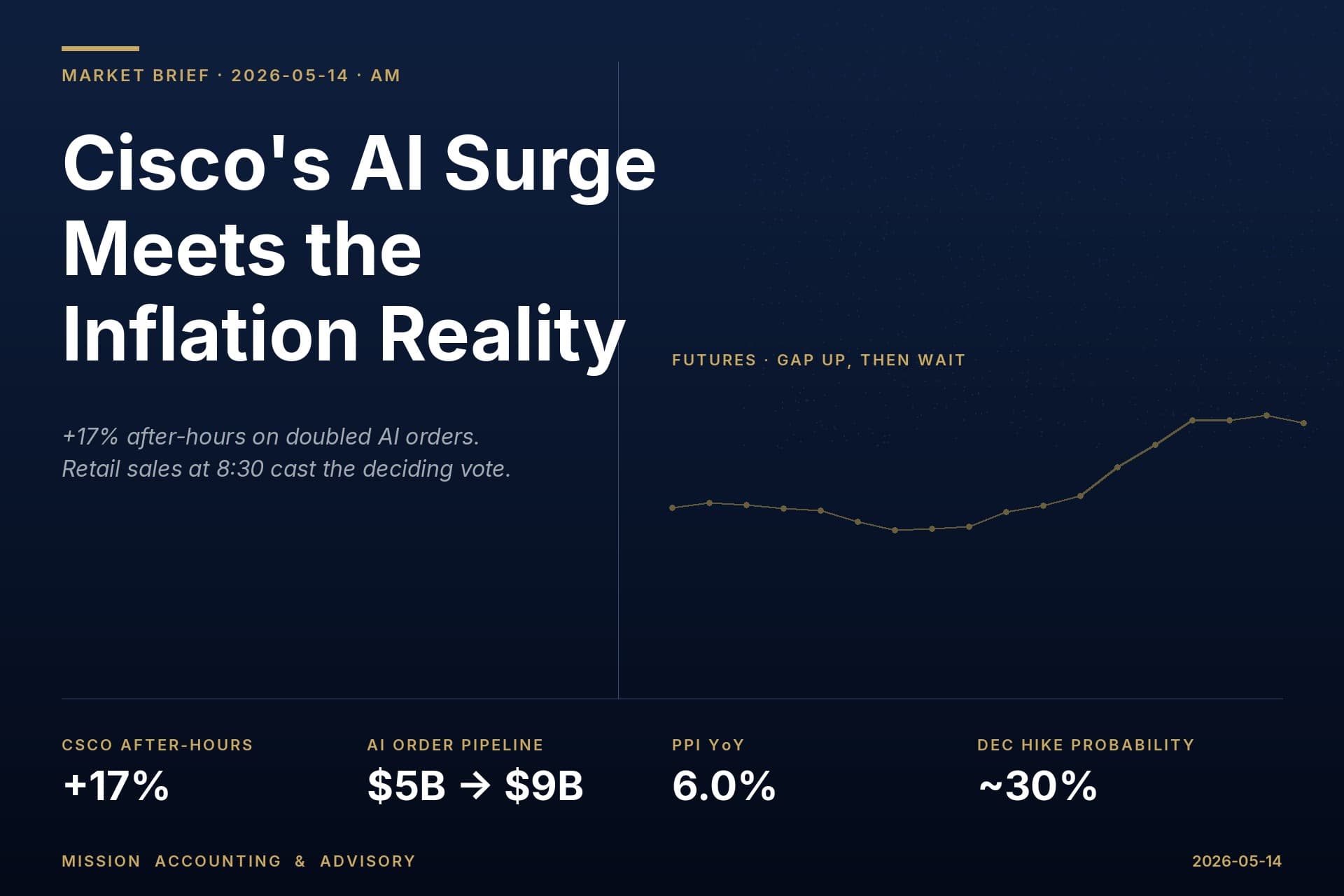
Cisco delivered adjusted earnings of $1.06 per share on $15.84 billion in revenue, beating consensus estimates of $1.04 and $15.56 billion. Guidance for the fiscal fourth quarter - $1.16 to $1.18 in adjusted EPS on $16.7 billion to $16.9 billion in revenue - came in well ahead of the Street.
But the figure that moved the tape was the AI infrastructure order book. Doubling that pipeline to $9 billion tells a specific story: enterprise customers are no longer in pilot mode. They are buying networking gear, optics, and silicon at scale to support generative AI workloads, and the order book is widening beyond the hyperscaler buyers that have carried the trade for two years. CEO Chuck Robbins framed the 4,000-person restructuring as a re-allocation toward higher-growth AI businesses rather than a cost cut born of weakness - a distinction the after-hours bid clearly accepted.
The Inflation Backdrop Just Got Heavier
Cisco's pop comes against a far less friendly macro tape. Tuesday's April CPI rose 0.6% month-over-month and 3.8% year-over-year, the hottest annual print since May 2023. Core CPI held at 2.8%, still well clear of the Fed's 2% target. Wednesday's wholesale data was worse: April PPI jumped 1.4% on the month - the biggest monthly increase since March 2022 - and accelerated to 6.0% year-over-year from 4.0% in March, blowing past forecasts.
The back-to-back hot prints have reshaped rate expectations meaningfully. Fed funds futures still price a near-98% probability of a hold at the June meeting, and the Fed is broadly expected to remain on the sidelines through most of 2026. The shift is at the back of the curve: by the December meeting, traders now assign roughly a 30% probability to a rate hike - a scenario that was effectively zero a month ago. Treasury yields eased modestly Wednesday as the inflation surge was largely energy-led, but the curve is increasingly signaling that the path of least resistance for the Fed may be patience stretching deeper into late 2026.
Retail Sales Cast a Decisive Vote
The morning's most consequential data point may not be Cisco. April retail sales, due before the open, will tell investors whether U.S. consumer demand is still cushioning the economy against tariff pass-throughs and energy spikes tied to the Iran conflict. A hot retail number would reinforce the "no landing" narrative that has supported equities all year - but it would also fuel the back-end rate-hike thesis. A soft number would calm the hike chatter but raise fresh questions about corporate revenue forecasts going into Walmart's report next week.
Watch the bond market's reaction more closely than the headline beat-or-miss. The 2-year and 10-year Treasury yields will tell you in real time how the inflation-versus-growth tug-of-war is being resolved.
Other Movers to Track
Beyond Cisco, Baidu (NASDAQ: BIDU) jumped roughly 7.9% in Wednesday's session on AI-driven momentum. Applied Materials (AMAT) reports later this week and Walmart (WMT) next week, rounding out the AI-and-consumer reads. Quantum names including Rigetti (RGTI) and tech-adjacent nuclear plays such as Oklo (OKLO) are in the after-close window and could move the speculative end of the tape. Simon Property Group (SPG) and Hims & Hers (HIMS) also report after the bell tonight.
What This Means for Investors
The macro and micro narratives are diverging - and that divergence is itself the story.
First, AI capex appears to be broadening. Whether or not Cisco continues to rally, the order book re-rating implies enterprise spending on AI infrastructure is shifting from pilots to production. For long-term portfolios, that strengthens the case for diversified exposure to the AI build-out across networking, semiconductors, power, and data infrastructure - not just the megacap names that have led the index.
Second, the inflation problem is not improving. A 6% wholesale print is not a rounding error, and the modest rise in rate-hike probabilities reflects a real change in expectations. Investors should review duration risk in fixed-income holdings, the rate sensitivity of growth-equity exposures, and the practical impact of higher-for-longer rates on personal balance sheets, mortgage decisions, and small-business borrowing plans.
Third, watch the consumer. This morning's retail sales, and Walmart next week, will be the tell-tales for whether the economy is absorbing tariff and energy pressure or starting to slow. Strong jobs plus strong consumption keeps the Fed on hold; a soft consumer would shift the calculus.
For small-business owners and individual investors alike, the lesson from this morning's tape is the one the last two weeks have hammered home: pricing power, balance sheet quality, and discipline on duration matter more than chasing the next print.
Grant Wilson is the founder and CEO of Mission Accounting & Advisory Incorporated, a San Antonio, Texas firm specializing in tax preparation, strategic tax advisory, bookkeeping, and financial advisory services. He holds FINRA Series 7, 63, and 65 licenses. The views expressed are his own and do not constitute personalized investment advice. Always consult a qualified professional before making financial decisions.
Published by Banx Network. This article is part of the Banx decentralized media programme, powered by the BXE token on the XRP Ledger.