
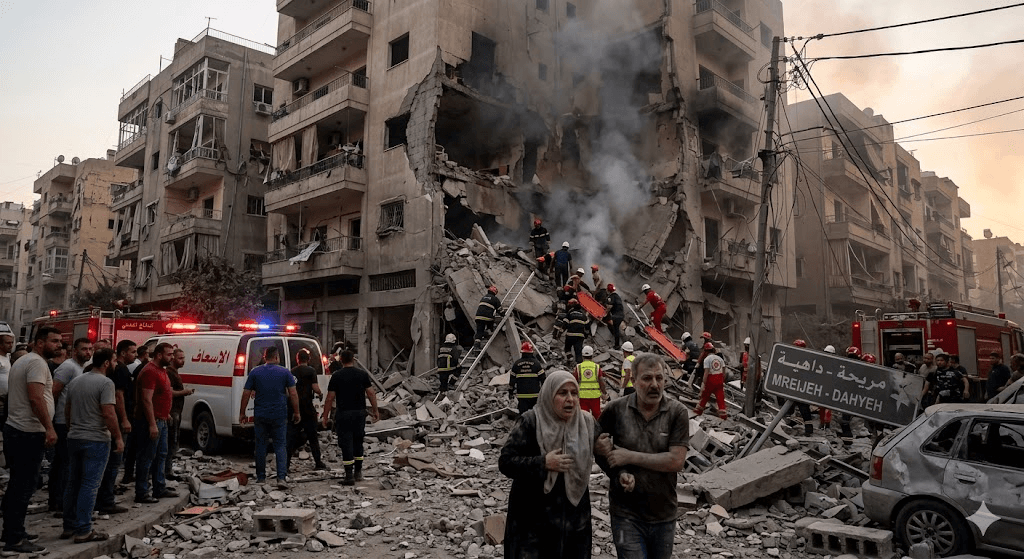
BEIRUT, LEBANON — A fragile, porous ceasefire was violently disrupted on Sunday, June 14, 2026 when an Israeli airstrike slammed into a residential neighborhood within Beirut’s southern Dahyeh suburb, killing two people and wounding at least 20 others.
The precision strike targeted two separate apartments in the Mreijeh district, sending a column of thick grey smoke rising above the capital and marking one of the most significant escalations in Beirut since the U.S.-brokered truce went into effect in mid-April.
According to Lebanon’s state-run National News Agency (NNA), the strike directly impacted two apartment buildings. Images and videos emerging from the aftermath showed heavily compromised multi-story structures, with shattered balconies, collapsed walls, and concrete debris raining down onto the streets below.
The office of Israeli Prime Minister Benjamin Netanyahu quickly confirmed the assault, stating that the military had "just struck a militant command center in Beirut's Dahyeh district". The Israel Defense Forces (IDF) further explained that the air raid was a direct response to a barrage of rockets fired by Hezbollah into northern Israel earlier that morning—the first major rocket fire directed at civilian communities since the truce was renewed. IDF officials maintained that precautions were taken to mitigate harm to civilians, though the choice of target inside a dense urban hub ensured immediate collateral damage.
Lebanon's Ministry of Public Health Emergency Operations Center released a statement detailing the human toll of the bombardment. Medics and first responders worked frantically through the dust-choked ruins to pull casualties from the apartments.
While two individuals were pronounced dead at the scene, the health ministry emphasized that the 20 wounded included at least four women and four children who were inside or near the targeted residential buildings when the missiles struck. Ambulances transported the victims to nearby medical facilities, with several reported to be in critical condition.
The strike has severely jeopardized the highly unstable April 16 truce. While Israel and Hezbollah have continued regular exchanges of fire along the southern border, the capital of Beirut had been relatively spared from direct aerial warfare over the preceding weeks.
The escalation triggered a fierce diplomatic response from regional backers. Following the strike, a senior Iranian parliament member issued an explicit warning.
"This rabid dog must be disciplined and put in its place. Watch the sky of the occupied territories tonight," posted Ebrahim Rezaei, spokesperson for the Iranian parliament's foreign policy and national security committee.
With Israel expanding its evacuation warnings in southern coastal hubs like Tyre and Hezbollah confirming it had deployed waves of missiles and drones against Israeli army barracks earlier in the day, United Nations monitors have renewed warnings that the region is balancing on the precipice of a full-scale humanitarian and security breakdown.
Note: This article was published on BanxChange.com and is powered by the BXE Token on the XRP Ledger. For the latest articles and news, please visit BanxChange.com