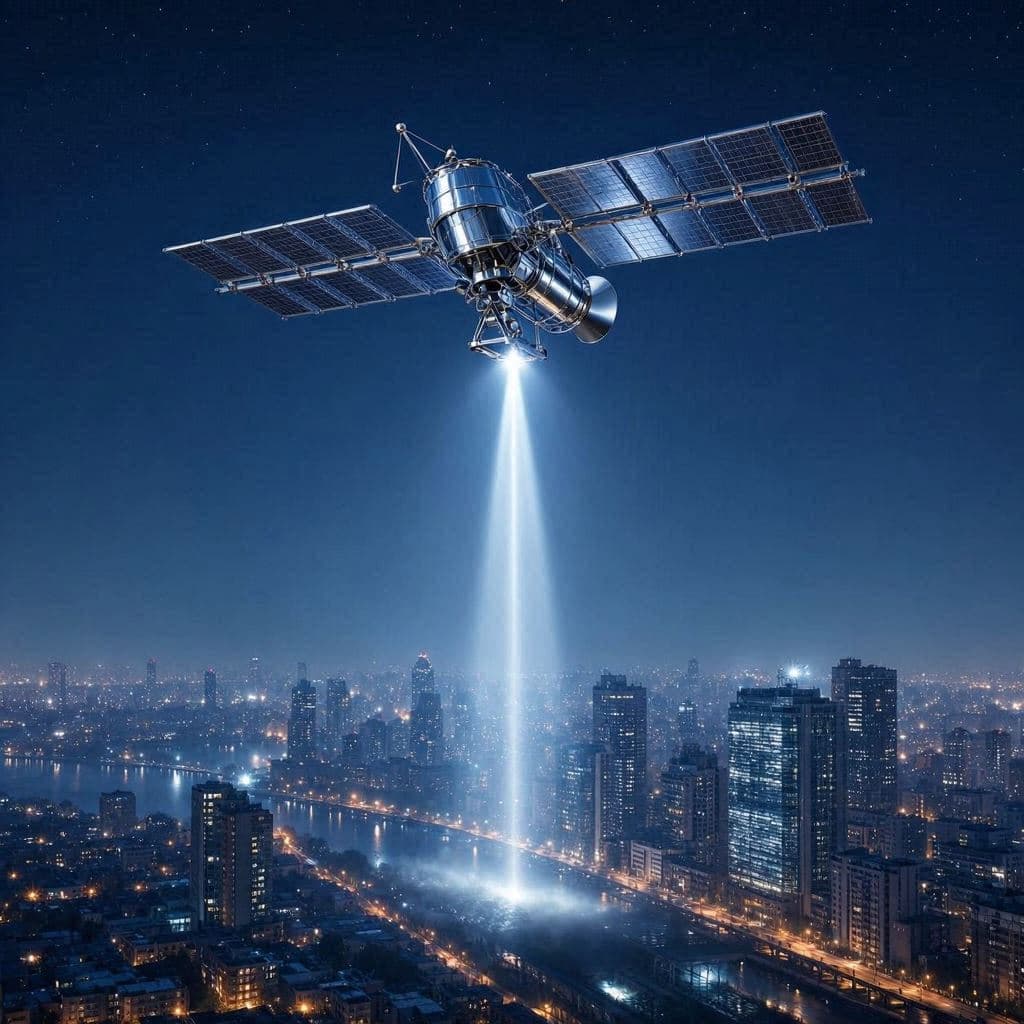
The night sky has long served as humanity’s oldest canvas, a vast expanse of darkness punctuated by the steady glow of distant stars. For centuries, this celestial dome has inspired wonder, navigation, and scientific discovery. However, a new development in space technology threatens to alter this ancient view. An enormous mirror satellite, designed to reflect sunlight back to Earth, has drawn sharp criticism from the astronomical community. This innovation, intended to provide artificial illumination for urban areas, is not merely an engineering feat; it is a profound intervention in the natural order. It invites reflection on the balance between technological progress and environmental preservation, and the unintended consequences of brightening our nights.
Body: The satellite in question utilizes large, reflective surfaces to capture solar radiation and direct it toward specific regions on Earth during nighttime hours. Proponents argue that this technology could reduce energy consumption by decreasing the need for streetlights and improving public safety in poorly lit areas. It is presented as a sustainable solution to urban lighting challenges, offering a clean alternative to fossil-fuel-powered electricity. The intent is benevolent, aiming to enhance quality of life through innovative infrastructure.
However, astronomers view this development with deep concern. The introduction of bright, moving objects into the night sky creates significant light pollution, obscuring faint stars and galaxies. Observatories rely on dark skies to detect distant cosmic phenomena, and even minor increases in ambient brightness can compromise sensitive instruments. For researchers, the loss of dark skies is not just an aesthetic inconvenience but a barrier to scientific understanding. It threatens the integrity of data collected over decades.
The ecological impact extends beyond astronomy. Many species, from migratory birds to nocturnal insects, rely on natural light cycles for navigation and reproduction. Artificial light at night can disrupt these rhythms, leading to confusion and population decline. By altering the luminosity of the night environment, we risk upsetting delicate ecosystems that have evolved in darkness. The interconnectedness of life means that changes in one area can ripple through others in unexpected ways.
Public reaction has been mixed. Some citizens welcome the idea of brighter nights, associating light with safety and modernity. Others express a longing for the starry skies of their childhood, viewing the satellite as an intrusion on natural beauty. This divide highlights differing values regarding urban development and environmental stewardship. It raises questions about who has the right to shape the shared experience of the night sky.
Regulatory frameworks for space-based lighting are currently limited. Unlike ground-based light pollution, which can be managed through local ordinances, orbital reflections affect vast geographic areas simultaneously. International cooperation will be necessary to establish guidelines that balance human needs with astronomical and ecological protection. Without clear rules, the potential for conflict and environmental harm increases. It is a challenge that requires global dialogue.
The technical feasibility of controlling such reflections is also under scrutiny. Ensuring that light is directed only where intended, without scattering into surrounding areas or affecting aviation, is complex. Errors in alignment could result in widespread glare, disrupting sleep patterns and daily routines. Precision is paramount, yet the scale of the project makes absolute control difficult. The margin for error is small.
As the debate continues, astronomers are calling for thorough environmental impact assessments before further deployment. They urge policymakers to consider long-term consequences alongside immediate benefits. The goal is to find solutions that illuminate our cities without extinguishing our view of the cosmos. It is a plea for thoughtful integration of technology and nature.
Closing: In the end, the mirror satellite represents a crossroads in our relationship with the night. It offers potential benefits but carries significant risks to science and ecology. As we navigate this new terrain, the hope is that we will prioritize preservation of the dark sky, recognizing its value to both knowledge and wonder.
AI Image Disclaimer: Please note that any accompanying visuals for this narrative are artificially generated interpretations meant to evoke the spirit of the story, not documentary evidence.
Sources: Scientific American Space.com International Dark-Sky Association
Published by Banx Network. This article is part of the Banx decentralized media programme, powered by the BXE token on the XRP Ledger.