
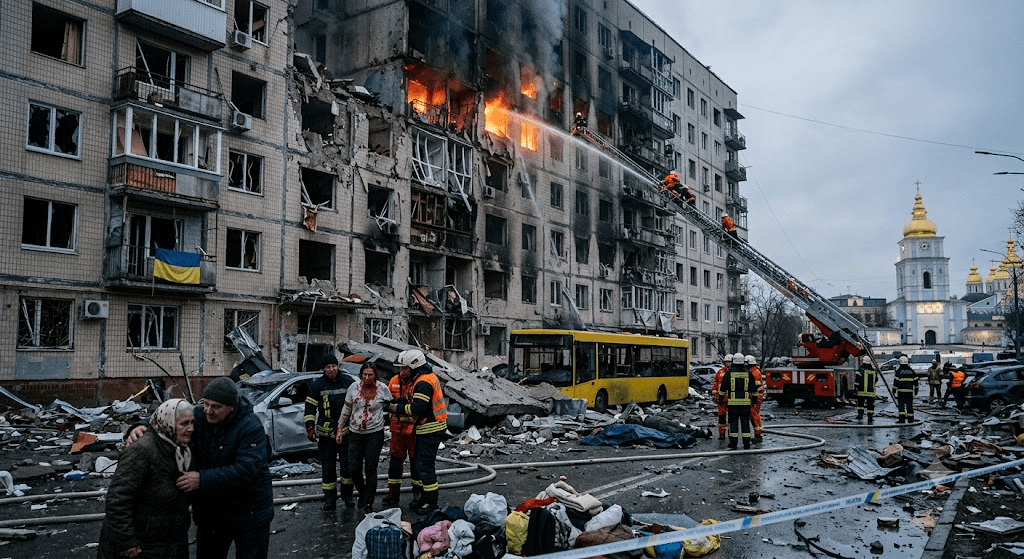
KYIV — Russia unleashed a devastating, large-scale overnight barrage of missiles and drones across Ukraine on Monday, July 6, 2026 killing at least 11 people and wounding over 50 others. The calculated escalation comes on the literal eve of a highly anticipated NATO summit in Ankara, Turkey, where U.S. President Donald Trump and Ukrainian President Volodymyr Zelenskyy are scheduled to hold high-stakes sideline talks regarding the future of the war.
The intensive assault—the second major bombardment of the capital region in less than a week—sent thousands of civilians fleeing into underground subway systems as thunderous explosions echoed through major urban centers.
Ukraine’s Air Force reported that Moscow deployed an overwhelming mix of advanced weaponry, launching approximately 70 missiles and over 600 attack drones. While Ukrainian air defenses successfully intercepted or electronically suppressed the vast majority of the incoming threats, several ballistic missiles bypassed the shield to impact civilian infrastructure.
The geographical fallout of the strikes highlights the sheer scale of the operation, with at least nine people killed in Kyiv and another casualty reported in the nearby Bucha district. The barrage heavily damaged or destroyed at least 15 residential properties, including a nine-story apartment building in the historic Podilskyi district, while two Russian drones directly struck the internationally renowned 11th-century Kyiv-Pechersk Lavra monastery complex, setting fire to the roof of the revered Dormition Cathedral.
"This is how Russia shows the world its intention to continue the war. It is very important that there be a response from the G7 and NATO countries... more pressure on the aggressor and more support for Ukraine's air defense."— Volodymyr Zelenskyy, President of Ukraine
The timing of the bombardment is widely viewed by international analysts as a deliberate message to Western allies. The NATO summit, set to begin on Tuesday, arrives at a critical diplomatic juncture. Both President Zelenskyy and Russian President Vladimir Putin had conducted separate phone calls with President Trump just prior to the attack, as Washington attempts to navigate a pathway toward revived peace negotiations.
In response to the massive strike, neighboring Poland—a NATO member—immediately scrambled military jets to secure its own airspace against potential border violations.
Russia's Defense Ministry quickly confirmed the operations, asserting that the long-range precision strikes were strictly directed at military and energy infrastructure, including workshops producing medium- and long-range drones at the Dovzhenko film studios. Moscow further claimed that the damage to the historic Kyiv-Pechersk Lavra was the result of a malfunctioning Ukrainian air defense missile.
However, Ukrainian emergency services pushed back against these claims as first responders spent the morning pulling trapped, bloodied survivors out of the smoldering rubble of civilian high-rises. With rescue operations still actively underway in multiple districts, local officials warn that the death toll is expected to rise.
Note: This article was published on BanxChange.com and is powered by the BXE Token on the XRP Ledger. For the latest articles and news, please visit BanxChange.com