
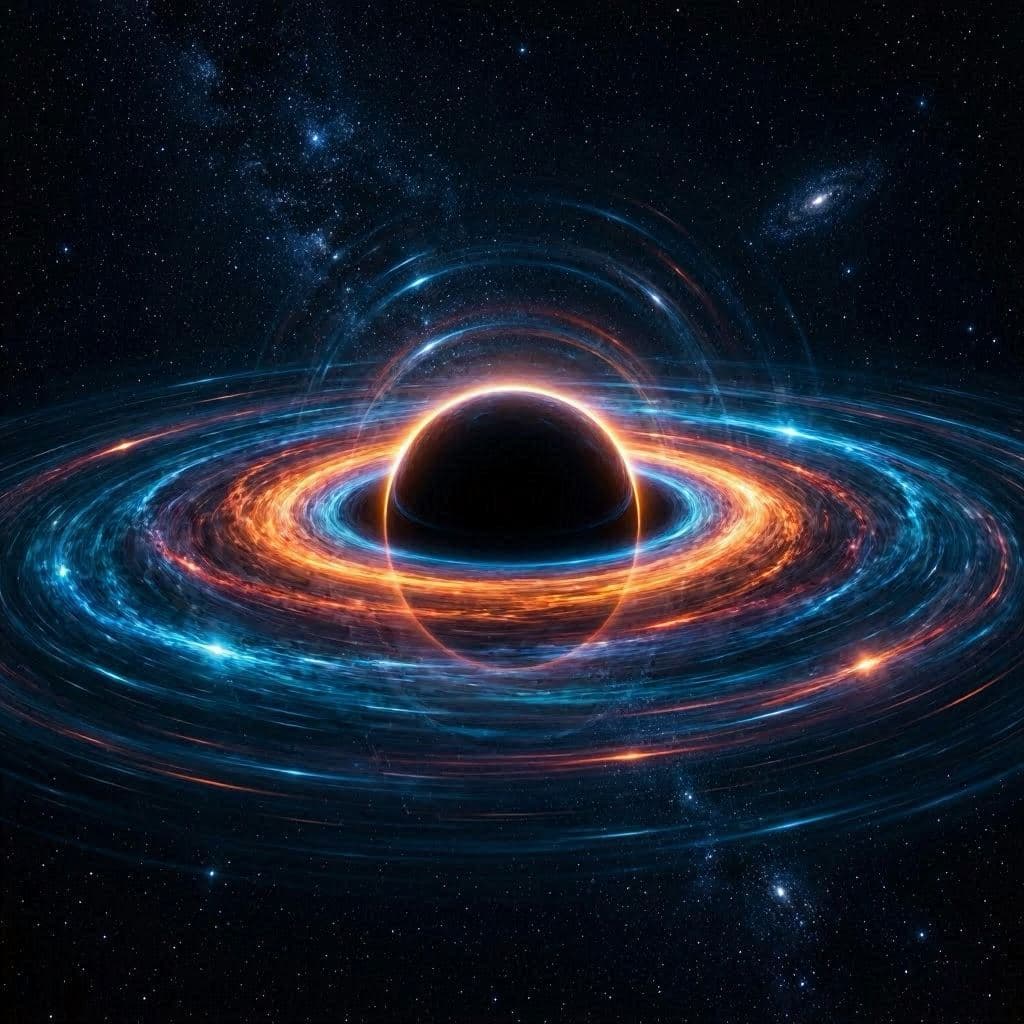
When we gaze upon the iconic image of a black hole, we are not just looking at an object in space; we are peering into the past. The light captured by telescopes has traveled for millions of years, carrying with it the history of the cosmos. Yet, physicists warn that our current understanding of these images may be overly simplified. They suggest that black holes are not static portraits but dynamic time machines, complex entities that challenge our perception of reality. This perspective invites a deeper reflection on the nature of observation and the limits of human comprehension.
Body: The famous image of the M87* black hole, released by the Event Horizon Telescope collaboration, was a triumph of engineering and science. However, it represents only a single moment in the life of a constantly evolving system. Black holes rotate, accrete matter, and emit jets of energy, all of which change over time. Treating them as static objects ignores the temporal dimension that is intrinsic to their physics. It is akin to judging a storm by a single photograph of a raindrop.
Physicists argue that the simplification arises from the need to make complex data understandable to the public and even to other scientists. The process of imaging involves averaging data over time, which can smooth out rapid fluctuations and subtle details. While this makes the image clearer, it may obscure important phenomena, such as turbulence in the accretion disk or variations in brightness. These details hold clues to the fundamental laws of gravity and magnetism.
The concept of the black hole as a "time machine" refers to the extreme gravitational time dilation near the event horizon. Time moves slower closer to the black hole relative to distant observers. This means that the light we see is not just old, but it has been stretched and distorted by the warping of spacetime. Understanding this effect is crucial for interpreting what we actually see versus what is happening in real-time.
New models and simulations are being developed to account for these temporal dynamics. Researchers are working on techniques to create "movies" of black holes rather than static images. These moving pictures would reveal the chaotic dance of matter and energy, providing a more accurate representation of these cosmic giants. It is a shift from snapshot science to cinematic science.
This evolution in understanding challenges us to rethink how we communicate scientific discoveries. It requires a willingness to embrace complexity and uncertainty. Instead of presenting simple answers, scientists are learning to share the nuances of their findings. This honesty builds trust and encourages a more sophisticated public engagement with science.
The implications for theoretical physics are profound. If our observations are oversimplified, our tests of general relativity may be incomplete. By accounting for time-dependent effects, physicists can perform more rigorous checks on Einstein’s theory. It may even reveal deviations that point toward new physics, such as quantum gravity.
As technology improves, the resolution and speed of black hole imaging will increase. Future telescopes will capture faster changes and finer details. The journey from static images to dynamic understanding is just beginning. It promises to reveal the true nature of the most mysterious objects in the universe.
Closing: In the end, the reminder that black hole images are time machines is a call for humility and curiosity. It asks us to look beyond the surface and appreciate the depth of cosmic reality. As we refine our views, the hope is that we will gain a richer, more accurate understanding of the universe’s darkest secrets.
AI Image Disclaimer: The visual representations associated with this article are AI-generated artistic interpretations designed to illustrate the themes of astrophysics and time.
Sources: Scientific American Nature Astronomy Event Horizon Telescope Collaboration
Published by Banx Network. This article is part of the Banx decentralized media programme, powered by the BXE token on the XRP Ledger.



