
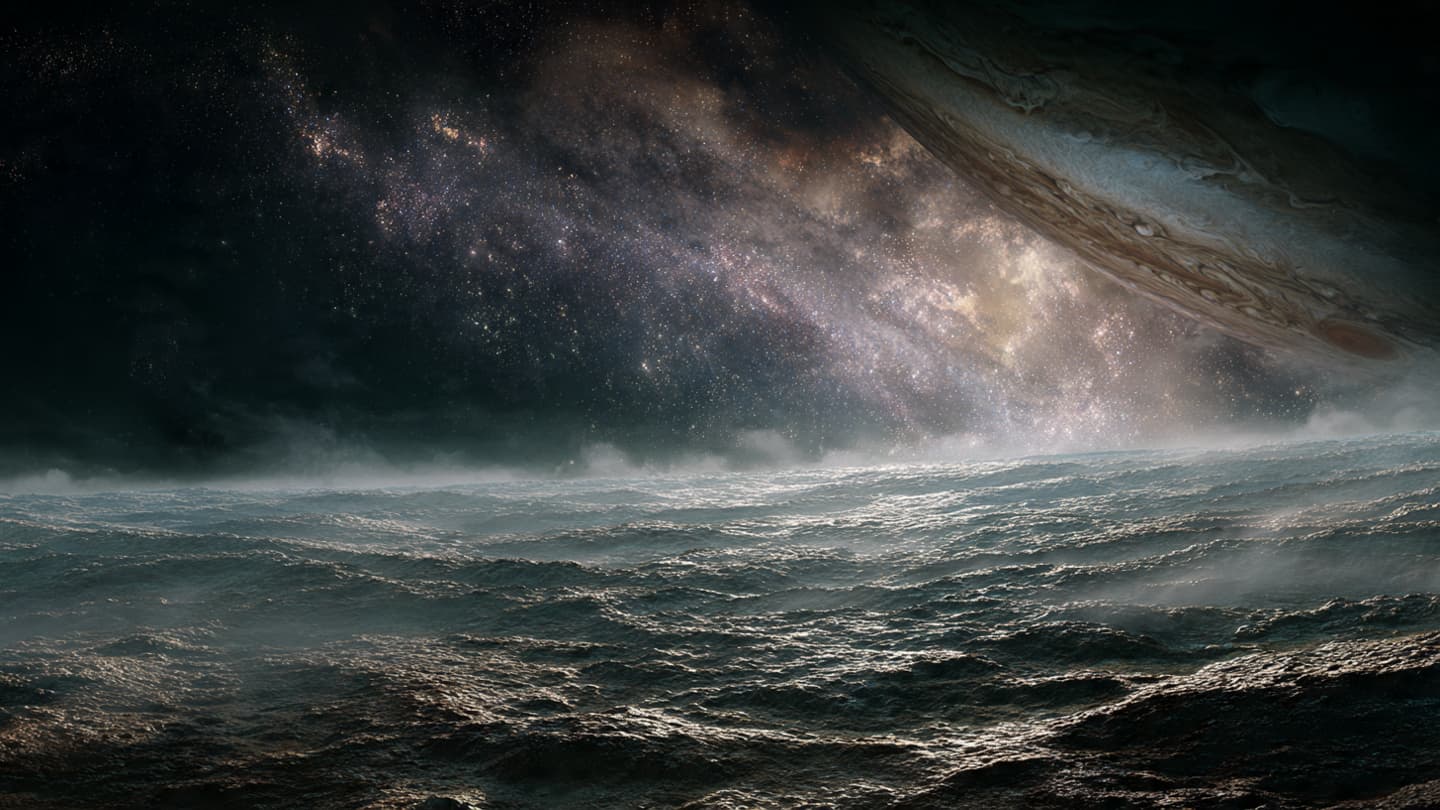
The solar system often appears orderly when viewed from textbooks and diagrams, each planet following its familiar orbit around the Sun. Yet beyond Jupiter, in the colder and darker outskirts of planetary space, scientists continue uncovering regions shaped by ancient collisions, drifting ice, and leftover building material from the solar system’s formation. Recent discoveries have now drawn attention to what researchers describe as a vast “planet factory” hidden in these distant reaches.
Astronomers studying protoplanetary systems and icy structures beyond Jupiter identified evidence of large concentrations of material capable of forming planetary bodies. These regions contain dense accumulations of dust, rock, and frozen compounds that gradually collide and merge over immense spans of time, potentially giving rise to moons, dwarf planets, and even larger worlds.
The findings were made possible through advanced telescope observations and computer simulations that allow scientists to examine how planetary systems evolve. Researchers observed patterns suggesting that the outer solar system remains far more active and structurally complex than previously assumed.
Scientists sometimes refer to such environments as “planet factories” because they contain the raw ingredients necessary for planetary construction. Within these regions, gravity slowly pulls smaller particles together into larger objects through a process known as accretion. Over millions of years, repeated collisions and clustering can transform scattered material into stable celestial bodies.
Beyond Jupiter lies a region populated by icy objects, including the Kuiper Belt, home to Pluto and countless smaller bodies. Researchers believe these distant zones preserve some of the oldest material from the early solar system, largely unchanged since planetary formation began billions of years ago.
The latest discovery may help scientists better understand how giant planets and smaller icy worlds developed not only within our own solar system but also around distant stars. Observations of young star systems elsewhere in the galaxy frequently reveal similar disks of dust and gas where planets are actively forming.
Modern astronomy increasingly depends on combining observational data with complex simulations. Because planetary formation unfolds over timescales far beyond human lifetimes, scientists rely on mathematical models to reconstruct the gradual evolution of these cosmic structures.
Researchers emphasize that the term “planet factory” is descriptive rather than literal. The region is not producing planets rapidly, but instead represents a long-term environment where natural processes continue shaping celestial bodies across immense periods of time.
As telescopes become more sensitive and computational methods improve, astronomers expect to uncover even more hidden structures in the outer solar system, where ancient material still circles quietly in the cold darkness beyond Jupiter.
AI Image Disclaimer: Certain astronomical scenes in this article were created using AI-generated visual interpretations.
Sources: NASA Space.com Nature Astronomy Scientific American European Southern Observatory
Published by Banx Network. This article is part of the Banx decentralized media programme, powered by the BXE token on the XRP Ledger.



