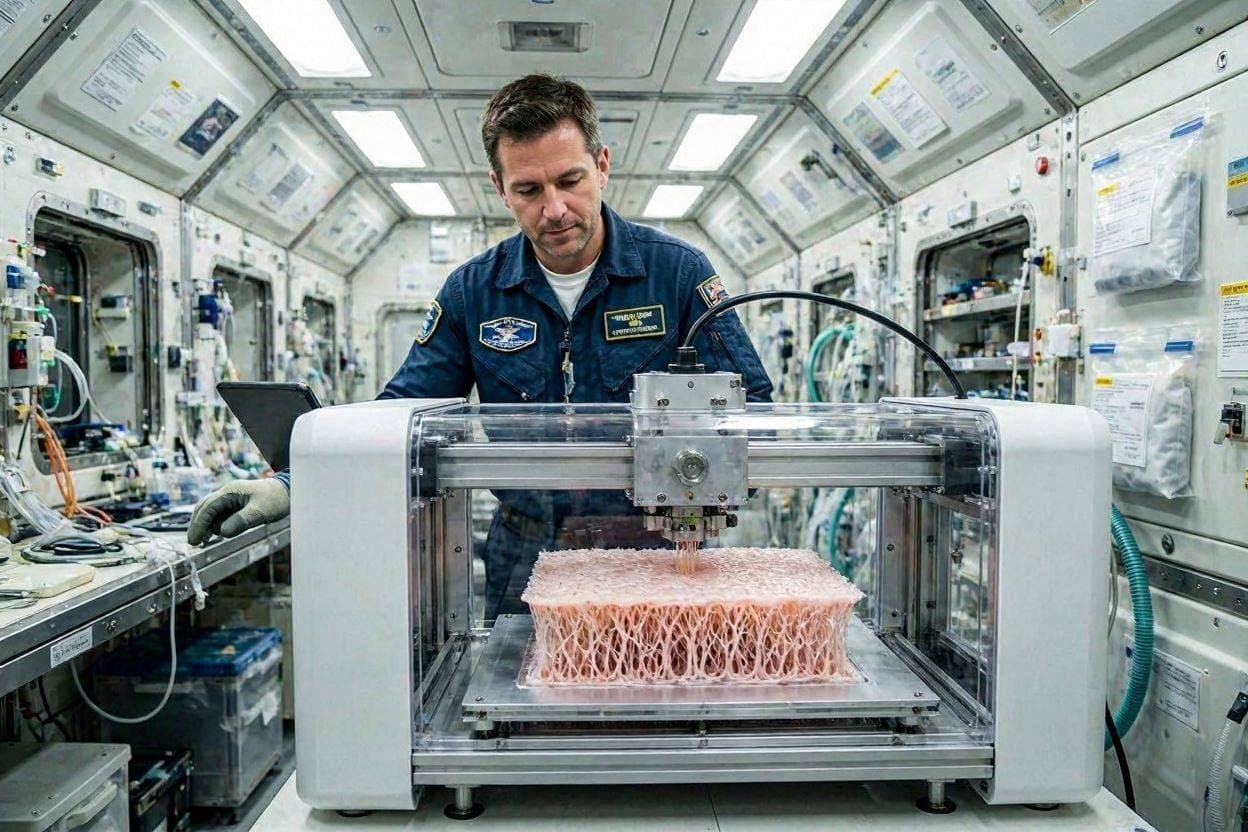
In the quiet hum of the International Space Station, where gravity’s pull is but a distant memory, a new frontier in medical science is taking shape. Astronauts and researchers have achieved a significant milestone in bioprinting, successfully creating functional human tissue patches in the microgravity environment. This breakthrough marks a pivotal step toward the long-term goal of fabricating complex organs for transplantation, offering hope to millions awaiting life-saving procedures.
The experiment, conducted using advanced 3D bioprinters adapted for space, leverages the unique conditions of microgravity to build biological structures that are difficult or impossible to create on Earth. Without the distorting effects of gravity, cells can assemble into more intricate and stable forms, mimicking the natural architecture of human tissues. The recent success involved printing kidney and liver tissue patches that showed promising signs of functionality and structural integrity.
On Earth, gravity often causes soft tissues to collapse under their own weight during the printing process, limiting the complexity of what can be achieved. In space, however, these constraints are lifted, allowing for the creation of thicker and more vascularized tissues. This capability is crucial for developing organs that require a robust network of blood vessels to survive and function once implanted in a patient.
The implications for regenerative medicine are profound. If scientists can master the art of bioprinting entire organs in space, it could revolutionize healthcare by reducing waiting lists for transplants and eliminating the risk of organ rejection when using a patient’s own cells. While full organs remain a distant goal, the ability to print tissue patches already holds potential for treating burns, wounds, and localized organ damage.
Commercial interest in this technology is growing, with several companies exploring the viability of space-based manufacturing for medical products. The high cost of launching materials into orbit is balanced by the potential value of producing high-quality biological constructs that cannot be made on Earth. This emerging industry could transform the economics of space exploration, turning the ISS into a hub for biomedical innovation.
Challenges remain, including the need to scale up production and ensure the long-term stability of printed tissues during return to Earth. Researchers are also working to refine the bioinks used in printing, ensuring they provide the right support for cell growth and differentiation. Each experiment adds to a growing body of knowledge that brings the dream of lab-grown organs closer to reality.
International collaboration plays a key role in these efforts, with scientists from various countries sharing data and expertise. The ISS serves as a global laboratory, where diverse perspectives converge to solve complex biological puzzles. This cooperative spirit accelerates progress and ensures that the benefits of space research are shared broadly.
Closing: As the ISS continues to host these groundbreaking experiments, the promise of bioprinting grows stronger. The recent achievements are not just scientific victories but beacons of hope for a future where organ failure is no longer a death sentence.
AI Image Disclaimer: The visual content accompanying this article is AI-generated for illustrative purposes and does not depict actual footage of the bioprinting process on the ISS.
Sources: Reuters NASA ScienceDaily
Published by Banx Network. This article is part of the Banx decentralized media programme, powered by the BXE token on the XRP Ledger.