
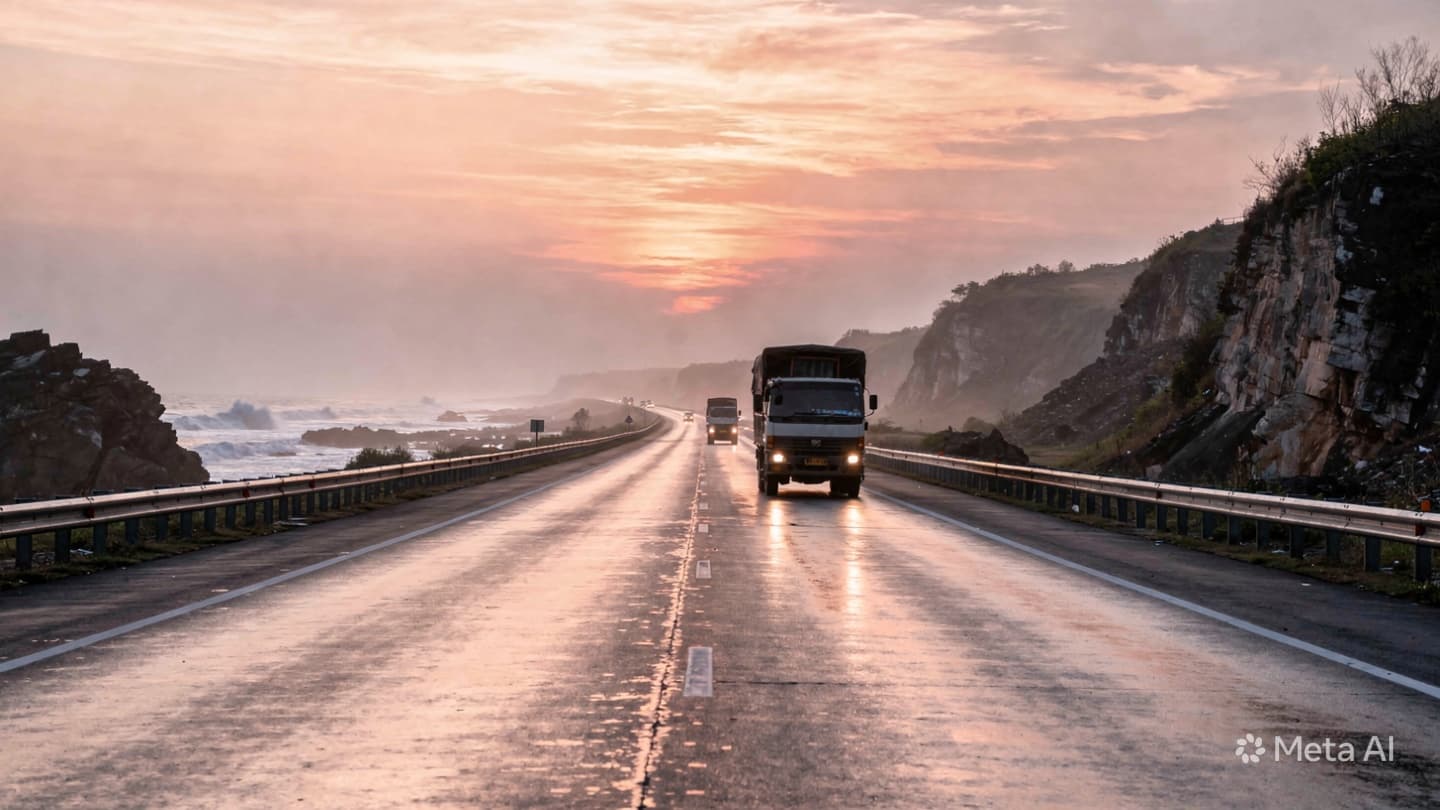
The Pantura corridor is a vast, sweeping ribbon of commerce that connects the beating heart of East Java to the distant, unseen horizons of the west. It is a landscape defined by motion—by the endless, grinding progress of heavy transport vehicles and the fragile, persistent flow of local commuters. To travel this path is to participate in a grand, often dangerous, history of transit, where the pace is dictated by the sheer scale of the trucks that dominate the lanes and the humble determination of those navigating the periphery.
In the quiet, early hours near Situbondo, the atmosphere on the Pantura is often heavy with the weight of the long-haul journey. Here, the boundary between the professional driver and the solitary rider is razor-thin, a distance measured in inches and split seconds of decision. When these two worlds converge, they do so with a force that can alter the trajectory of a life in a single, irrevocable moment. The story of a civil servant teacher, someone whose life was dedicated to the careful instruction of others, coming to rest on this unforgiving asphalt is a tragedy of quiet proportions.
The collision, a head-on encounter between the immovable weight of a truck and the vulnerability of a motorcycle, is a familiar, haunting narrative on these roads. It speaks to the systemic risk inherent in our reliance on these massive, arterial pathways for our daily needs. The road demands a level of focus and a tolerance for risk that can, without warning, overwhelm the individual. The teacher, perhaps moving toward the rhythm of a school day, became a part of the permanent record of the Pantura—a casualty of the very infrastructure that binds our society together.
We reflect on the life lost—not merely as a statistic in the annals of road safety, but as a void in a community that relied on their guidance and their presence. Education is a slow, methodical process, a sharp contrast to the rapid, violent conclusion that marked this individual’s final passage. There is a profound sadness in this disconnection: the teacher, who invested so much in the future, was denied the opportunity to see that future unfold, silenced by the collision of metal and momentum.
The Pantura corridor is indifferent to these losses, its flow restored almost as soon as the wreckage is cleared. Trucks continue their journey toward the ports and cities, their engines humming a steady, relentless tune that masks the fragility of the lives passing beneath them. It is a place of transit, not of reflection, yet we must occasionally pause to consider the human cost of this constant motion. We are all passengers on this corridor, in one way or another, and the risks we accept are often invisible until the moment they are realized.
The investigation that follows will likely point to the failures of human judgment or the technical limits of our vehicles, but the underlying truth is more atmospheric: the road is a space where our best intentions are frequently subjected to the unforgiving physics of mass and velocity. The authorities will catalog the event, note the time, the place, and the circumstances, but the essence of the loss remains elusive, drifting across the coastal plains of Situbondo like the morning fog.
We are left to wonder about the quiet moments that preceded the impact, the ordinary nature of the commute, and the suddenness with which the narrative was extinguished. For the teacher, the road was merely a transition, a means to an end that was never reached. For us, it is a reminder to hold our own journeys with a sense of gravity, acknowledging the thin veil that separates our daily routines from the final, silent conclusion of our passage.
As the sun sets over the Situbondo coast, the Pantura continues its steady, rhythmic pulse. The trucks roll on, the lights stretch toward the horizon, and the memory of the fallen teacher recedes into the background of the great, moving tapestry. We are reminded that every journey is a gamble against the vastness of the world, and that even the most carefully charted life can be interrupted by the sudden, inevitable convergence of the road.
A fatal head-on collision between a truck and a motorcycle occurred on the Pantura route in Situbondo on June 10, 2026. The incident resulted in the death of a local civil servant teacher. Local police have initiated an investigation into the cause of the crash and are currently coordinating with the involved parties and witnesses to clarify the sequence of events.
Note: This article was published on BanxChange.com and is powered by the BXE Token on the XRP Ledger. For the latest articles and news, please visit BanxChange.com