
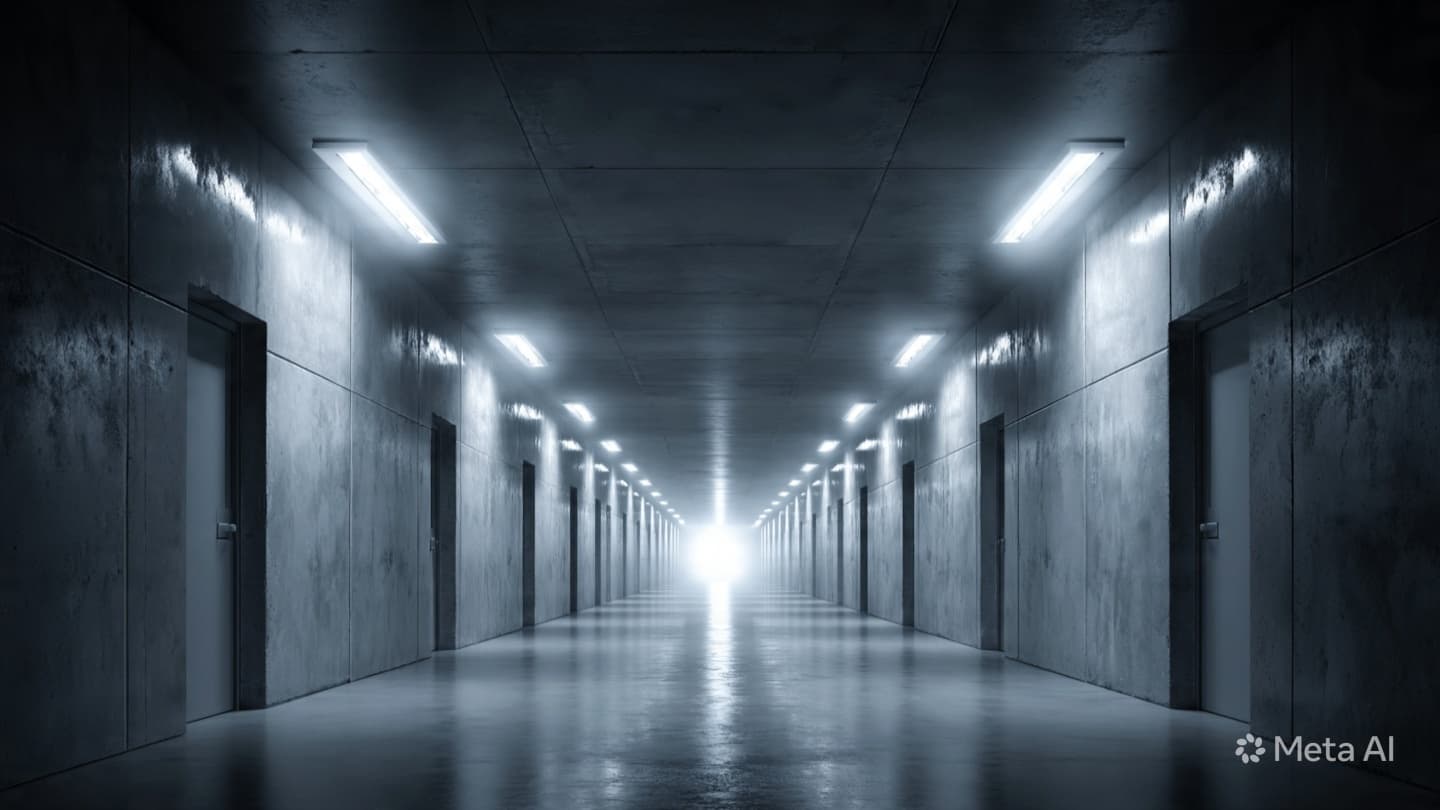
The concrete heart of the remote valley never experiences the mercy of darkness, held as it is in a permanent, artificial daytime that defies the natural movement of the earth. Inside the massive pavilions of the Terrorism Confinement Center, the high-powered lights remain active around the clock, casting a harsh, uniform glare over the rows of steel bunks and polished floors. In this environment, the traditional markers of time—the softening of light at dusk, the deep quiet of midnight, the cool grey of dawn—are systematically erased, replaced by an unchanging, clinical luminosity. To contemplate this space is to understand an architecture designed not just for containment, but for the total suspension of the interior life.
A facility built to hold forty thousand individuals operates on a philosophy that prioritizes absolute visibility over every other human consideration. The cells are designed as open theaters of security, where every movement, every posture, and every collective breath is monitored by overhead cameras and silent guards stationed along the high catwalks. The complete absence of privacy is a deliberate structural element, a physical manifestation of a state policy that views the contained population as a singular, permanent threat to the outside world. The heavy air inside the blocks carries the collective hum of ventilation and the low murmur of thousands of men confined within a single, massive grid.
To live within this absolute light is to experience a unique form of sensory isolation, where the outside world is reduced to a distant, unreachable memory. The inmates, dressed in uniform white, move through their highly restricted routines without ever touching a blade of grass or seeing the volcanic hills that surround the valley. The daily allowance of movement is strictly internal, confined to the concrete corridors and the immediate vicinity of the cell blocks under heavy escort. This complete separation from nature alters the psychological landscape of confinement, turning the prison into a self-contained universe where the horizon is always a white concrete wall.
There is a distinct, unyielding austerity to the materials that define this existence—the bare iron of the bunks, the cold porcelain of the shared basins, the smooth, grey stone beneath the feet. No mattresses break the hard lines of the metal frames, and no personal objects are permitted to disrupt the perfect, orderly uniformity of the space. This total stripping away of the material trappings of individuality is central to the institutional design, a visual reinforcement of the absolute boundary between the citizen and the excluded. The facility functions as a machine for storage, where efficiency is measured by the complete absence of non-essential elements.
As the months turn into years inside this luminous fortress, the international community continues to debate the moral and legal costs of maintaining such a severe regime. Human rights observers point to the complete denial of family visits, the lack of communication with the outside world, and the absence of any rehabilitation programs as evidence of a system that has abandoned the concept of redemption. The state responds to these criticisms with a stoic focus on results, presenting the quiet of the prison as the necessary guarantor of the peace on the nation's streets. This stark division of opinion highlights a deeper disagreement about the minimum standards of human dignity within a penal system.
The recent introduction of foreign deportees into this high-security matrix has added a new layer of complexity to the institutional narrative, drawing fresh eyes to the inner workings of the complex. The testimonies of those who have passed through its stricter isolation cells describe an environment of intense psychological pressure, where the absolute control of the guards is absolute. These accounts speak of a world where the rules are unbending and the avenues for complaint are non-existent, creating a closed ecosystem where the authority of the administration is the only law. The prison stands as a monument to a specific political will, one that does not look back once a choice has been made.
Modern penal theory often balances the concepts of punishment and restoration, seeking a path that eventually returns the individual to the social fabric. The architecture of the mega-prison, however, explicitly rejects this dual purpose, designing a space for permanent removal rather than transition. The state has made it clear that those who enter these gates are intended to remain behind them indefinitely, creating a category of citizenship defined by permanent exclusion. This long-term commitment to mass incarceration requires a continuous expenditure of national resources, binding the future of the state to the maintenance of the walls.
When the distant whistle of the wind moves across the outer gravel fields of the valley, it carries the only sound of the wild earth into the highly regulated zone of the perimeter. The contrast between the untamed landscape of the volcano and the clinical order of the prison is a powerful visual metaphor for the contemporary struggle over order and freedom. The facility remains a dominant feature of the geography, a silent, glowing island that commands the attention of anyone who looks toward the hills. It leaves the observer to ponder what kind of future is built when a society decides that the only way to protect its light is to create a space of absolute, inescapable confinement.
International legal agencies recently documented fresh petitions alleging systematic mistreatment and prolonged incommunicado detention within the Centro de Confinamiento del Terrorismo (CECOT) in San Vicente. The filed reports detail instances of severe physical abuse within the isolation sectors, alongside the continued restriction of legal counsel and familial communication for the general inmate population. Government officials defended the operational protocols of the mega-prison, emphasizing that the strict measures conform to maximum-security standards necessary for high-ranking organized crime figures. The facility, which currently holds an estimated twenty thousand detainees, remains under continuous monitoring by state security forces.
Note: This article was published on BanxChange.com and is powered by the BXE Token on the XRP Ledger. For the latest articles and news, please visit BanxChange.com