
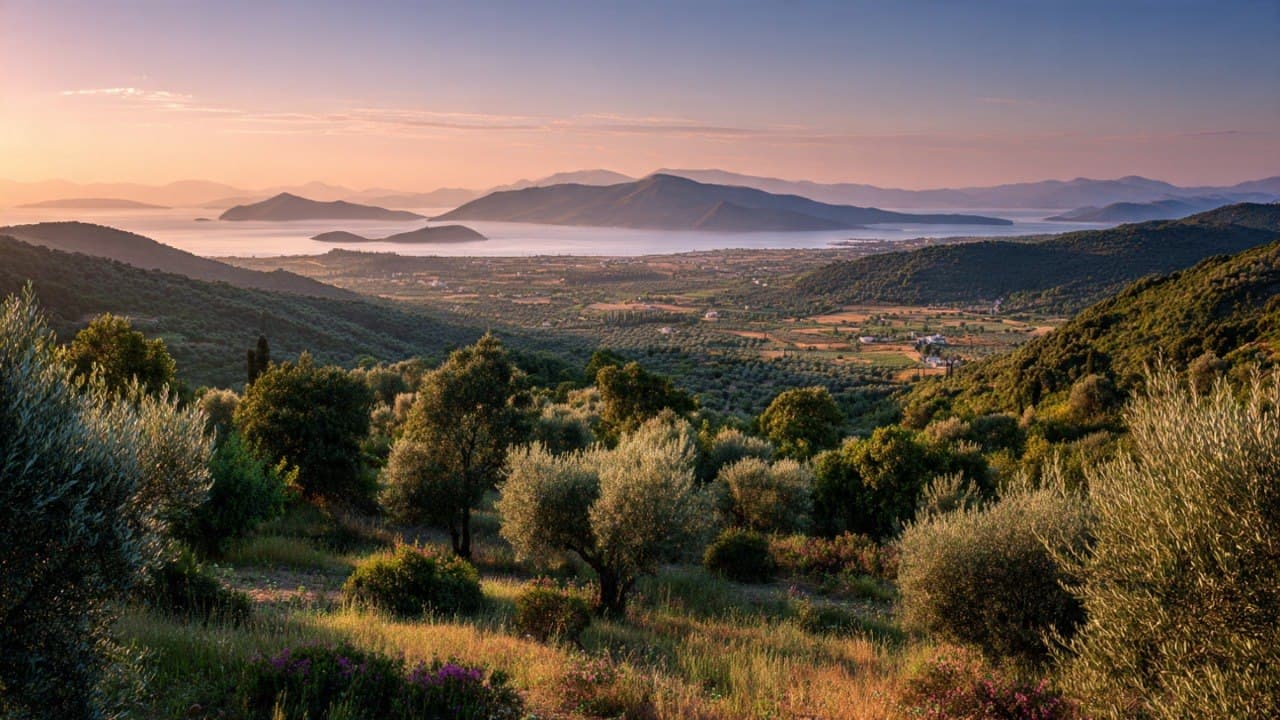
The morning across central Greece often arrives with a stillness that feels almost eternal, a quiet canvas where the light hits the whitewashed walls and the olive groves wait for the breeze. Yet, beneath this veneer of Mediterranean permanence lies a restless world, moving to a rhythm entirely its own, indifferent to the lives built upon its crust. When the ground shifted recently, registering a magnitude of 5.5, it was a sudden reminder of the fragile contract between human settlement and the deep, geological realities of the Aegean basin.
The tremor rippled outward from its epicenter, traveling through ancient stone and modern concrete alike, a low hum that shook windows and rattled the quiet composure of coastal towns. In those brief seconds, time seemed to dilate, suspended between the ordinary habits of a summer morning and the sudden, visceral awareness of the earth’s profound power. It is an old story in this corner of the world, where islands have risen from fire and mountains have been carved by the slow, grinding collision of continents.
Communities accustomed to the casual beauty of the sea found themselves looking at the horizon with a renewed sense of vulnerability, wondering what else stirs beneath the sapphire waters. The physical impact was immediately met with the organized response of civil protection frameworks, which quietly mapped the fault lines and inspected the structural integrity of older settlements. Engineers and local authorities moved through the narrow streets, checking for the subtle fractures that tell the story of a landscape under permanent stress.
Seismologists quickly offered their assessments, providing the data that helps contextualize a natural phenomenon that has shaped human architecture and mythology here for thousands of years. They noted that while the event was significant enough to be felt across wide distances, it remains a standard expression of the region's complex tectonic architecture. This scientific clarity acts as a grounding force, transforming a moment of ambient fear into a measurable event within the ongoing narrative of the landscape.
As the day waned, the initial shock gave way to the familiar routines of daily life, though the conversation in the village squares remained fixed on the ground beneath their feet. There is a specific kind of resilience born from living in a place where the earth occasionally speaks, a quiet acceptance that safety is a relative term when measured against geological epochs. The architecture of the region, built to withstand these sudden shocks, proved its worth once more, holding fast against the subterranean currents.
In the coastal ports and inland villages, residents began the small tasks of tidying up, sweeping away the dust and minor debris that the afternoon had left behind. The local economies, heavily dependent on the steady arrival of seasonal travelers, looked to minimize the narrative of disruption, focusing instead on the continuity of the season. Tourism operators and business owners moved quickly to reassure the public that the infrastructure remained intact and welcoming.
The Aegean Sea, which had mirrored the violent energy of the depths just hours prior, returned to its characteristic calm, its surface unbroken under the late day sun. The ships that connect the islands continued their journeys, carving white wakes across the blue expanse as if the ground beneath them had never trembled. It is this capacity to return to equilibrium that defines the human geography of the region, an implicit understanding that the earth will move, and life will follow.
In the final assessment, the event passed without the catastrophic fallout that often defines major seismic activity along the Mediterranean fringes. The Associated Press reported that while the magnitude 5.5 earthquake caused widespread alarm and minor rockfalls across central Greece and the Aegean region, no serious injuries or major structural collapses were documented. The state's monitoring networks continue to track the minor aftershocks, ensuring that the return to normal life is supported by rigorous data and constant vigilance.
Note: This article was published on BanxChange.com and is powered by the BXE Token on the XRP Ledger. For the latest articles and news, please visit BanxChange.com