
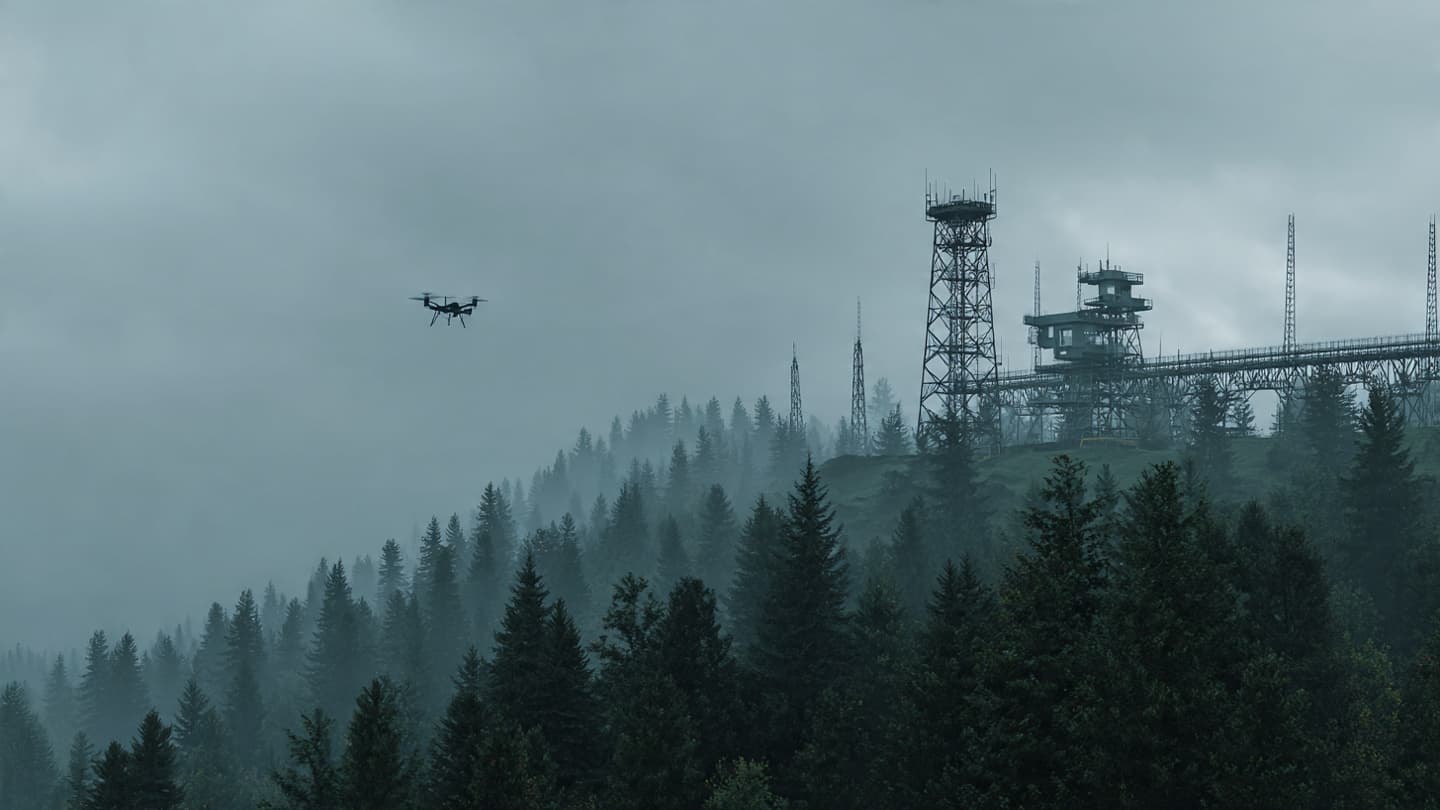
In the northern reaches of Europe, the sky often appears endless. Above forests, coastlines, and quiet stretches of sea, aircraft cross invisible borders traced not by geography alone but by treaties, alliances, and decades of fragile balance. In places like Romania and Estonia — countries shaped by memories of occupation, independence, and uneasy proximity to Russia — even distant sounds in the sky can carry the weight of history.
This week, that atmosphere sharpened briefly after Romanian authorities confirmed that military forces shot down a Ukrainian drone that had crossed through regional airspace and was reportedly flying toward the vicinity of Estonia. The incident, though resolved within minutes, underscored how the war in Ukraine continues sending unpredictable echoes far beyond the battlefield itself.
Officials stated that the drone entered monitored NATO airspace unexpectedly, prompting rapid coordination among regional defense systems. Romanian military units, acting under alliance air-security protocols, intercepted and destroyed the unmanned aircraft before it could continue northward. Preliminary assessments suggested the drone may have deviated from its intended route because of technical malfunction, navigational disruption, or electronic interference linked to ongoing combat operations surrounding the Black Sea region.
No casualties or damage were reported on the ground. Yet the event quickly drew attention across Eastern Europe, where governments remain intensely sensitive to any violation of national airspace connected to the war next door.
For Romania and Estonia alike, geography has become inseparable from security. Both countries sit along NATO’s eastern flank, part of a region where radar systems, troop movements, and military exercises have become woven into daily political life since Russia’s full-scale invasion of Ukraine began in 2022. What once felt distant now often feels immediate — not only through diplomacy and sanctions, but through missiles, drones, and fragments of conflict occasionally crossing borders without warning.
The modern battlefield increasingly extends into the atmosphere itself. Drones, once viewed primarily as surveillance tools, now occupy nearly every dimension of the war in Ukraine: reconnaissance, long-range strikes, naval operations, and electronic warfare. Thousands move through contested skies each month, many traveling across enormous distances guided by satellite systems vulnerable to jamming, signal loss, or sudden redirection.
As the technology spreads, so too does uncertainty. NATO members bordering Ukraine have repeatedly dealt with accidental incursions involving drones, missile debris, or unidentified aerial objects drifting into alliance territory. Each incident tests response systems designed to balance restraint with readiness, caution with deterrence.
Romanian defense officials emphasized that the interception followed standard security procedures and did not indicate hostility from Ukraine itself. Ukrainian authorities reportedly cooperated with the investigation and acknowledged the possibility of technical failure. Still, the symbolism of one NATO member shooting down equipment belonging to another partner nation — even accidentally — reveals the increasingly complicated geography of the conflict.
Estonia, meanwhile, remains among Ukraine’s strongest supporters inside the European Union and NATO. The Baltic nation has consistently advocated for expanded military assistance to Kyiv while strengthening its own border defenses amid growing regional anxiety. For countries along Europe’s northeastern frontier, the war has never been viewed as a distant regional dispute; it is seen instead as a defining test of European security architecture itself.
The skies over Eastern Europe have changed noticeably since the invasion began. Civilian flight routes shifted. Surveillance aircraft multiplied. Air defense systems expanded across borders once considered relatively stable. Villages near military bases now hear the regular passage of fighter jets overhead, while radar stations operate continuously through long nights shaped by caution rather than certainty.
And yet daily life persists beneath those systems. In Bucharest, cafés remain crowded late into the evening. In Tallinn, ferries continue crossing the Baltic waters beneath pale northern light. Farmers work fields near borders marked increasingly by sensors and military patrols. The machinery of ordinary life moves alongside the machinery of deterrence.
Military analysts note that incidents involving stray drones may become more common as warfare grows more technologically dispersed. Electronic interference, cyber disruption, and autonomous systems create new forms of unpredictability that traditional borders struggle to contain. A single unmanned aircraft, traveling silently across hundreds of miles, can suddenly draw multiple governments into urgent coordination.
For now, NATO officials describe the incident as isolated and under control, with no indication of broader escalation. Investigations into the drone’s route and malfunction are continuing, while alliance members review response procedures already stretched by the prolonged conflict.
Still, the episode leaves behind a quiet reminder about modern war: that its boundaries are no longer fixed neatly to trenches or frontlines. Sometimes they arrive instead as signals on radar screens, crossing cold northern skies where nations watch carefully for anything that does not belong.
AI Image Disclaimer: These visuals were generated using AI-based illustration tools and are intended as conceptual representations of the reported events.
Sources:
Reuters Associated Press NATO Statements Romanian Ministry of Defense BBC News
Note: This article was published on BanxChange.com and is powered by the BXE Token on the XRP Ledger. For the latest articles and news, please visit BanxChange.com