In the long arc of national economies, there are periods when stability is not a quiet condition but a tightly managed one—held together by policy restraint, controlled flows of capital, and decisions that prioritize balance over expansion. These periods often feel less like growth and more like calibration, where every sector adjusts to a narrower set of constraints.
In the case of Vladimir Putin’s economic strategy, this sense of calibration has increasingly defined the direction of Russia’s macroeconomic environment. Officials have emphasized fiscal discipline, inflation control, and currency stability as central pillars of policy, particularly under conditions shaped by sustained geopolitical pressure and structural adjustment.
At the center of this framework is a deliberate tightening of macroeconomic levers—interest rates maintained at elevated levels, government spending shaped by strategic priorities, and monetary policy designed to contain inflationary pressure. Institutions such as the Central Bank of Russia have played a key role in maintaining this equilibrium, often navigating between growth stimulation and price stability in a constrained external environment.
Yet this form of discipline, while stabilizing in aggregate terms, produces uneven effects across the economy. Key productive sectors—particularly those reliant on credit expansion, investment cycles, and consumer demand—operate under conditions where financing is more expensive and liquidity more carefully rationed. Over time, this can translate into slower expansion in areas that traditionally serve as engines of broad-based growth.
Much of Russia’s economic structure remains closely linked to energy exports and state-influenced industrial activity. In such a configuration, macroeconomic tightening does not affect all sectors equally. Export-oriented industries, particularly in oil and gas, are often buffered by global demand dynamics, while domestic-facing sectors experience more immediate pressure from high borrowing costs and constrained household spending.
This divergence creates a layered economic landscape: one segment shaped by external revenue streams and strategic industries, and another shaped by internal consumption and investment cycles. Macro discipline, in this context, functions less as a uniform constraint and more as a selective force, reshaping the rhythm of different parts of the economy at different speeds.
Observers of Russia’s economic trajectory often describe this as a trade-off between resilience and momentum. On one hand, tighter macro controls can reduce volatility, stabilize inflation expectations, and preserve fiscal buffers. On the other, they can limit the pace at which smaller enterprises, innovation sectors, and consumer-driven industries expand.
The broader geopolitical environment adds additional structure to these choices. Sanctions regimes, shifting trade routes, and evolving financial linkages have altered how capital moves in and out of the Russian economy, reinforcing the importance of internal policy tools. In this context, macro discipline becomes not only an economic strategy but also a mechanism of adaptation to external constraint.
Within policy discourse, these adjustments are often framed as necessary conditions for stability under pressure. However, they also raise ongoing questions about long-term growth potential, productivity dynamics, and the balance between state-led coordination and private sector flexibility.
As the system continues to operate under these conditions, the “main economic engine” of Russia—understood as the interconnected network of domestic demand, investment activity, and industrial output—experiences both support and compression. Stability is maintained, but expansion becomes more selective, shaped by policy priorities and structural limitations.
In the end, macro discipline functions like a tightening frame around a moving picture: it keeps the image steady, but it also narrows the field of motion. And within that frame, the Russian economy continues to adjust, recalibrate, and seek equilibrium between control and growth.
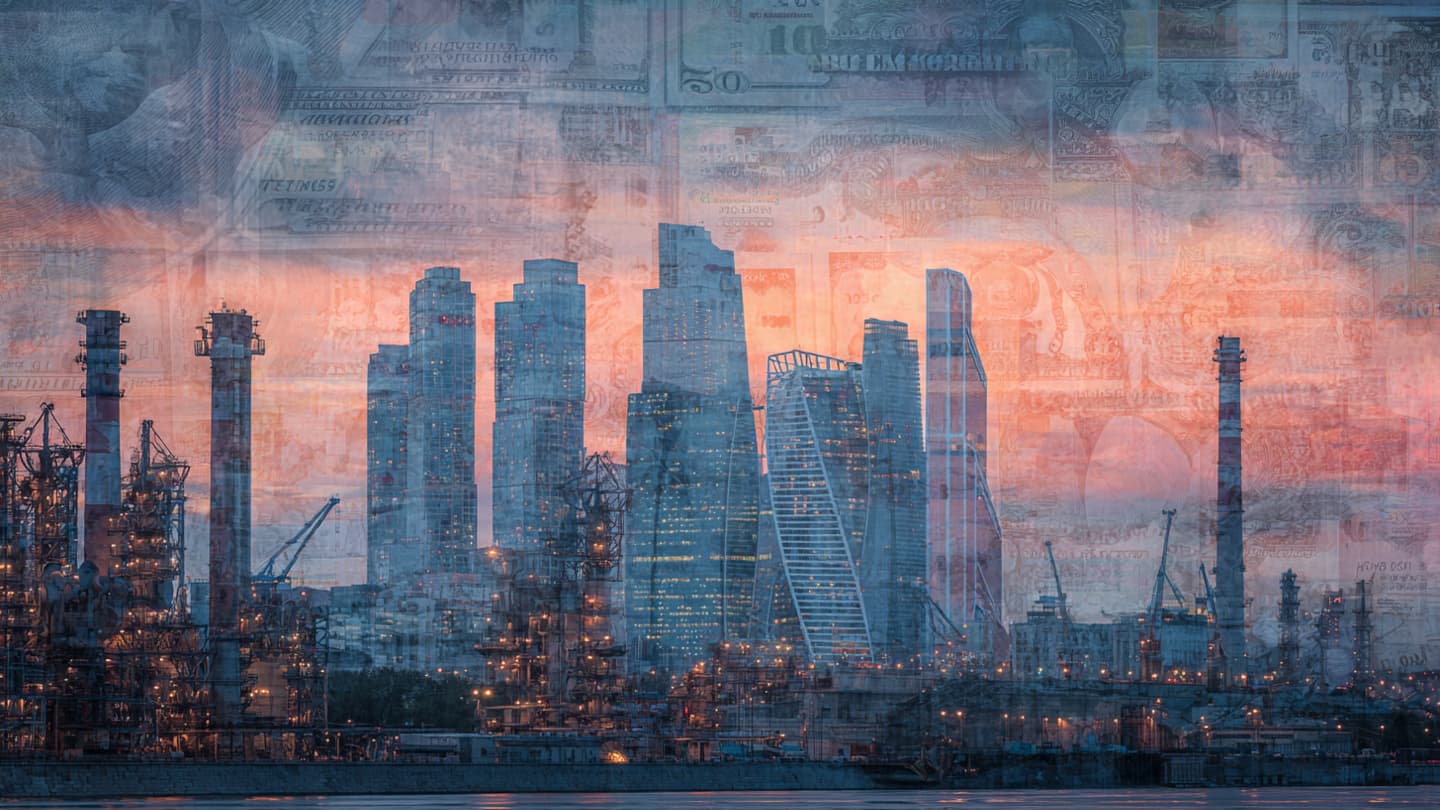
AI Image Disclaimer Visuals were created using AI tools and are not real photographs.
Sources Reuters, Financial Times, Bloomberg, The Economist, International Monetary Fund
Published by Banx Network. This article is part of the Banx decentralized media programme, powered by the BXE token on the XRP Ledger.