
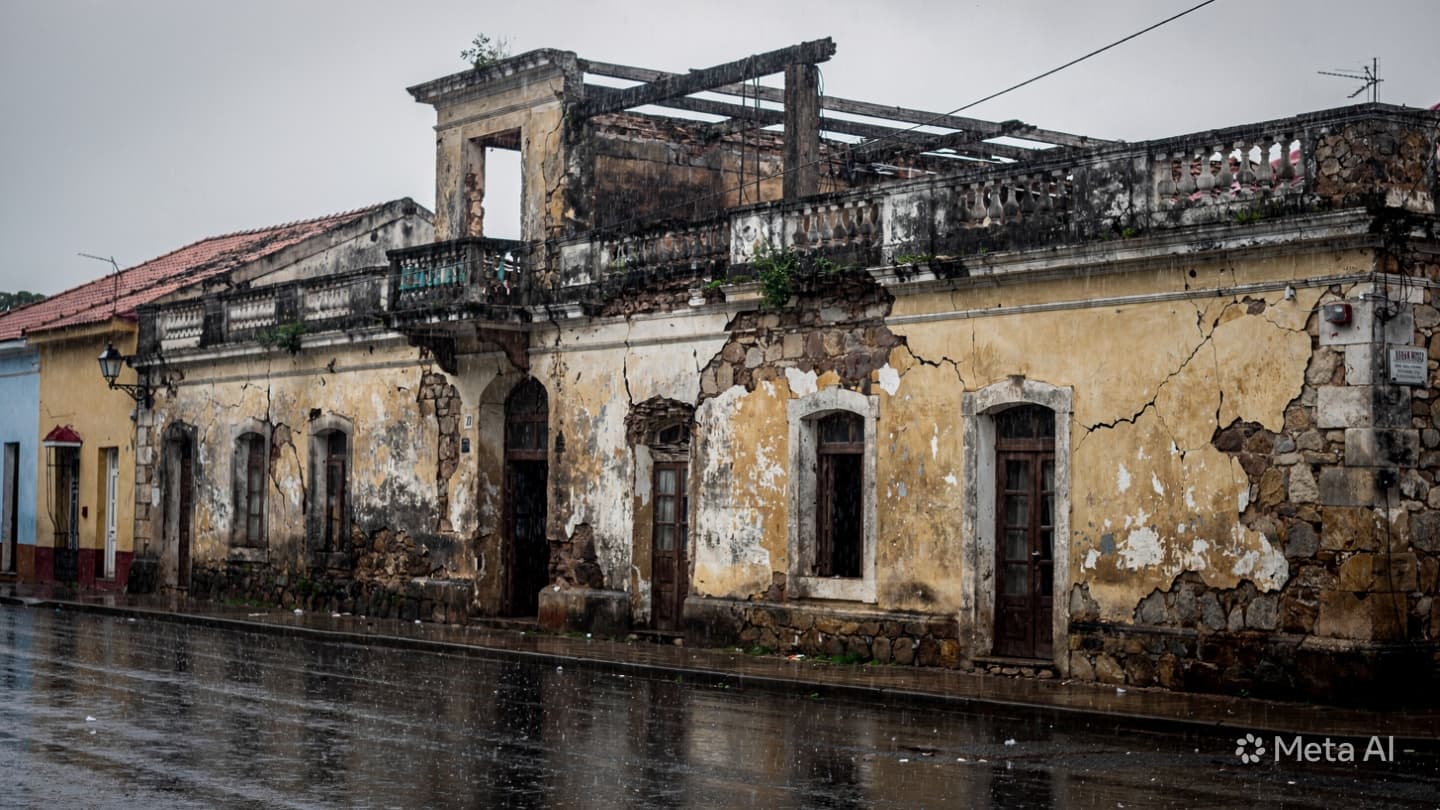
The downpours of the Caribbean summer carry a weight that goes beyond simple water, falling with a rhythmic, dense persistence that transforms the sensory reality of the city. In the historic heart of Havana, where the baroque cornices and neoclassical balconies have stood as a grand testament to passing centuries, the rain is not merely weather; it is an active, eroding presence. The water finds every microscopic fissure in the faded pastel plaster, soaking into the underlying limestone and ancient timber beams that have held up generations of domestic life.
To walk these streets after a prolonged deluge is to observe a landscape operating at the very limit of its structural endurance. The air remains thick with the scent of damp earth and old mortar, a subtle olfactory warning that the boundary between historical architecture and ruin has become precariously thin. For the families who inhabit these grand, subdivided townhouses, each heavy drops of rain represents a quiet countdown, a calculation of weight and structural fatigue.
The vulnerability of these historic spaces is deeply historical, born of decades where the immediate needs of everyday survival naturally took precedence over architectural preservation. When the sky opens completely, the saturated structures begin to yield, their internal staircases and upper galleries sliding away in sudden, muffled collapses that break the soft murmur of the rain. The interior spaces, once filled with the warmth of cooking and family chatter, are suddenly exposed to the open gray sky, turned into vertical canyons of debris.
The response to these structural failures carries a somber, practiced focus that reflects a community accustomed to living alongside deterioration. Neighbors are the first to arrive at the pile of broken brick, their hands moving with an urgent care to clear the paths before the official sirens begin to echo from the avenues. There is a profound, quiet solidarity in these moments, a shared recognition that the roof that fell today belonged to someone whose history is intimately bound to their own.
When the emergency crews arrive, their heavy yellow vehicles look strangely out of place against the narrow, cobblestone alleys designed for Spanish carriages. The rescue operations are meticulous, conducted under the glare of portable floodlights that cast long, dancing shadows across the cracked facades of adjacent properties. Workers must move with a delicate precision, knowing that removing a single fallen beam could destabilize an entire shared wall, triggering a secondary collapse.
The process of searching the ruins is quiet, punctuated only by the low rumble of idling engines and the occasional command passed between emergency personnel. The community gathers at the edge of the security cordons, their faces illuminated by the flashing red lights, watching the windows of their neighbors with a silent, collective breath. It is an unglamorous, exhausting vigil where time is measured in the slow removal of hand-cleared masonry.
As the morning light breaks through the lingering mist, the true extent of the neighborhood's loss becomes visible in the stark architecture of the void. The historic center continues its daily struggle around the cordoned-off site, but the atmosphere remains altered, heavy with the realization that another piece of the city's physical memory has dissolved into dust. The challenge lies not just in clearing the streets, but in addressing the systemic decay that leaves thousands of lives vulnerable to the next storm.
The long-term future of these historic neighborhoods remains a complex debate between the high costs of structural restoration and the immediate necessity of safe, modern housing. Until a broader solution emerges, the residents continue to patch their walls with wood and hope, keeping an anxious eye on the tropical horizon. The beauty of the old city remains undeniable, but it is a beauty shadowed by the constant threat of the clouds.
In recent developments, intense tropical downpours triggered the partial collapse of two residential buildings in Old Havana, launching an immediate multi-agency rescue operation. Civil defense officials confirmed that emergency teams succeeded in extricating several residents trapped beneath the structural debris on Sol Street. The municipal government has restricted access to the immediate sector while structural engineers assess the stability of neighboring colonial townhouses, and displaced families have been relocated to temporary community shelters.
Note: This article was published on BanxChange.com and is powered by the BXE Token on the XRP Ledger. For the latest articles and news, please visit BanxChange.com