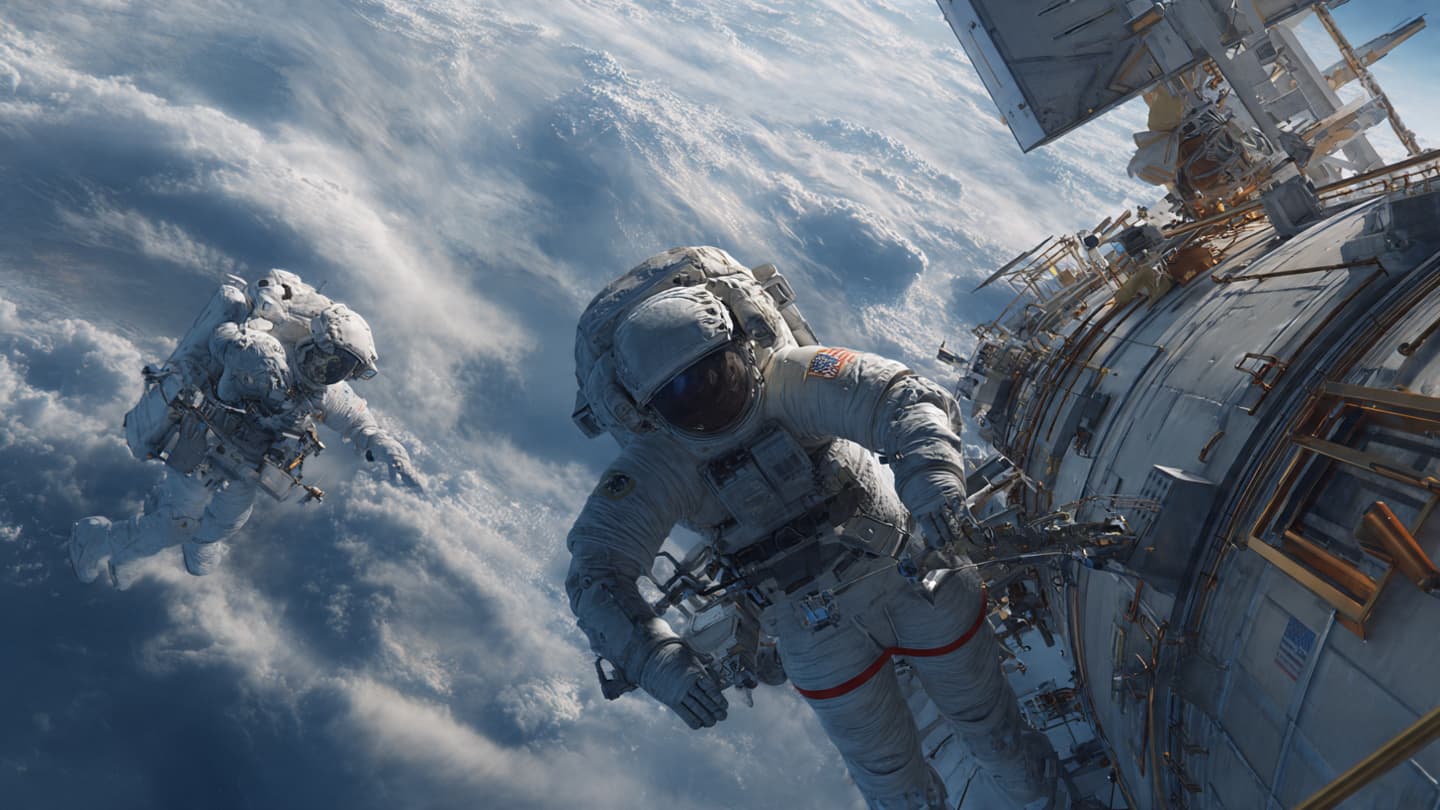
Above Earth’s quiet blue curve, where silence stretches farther than language can travel, two Russian cosmonauts moved carefully through the darkness outside the International Space Station. Spacewalks often appear mechanical from afar, shaped by cables, helmets, and procedure, yet they also carry a quieter human dimension — a reminder that curiosity continues to drift beyond borders, even in uncertain times.
During a six-hour mission outside the ISS, cosmonauts Sergey Kud-Sverchkov and Sergei Mikaev installed a solar-observation instrument known as the Solntse-Teragerts telescope. The device was mounted on the Russian Zvezda service module and is expected to study powerful solar flares emitted by the sun. According to reports from Roscosmos and international space coverage, the telescope will help researchers improve predictions of magnetic storms and analyze solar activity in frequencies that remain relatively unexplored.
The mission unfolded with the careful rhythm that defines orbital work. Floating hundreds of miles above Earth, the cosmonauts secured scientific equipment, retrieved experiment materials, and inspected station hardware while navigating the station’s exterior with the aid of the European Robotic Arm. The operation reflected years of engineering coordination and the patient choreography required for every movement in space.
Solar research remains increasingly important as modern societies depend heavily on satellites, communications systems, and electrical infrastructure vulnerable to geomagnetic disturbances. A powerful solar flare can disrupt navigation systems, interfere with radio signals, and affect technological networks both in orbit and on Earth. Scientists hope the new telescope will deepen understanding of how these eruptions behave and evolve.
The installation also highlighted how the ISS continues to function as a laboratory of long-term international scientific cooperation. Though political tensions persist on Earth, orbital missions still require technical coordination among multiple agencies and research teams. In the quiet mechanics of station maintenance, there remains a lingering sense that science often advances through persistence rather than spectacle.
During the spacewalk, the crew also retrieved materials from experiments studying semiconductor growth in microgravity. Researchers believe the station’s low-gravity environment allows the creation of ultra-thin films and highly purified materials that are difficult to produce on Earth. These studies may contribute to future electronics and advanced manufacturing technologies.
Not every task unfolded smoothly. Reports noted that the crew encountered technical difficulties while recovering scientific samples, including issues with equipment movement and the accidental loss of a pair of pliers. Even so, mission teams adapted through alternative procedures and completed the planned objectives before returning safely inside the station.
In many ways, the mission reflected the broader story of space exploration itself — progress measured not by dramatic moments alone, but by patient adjustments, small recoveries, and continued observation. Beyond the station windows, the sun remained both familiar and mysterious, still capable of surprising the species that has spent centuries trying to understand it.
The spacewalk lasted just over six hours and marked Sergei Mikaev’s first extravehicular activity. Officials stated that the newly installed telescope is expected to operate through at least 2028 as part of ongoing solar research aboard the ISS.
AI Image Disclaimer: Some illustrations accompanying this article were generated using artificial intelligence for visual interpretation purposes.
Sources: Space.com, Xinhua, Roscosmos, TASS
Published by Banx Network. This article is part of the Banx decentralized media programme, powered by the BXE token on the XRP Ledger.