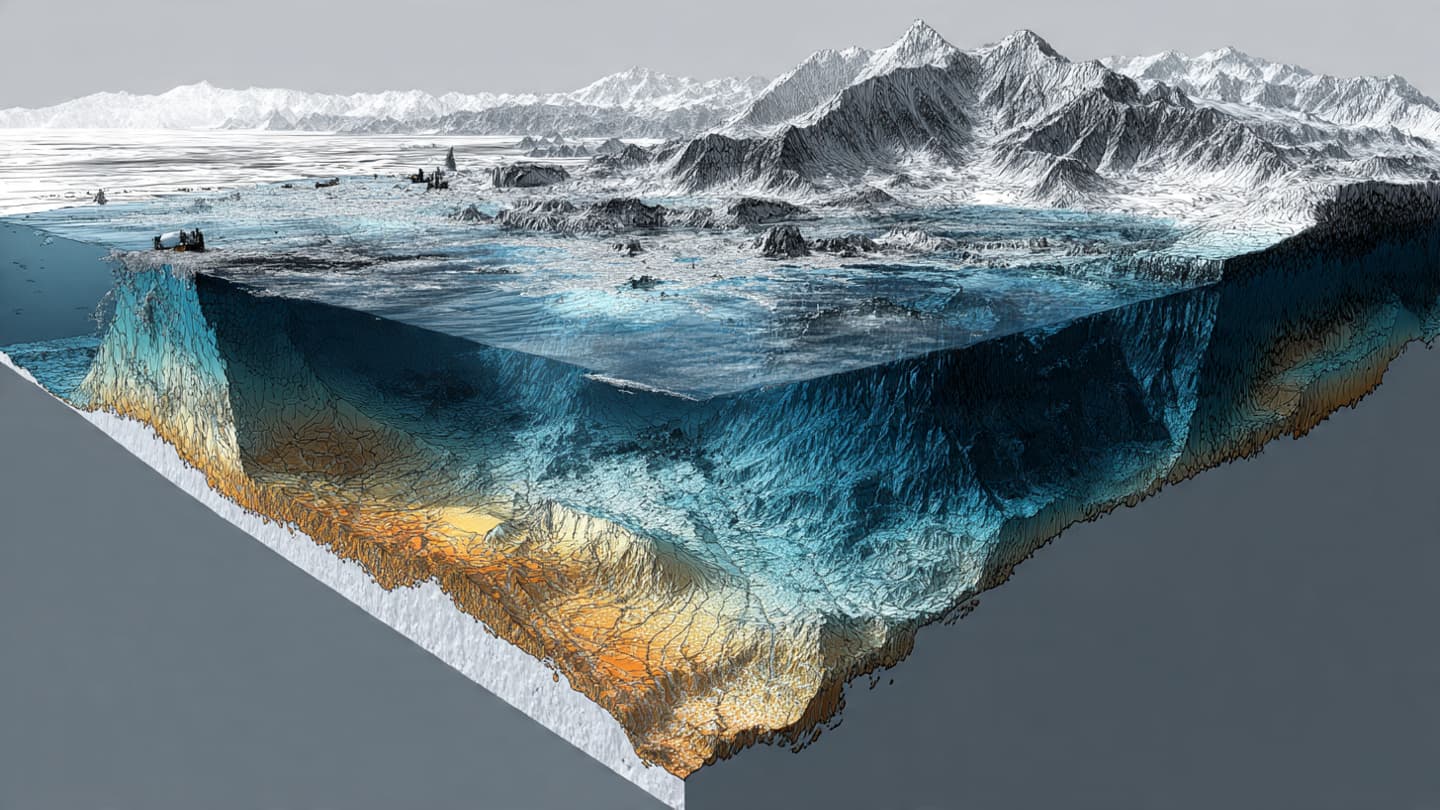
Antarctica has long been compared to a vast white archive, a frozen continent whose deepest chapters remain sealed beneath layers of ancient ice. While satellites and research stations reveal much about its surface, the landscape hidden below continues to surprise scientists. A newly discussed discovery of a colossal structure buried nearly two miles beneath the Antarctic ice sheet has once again reminded researchers that some of Earth's oldest stories remain unfinished.
Body:
The structure, identified through advanced geophysical surveys and radar imaging, has attracted attention because of its enormous scale and unusual characteristics. Hidden beneath one of the most remote regions on Earth, it appears to differ significantly from surrounding geological formations, prompting questions about its origin and age.
For decades, Antarctica was viewed primarily through the lens of climate science. Yet beneath the ice lies a continent with mountains, valleys, ancient river systems, and geological features that predate the formation of the ice sheet itself. Each new discovery adds another piece to a puzzle that spans hundreds of millions of years.
Researchers examining the buried formation have explored several possibilities. Some scientists suggest it could be linked to ancient tectonic activity that shaped the continent long before Antarctica became an icy wilderness. Others have considered whether the feature may represent the remnants of a massive impact event from Earth's distant past.
The significance of the discovery extends beyond simple curiosity. Understanding what lies beneath the ice can help scientists reconstruct Antarctica's geological evolution and better understand how continents moved and interacted over geological timescales. Such insights contribute to broader studies of Earth's history.
Modern technology has played a crucial role in revealing these hidden landscapes. Radar systems mounted on aircraft can penetrate thick ice layers, providing detailed images of structures that would otherwise remain invisible. Combined with satellite observations and computer modeling, these tools allow researchers to investigate areas that are nearly impossible to access directly.
The discovery also highlights how much remains unknown about Antarctica. Despite decades of exploration, large portions of the continent's subsurface environment remain only partially mapped. Every new survey has the potential to uncover features that challenge established assumptions.
Scientists emphasize that further investigation will be necessary before firm conclusions can be drawn. Additional data collection and analysis are expected to help determine the structure's exact nature and its place within Antarctica's geological history.
Closing:
As research continues, the buried formation serves as a reminder that even in an age of satellites and sophisticated instruments, Earth still holds hidden chapters beneath its surface. Antarctica's frozen landscape may yet reveal discoveries capable of reshaping how humanity understands the planet's distant past.
AI Image Disclaimer: Illustrative images accompanying this article may be generated using artificial intelligence and are intended for visual representation only.
Source Verification Check: BBC News, Live Science, New Scientist, Nature, Scientific American
Published by Banx Network. This article is part of the Banx decentralized media programme, powered by the BXE token on the XRP Ledger.