
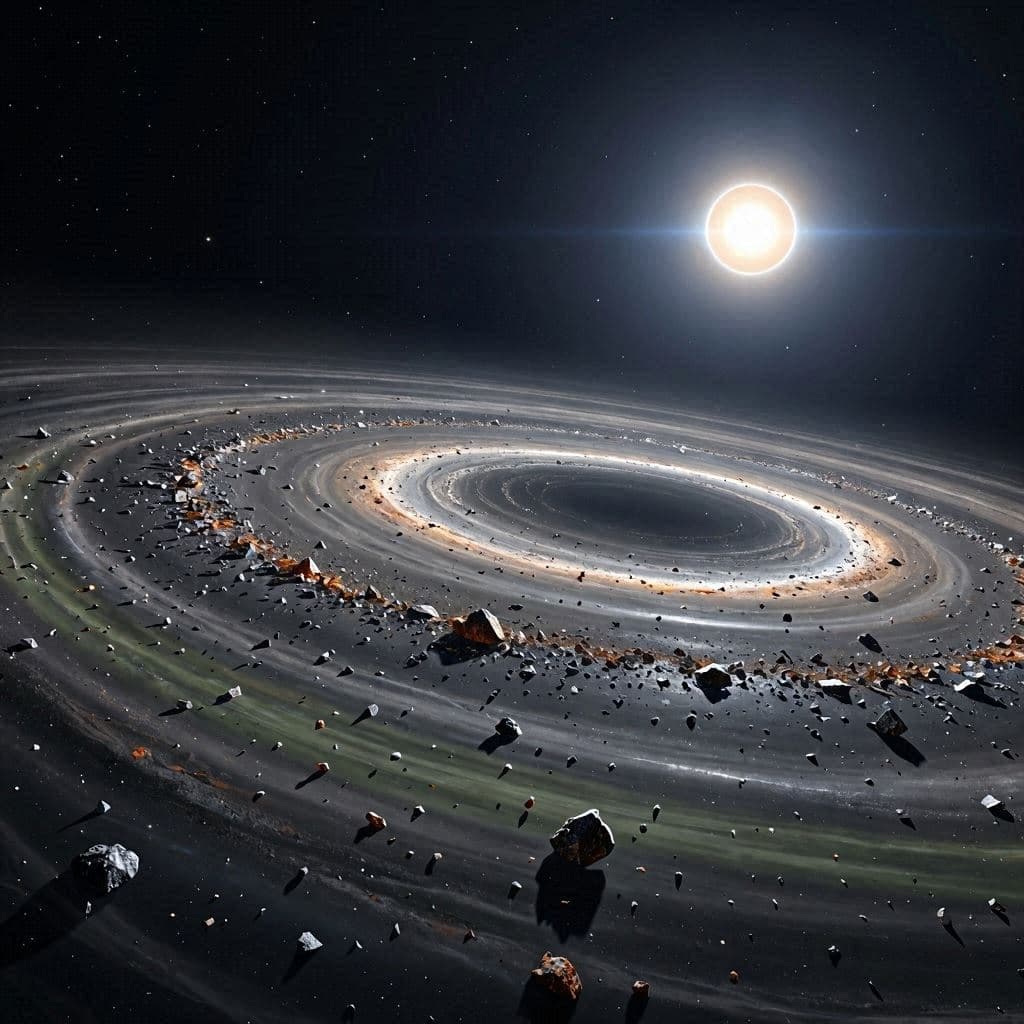
In the quest to understand our place in the universe, astronomers often look to the stars for clues about planet formation. But sometimes, the answers lie in the debris of destroyed worlds. A side project from the Dark Energy Spectroscopic Instrument (DESI) has analyzed the chemical composition of white dwarf stars, revealing traces of exoplanets that were torn apart by their host stars. Surprisingly, the elemental makeup of these shattered planets closely resembles that of Earth and its neighbors. This finding suggests that rocky, Earth-like planets may be common throughout the galaxy, offering hope in the search for habitable worlds.
Body: White dwarfs are the remnants of stars like our Sun, dense and hot after shedding their outer layers. When a planet orbits too close to a white dwarf, tidal forces can rip it apart, creating a disk of debris that eventually rains down onto the star’s surface. By analyzing the light from these white dwarfs, scientists can detect the presence of elements such as magnesium, silicon, and iron, which are characteristic of rocky planets. DESI’s high-precision spectroscopy has allowed for a detailed chemical census of this planetary graveyard.
The study focused on a sample of white dwarfs observed by DESI, originally intended for mapping dark energy. However, the instrument’s capability to capture detailed spectra proved invaluable for studying stellar atmospheres. The data revealed that many of the destroyed planets had compositions similar to Earth, Mars, and Venus. This similarity implies that the processes forming rocky planets in our solar system are not unique but rather a standard outcome of stellar evolution.
These findings have significant implications for astrobiology. If Earth-like planets are common, then the conditions necessary for life may also be widespread. While the destruction of these planets is tragic, their chemical signatures provide a window into the diversity of planetary systems. They serve as fossils, preserving the history of worlds that no longer exist.
The DESI project, primarily designed to study the expansion of the universe, demonstrates the value of multi-purpose astronomical instruments. Data collected for one purpose can yield unexpected discoveries in another field. This serendipity is a hallmark of scientific exploration, where curiosity and open-mindedness lead to breakthroughs.
Researchers are now expanding the study to include more white dwarfs, aiming to build a larger statistical sample. This will help determine how common Earth-like compositions are across different galactic environments. Variations in metallicity and age may reveal trends in planet formation, offering insights into the cosmic timeline of rocky world creation.
The emotional resonance of discovering "dead Earths" is poignant. It reminds us of the fragility of planetary systems and the eventual fate of our own sun. Yet, it also offers comfort in the knowledge that our world is not an anomaly. We are part of a vast family of rocky planets, scattered across the cosmos.
Closing: The DESI side project has turned a tool for cosmology into a probe for planetary archaeology. By reading the chemical remains of destroyed exoplanets, scientists have found evidence that Earth-like worlds are abundant. In the ashes of dead stars, we see the reflection of our own home.
AI Image Disclaimer: The images associated with this article are AI-generated illustrations designed to represent the themes of exoplanet destruction and spectral analysis.
Sources: DESI Collaboration, ArXiv, Space.com, NASA Exoplanet Archive
Published by Banx Network. This article is part of the Banx decentralized media programme, powered by the BXE token on the XRP Ledger.



