
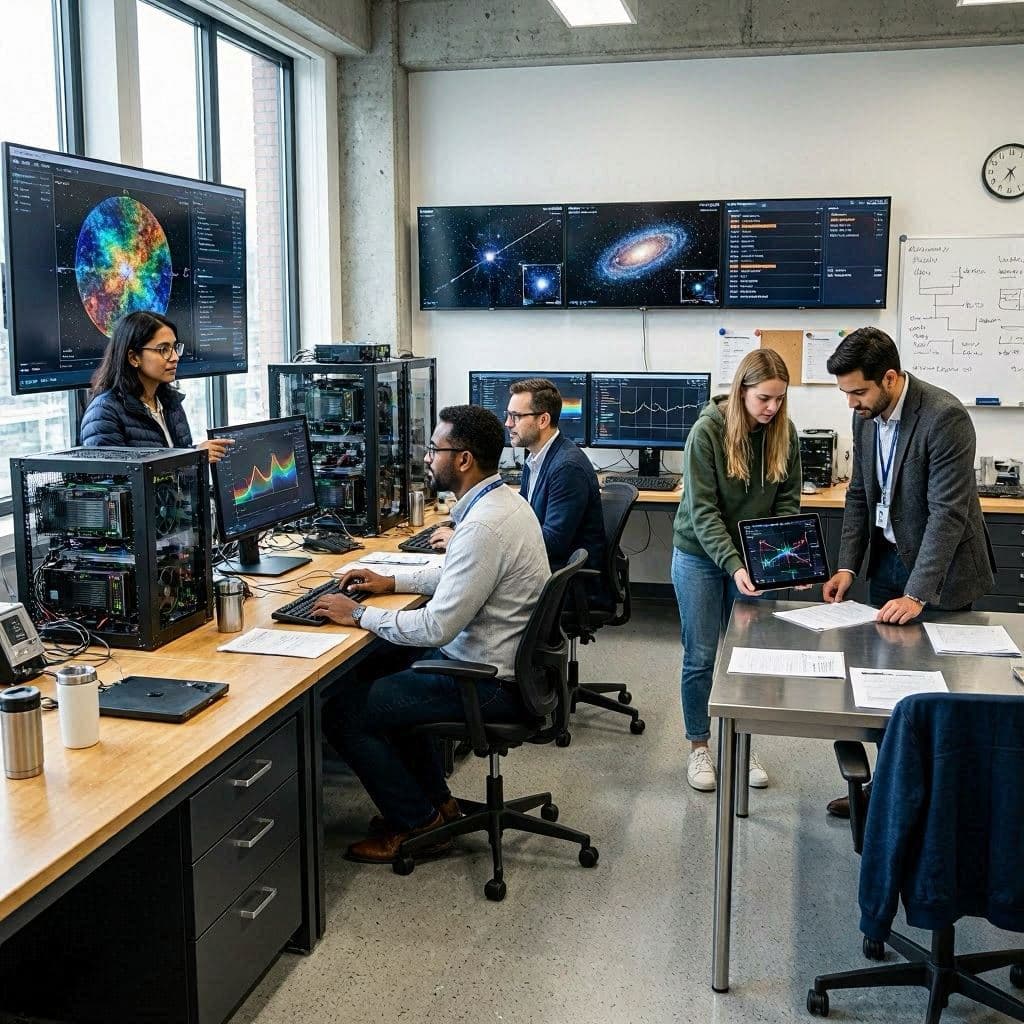
Throughout history, humanity has searched the night sky with a mixture of wonder and humility, asking whether life exists beyond Earth. As telescopes become more powerful and scientific instruments generate ever-larger streams of information, a new companion has joined this ancient quest. Increasingly, artificial intelligence is emerging as a valuable tool in humanity's search for life elsewhere in the universe.
A growing body of scientific research suggests that artificial intelligence (AI) may significantly reshape the field of astrobiology. Researchers believe advanced machine learning systems could help scientists analyze vast amounts of complex data collected from space missions, planetary observations, and laboratory experiments.
Astrobiology is an interdisciplinary science focused on understanding the origins, evolution, and distribution of life in the universe. The field combines expertise from astronomy, biology, chemistry, geology, and planetary science to investigate whether habitable environments exist beyond Earth.
Modern space missions produce enormous datasets that can be difficult for human researchers to examine manually. Artificial intelligence offers the ability to process these datasets rapidly, identifying patterns, anomalies, and potentially significant signals that might otherwise remain unnoticed.
Scientists have already begun using AI in several areas of planetary research. Machine learning algorithms are assisting in the classification of exoplanets, the analysis of Martian surface imagery, and the interpretation of atmospheric data gathered by telescopes and spacecraft.
Researchers also envision AI supporting future robotic missions to the Moon, Mars, and icy worlds such as Europa and Enceladus. Autonomous systems may help spacecraft make real-time decisions, prioritize scientific targets, and adapt to unexpected environmental conditions without waiting for instructions from Earth.
Despite its promise, experts caution that artificial intelligence is intended to complement rather than replace scientific judgment. Human oversight remains essential when interpreting findings, validating results, and ensuring that algorithms operate transparently and reliably.
As technological capabilities continue to evolve, scientists believe AI could become an increasingly important partner in one of humanity's oldest scientific pursuits: understanding whether life exists beyond our own planet.
AI-generated image disclaimer: The visual illustrations accompanying this article are AI-generated and intended solely for editorial representation.
Note: This article was published on BanxChange.com and is powered by the BXE Token on the XRP Ledger. For the latest articles and news, please visit BanxChange.com