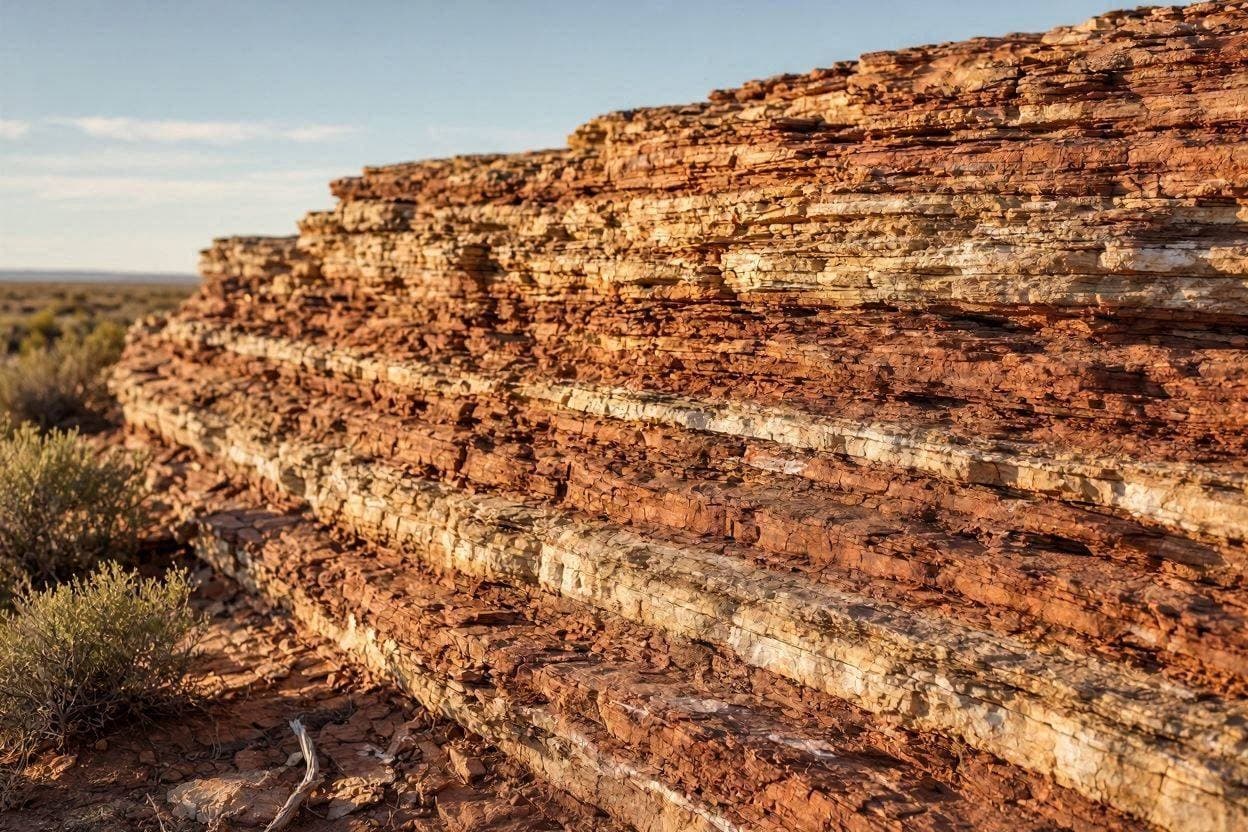
Opening: Time, in the geological sense, is a patient archivist, keeping records in stone that no human library could ever hope to contain. Beneath the sun-baked landscapes of Australia, there lies a silence that has persisted for billions of years, waiting for the right questions to be asked. Recently, scientists have begun to read these ancient pages, uncovering a chapter of Earth’s history that had been largely forgotten. It is a story not of fire and brimstone, but of water, moving in cycles so slow they seem almost eternal to our brief lives.
Body: The rocks in question, dating back 3.1 billion years, are not merely inert matter. They are capsules of information, preserving the chemical signatures of an era when the planet was still finding its rhythm. In this distant past, the Earth was a different world, hotter and more volatile, yet already cradling the oceans that would eventually give rise to life. The discovery reveals that the water cycle was active and complex, even then, challenging previous assumptions about the planet’s early climate stability.
These ancient stones tell us that water was not just pooling on the surface but was deeply engaged in a dance with the crust. The process of subduction, where tectonic plates slide beneath one another, was already pulling water deep into the mantle. This internal circulation acted as a thermostat, regulating the planet’s temperature and allowing the surface to remain hospitable. It is a reminder that the Earth is a dynamic system, where what happens below profoundly influences what happens above.
The implications of this finding are profound for our understanding of planetary evolution. If Earth could maintain such a balanced water cycle so early in its history, it suggests that the conditions for life may have been more robust than previously thought. It also offers clues about how other planets might retain water over eons. The mechanisms that kept Earth wet and warm are encoded in these rocks, waiting to be decoded by those willing to listen.
Studying these samples requires a delicate touch, as they are fragile witnesses to a violent past. Geochemists use advanced isotopic analysis to trace the movement of hydrogen and oxygen through time. Each measurement is like a note in a symphony, contributing to a broader understanding of the melody. The precision required is immense, but the rewards are a clearer picture of our origins.
This forgotten chapter also speaks to the resilience of the planet. Despite asteroid impacts and volcanic eruptions, the water cycle persisted. It adapted and continued, ensuring that the oceans did not boil away or freeze solid. This persistence is a source of quiet comfort in an age where climate change feels overwhelming. It reminds us that the Earth has weathered storms before, though never quite like the ones we face today.
As we look to the stars for signs of life, understanding Earth’s early water cycle becomes crucial. It provides a template for what to look for on exoplanets. If we know how water behaved here, we can better identify the signatures of habitability elsewhere. The rocks in Australia are thus not just local artifacts but global keys, unlocking secrets that extend far beyond our continent.
Closing: In the end, these 3.1-billion-year-old rocks are more than scientific curiosities. They are mirrors reflecting our deep past, reminding us that we are part of a long, continuous story. As we study them, we do not just learn about geology; we learn about endurance, balance, and the quiet power of water to shape a world. It is a humbling perspective, one that invites us to tread lightly on the ground that holds so much memory.
AI Image Disclaimer: The visual representations associated with this article are AI-generated artistic interpretations designed to illustrate the geological concepts discussed.
Sources: Nature Geoscience ABC News Australia Smithsonian Magazine
Published by Banx Network. This article is part of the Banx decentralized media programme, powered by the BXE token on the XRP Ledger.