
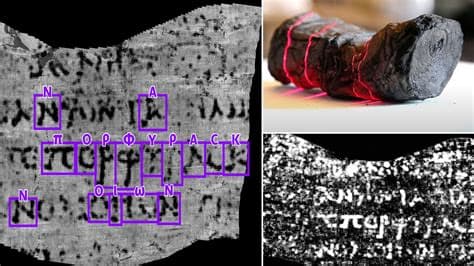
Researchers have successfully read an ancient Herculaneum scroll end-to-end for the first time in nearly 2,000 years, using high-resolution X-ray imaging and artificial intelligence to recover the text from a sealed carbonized papyrus.
The scroll, known as PHerc. 1667 (also referred to as Scroll 4 in the Vesuvius Challenge), survived the eruption of Mount Vesuvius in A.D. 79 because the papyrus was charred into a fragile carbon block. But that same preservation method made the scroll too brittle to open: earlier attempts to unroll or manipulate similar scrolls damaged or destroyed them, leaving scholars only partial fragments and isolated readable sections.
Instead of physically opening the papyrus, the team produced detailed 3D imaging of the scroll at facilities including the European Synchrotron Radiation Facility, reconstructed the rolled pages digitally, and then trained AI models to detect the faint ink impressions hidden in the carbonized material. Papryologists then reviewed the AI readings column by column to produce a continuous Greek transcription of the surviving text.
The preserved portion is about nearly 5 feet (around 1.5 meters) of continuous writing across roughly 20 columns, and the recovered text appears to be a philosophical treatise on ethics, associated with Stoicism. The scroll’s final preserved column names Aristocreon, identified as the nephew and student of the Stoic philosopher Chrysippus, helping place the manuscript within a Stoic context and suggesting an early date relative to the Herculaneum library.
The project is part of the broader Vesuvius Challenge, which aims to scale “virtual unwrapping” so that many other sealed scrolls—hundreds remain—can be read without risking physical damage. In addition to PHerc. 1667, the work also reports progress on other scrolls, including improvements to ink visibility and identification of previously unknown text elements, demonstrating that the methods are working beyond a single manuscript.
Published by Banx Network. This article is part of the Banx decentralized media programme, powered by the BXE token on the XRP Ledger.

.jpg&w=3840&q=75 "US Declares Drought Disaster for Parts of Puerto Rico as Dry Conditions Persist")
