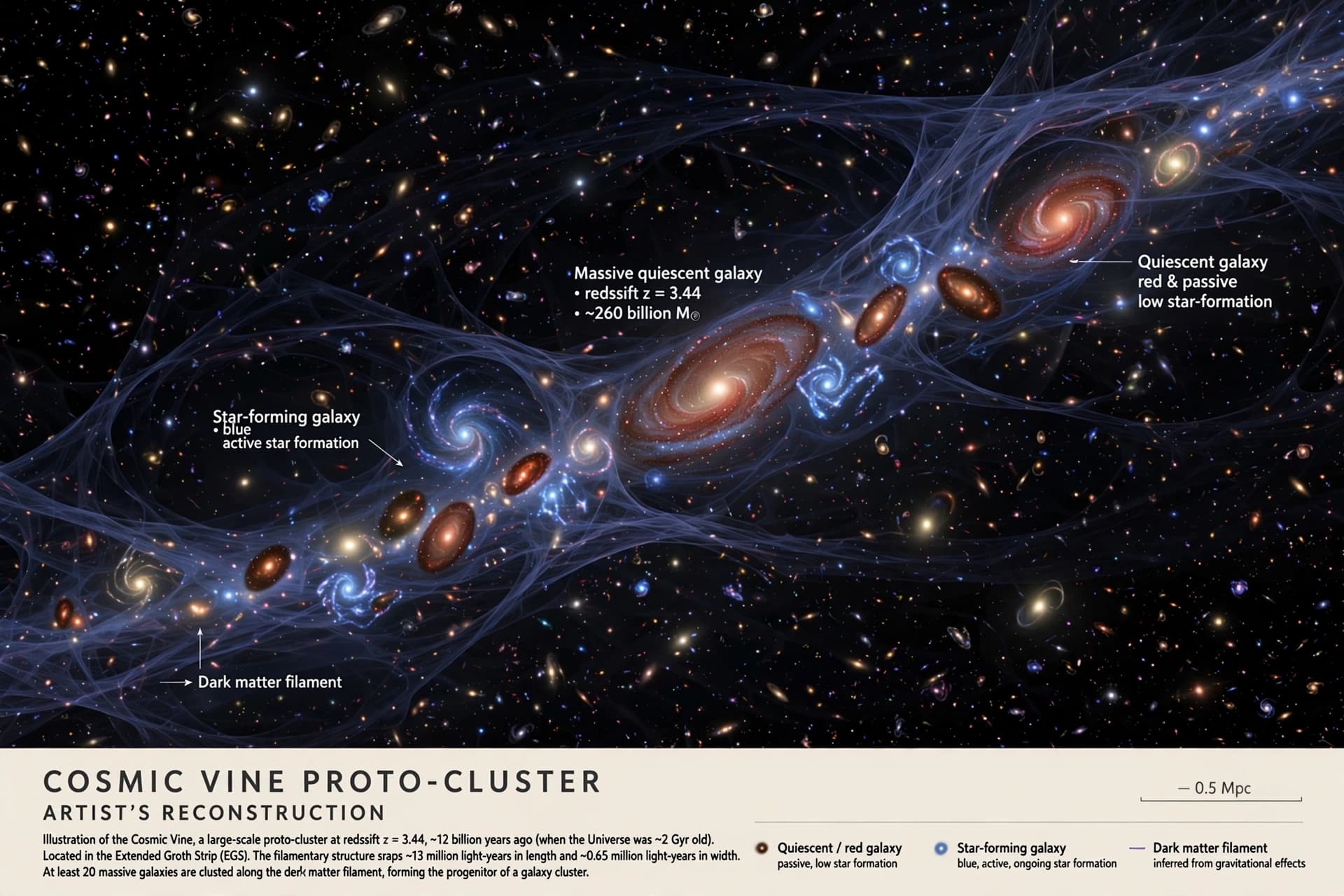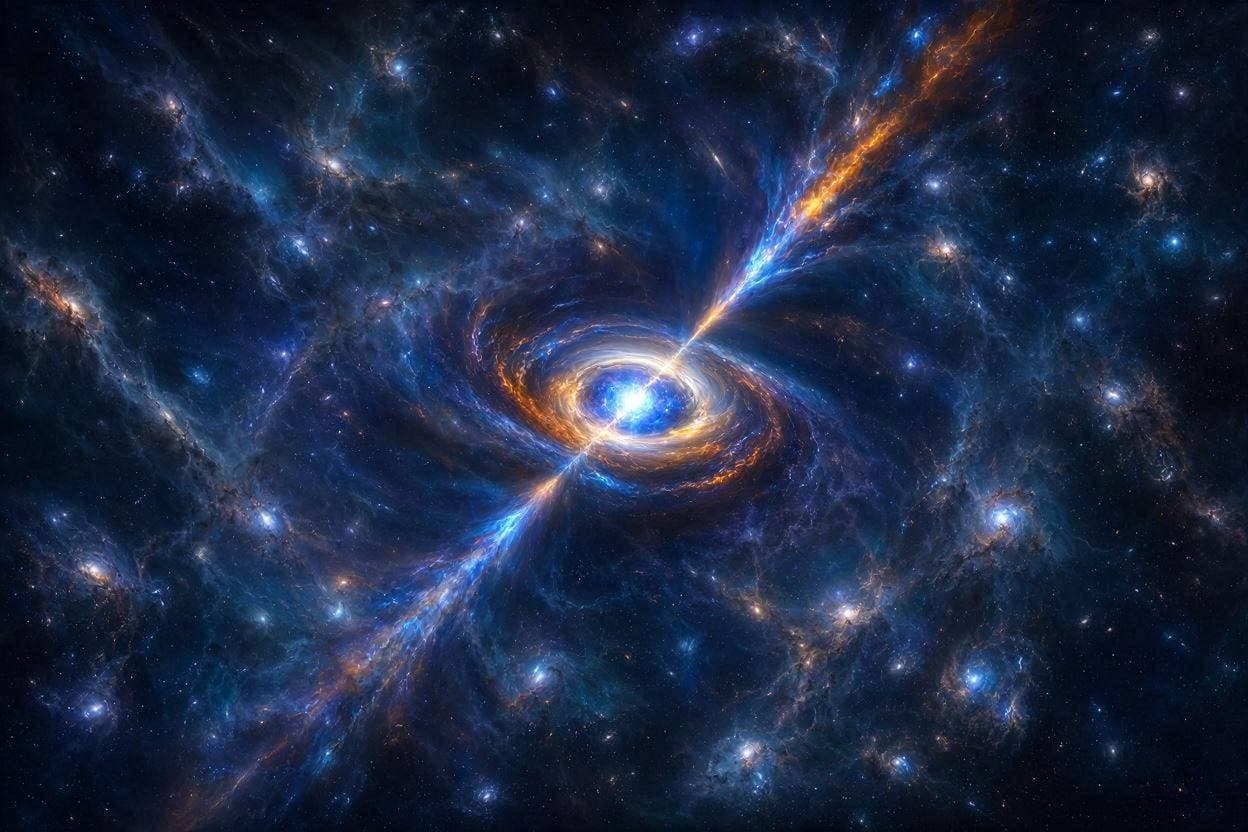
In the deepest recesses of cosmic time, where the universe was still young and formative, there lurk giants that defy our understanding of growth. The Euclid space telescope, designed to map the dark geometry of the cosmos, has turned its gaze toward the dawn of creation and found something extraordinary. It has identified two supermassive black holes from an era when the universe was less than a billion years old. These celestial behemoths shine with the brilliance of a trillion suns, challenging the very models we use to explain how such massive objects could form so quickly after the Big Bang.
Body: The discovery is significant not just for the size of these black holes, but for their age. In the standard model of cosmology, black holes grow slowly, feeding on gas and merging with other stars over billions of years. To find objects of this magnitude in the infant universe suggests that either our understanding of early star formation is incomplete, or that there were mechanisms for rapid growth that we have yet to fully comprehend. It is as if finding a fully grown oak tree in a garden that was planted only yesterday.
Euclid’s ability to detect these distant quasars relies on its powerful infrared instruments, which can peer through the dust and haze of the early cosmos. The light from these black holes has traveled for over thirteen billion years to reach us, carrying information about a time when the first galaxies were just beginning to coalesce. By studying their spectra, astronomers can determine their mass, temperature, and the rate at which they are consuming matter. The data reveals a ferocity of activity that is difficult to reconcile with current theories.
These "monster" black holes reside at the centers of what would become massive galaxies. Their intense radiation influences the formation of stars around them, potentially halting or accelerating the birth of new solar systems. This feedback loop between the black hole and its host galaxy is a critical component of cosmic evolution. Understanding how these early giants interacted with their environment helps scientists piece together the history of structure formation in the universe.
The brightness of these objects, equivalent to a trillion suns, is a testament to the efficiency of their accretion disks. As matter spirals into the event horizon, it heats up and emits enormous amounts of energy. In the early universe, where gas was abundant and dense, these black holes may have had access to a nearly unlimited food supply. This abundance could explain their rapid growth, but it also raises questions about why similar objects are not more common in later epochs.
This finding adds to a growing list of anomalies detected by modern telescopes like James Webb and Euclid. Each discovery chips away at the edges of our knowledge, revealing a universe that is more complex and dynamic than previously thought. It reminds us that the cosmos is not static; it is a place of constant change, where the rules of physics play out in ways that continue to surprise us. The early universe was a violent, energetic place, and these black holes are its lingering signatures.
As Euclid continues its mission, it will likely uncover more of these ancient giants. Each new detection will help refine our models and deepen our understanding of cosmic history. The search for the first black holes is not just a quest for records; it is a search for origins. It asks the fundamental question of how the structures we see today came to be, starting from the simplest beginnings.
Closing: In the end, the discovery of these ancient black holes is a reminder of the vastness of our ignorance and the power of our curiosity. They stand as silent sentinels in the dark, watching over the evolution of the cosmos. As we study them, we do not just learn about black holes; we learn about the resilience of light and the enduring mystery of the universe’s first moments.
AI Image Disclaimer: Please note that any accompanying visuals for this narrative are artificially generated interpretations meant to evoke the spirit of the story, not documentary evidence.
Sources: European Space Agency (ESA) Nature Astronomy Scientific American
Published by Banx Network. This article is part of the Banx decentralized media programme, powered by the BXE token on the XRP Ledger.