In the dry stone layers of New Mexico, time sometimes waits quietly for someone patient enough to listen. Fossils do not speak in sudden revelations. Instead, they offer fragments — a curve of bone, a worn joint, a missing tooth — and ask modern science to imagine worlds long dissolved into dust. Recently, one such fragment reshaped assumptions about an ancient reptile that once wandered the Triassic landscape.
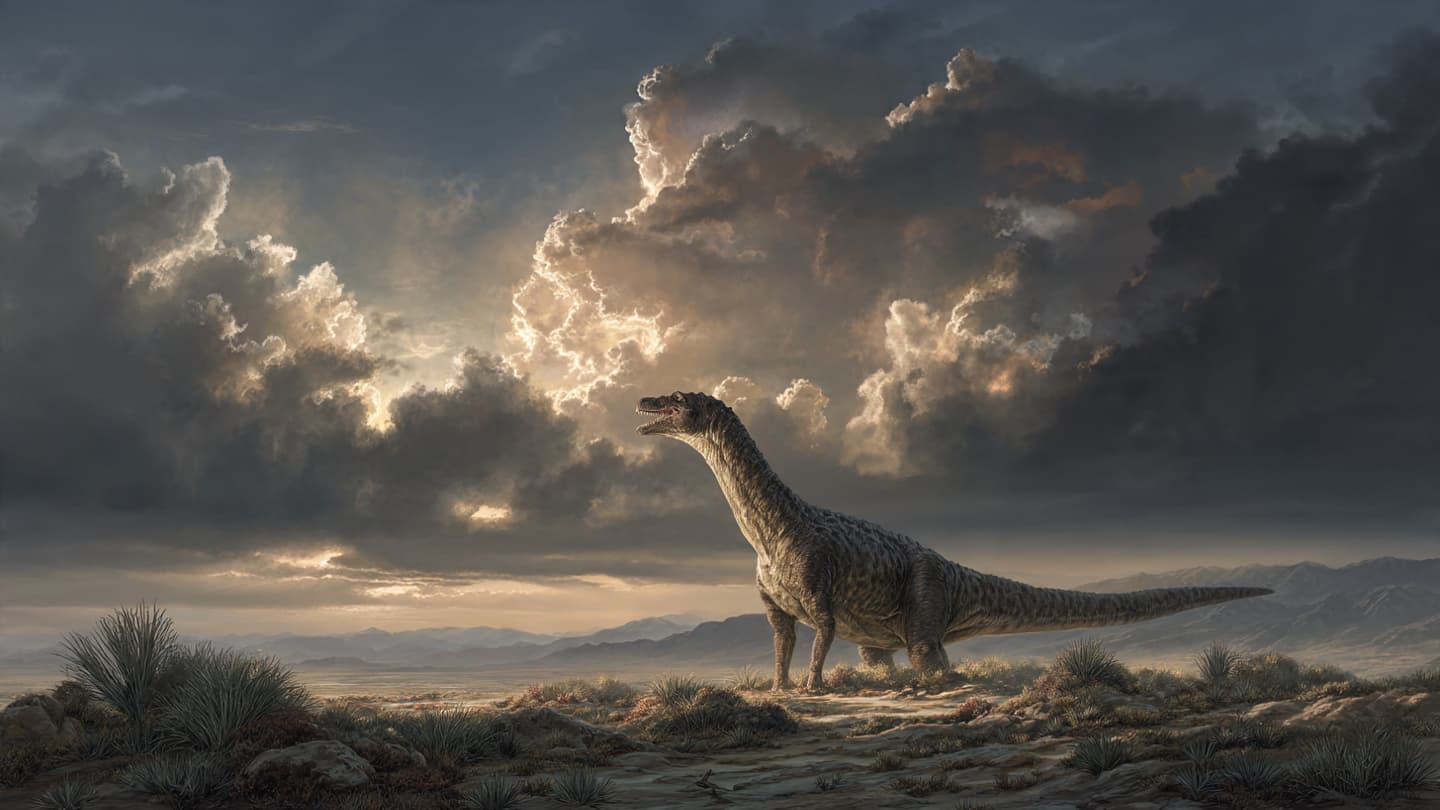
Researchers studying fossils from Ghost Ranch, New Mexico, identified a previously unknown reptile species named Labrujasuchus expectatus. Though the creature appeared strikingly dinosaur-like, scientists determined that it was actually a distant relative of modern crocodiles. The reptile possessed a beak instead of teeth and walked upright on two legs, features rarely associated with crocodilian ancestry.
The discovery has drawn attention because of how unusual the animal appears compared with living crocodiles. Modern crocodilians are low-slung predators with powerful jaws and heavy bodies adapted to water and marsh environments. By contrast, this ancient species moved on hind legs, had small forelimbs, and likely occupied a very different ecological role during the Late Triassic period roughly 212 million years ago.
Scientists described the species after reexamining fossils uncovered in 2006 from a quarry already famous for preserving Triassic-era animals. At first glance, the bones resembled those of previously known shuvosaurids, a group of reptilian relatives connected to the crocodile lineage. However, subtle differences in the skeleton eventually convinced researchers they were looking at a distinct species.
The discovery also highlights the strange paths evolution can take. Paleontologists describe this phenomenon as convergent evolution, where unrelated species independently develop similar physical traits. Although Labrujasuchus expectatus resembled some birdlike dinosaurs, researchers say its ancestry branched from the crocodile line millions of years earlier. Nature, it seems, occasionally repeats ideas while writing entirely different stories.
Ghost Ranch itself has long occupied a special place in paleontology. Its layered desert terrain preserves evidence from a period when Earth’s ecosystems were rapidly changing and ancient reptile groups experimented with a wide variety of body forms. During the Triassic, long before mammals or birds dominated the planet, evolutionary diversity flourished in ways that still surprise modern researchers.
Scientists remain uncertain about the creature’s diet. Some researchers suggest it may have been carnivorous or perhaps scavenged for food, though the absence of teeth complicates easy conclusions. Fossils often preserve anatomy more clearly than behavior, leaving scientists to reconstruct lifestyles through comparison and inference rather than certainty.
Beyond its unusual appearance, the reptile offers a broader reminder that evolutionary history is rarely linear. Species emerge, diversify, vanish, and leave behind traces that challenge assumptions formed by living animals alone. The crocodile family tree, now associated with ambush hunters and riverbanks, once contained forms that moved upright beneath ancient forests.
Researchers published their findings in the Journal of Vertebrate Paleontology, adding another chapter to ongoing efforts to better understand reptile evolution during the Late Triassic era.
AI Image Disclaimer: Visual depictions in this article include AI-assisted illustrations based on scientific descriptions and fossil evidence.
Sources: Scientific American, The Cool Down, Journal of Vertebrate Paleontology, Times of India
Published by Banx Network. This article is part of the Banx decentralized media programme, powered by the BXE token on the XRP Ledger.