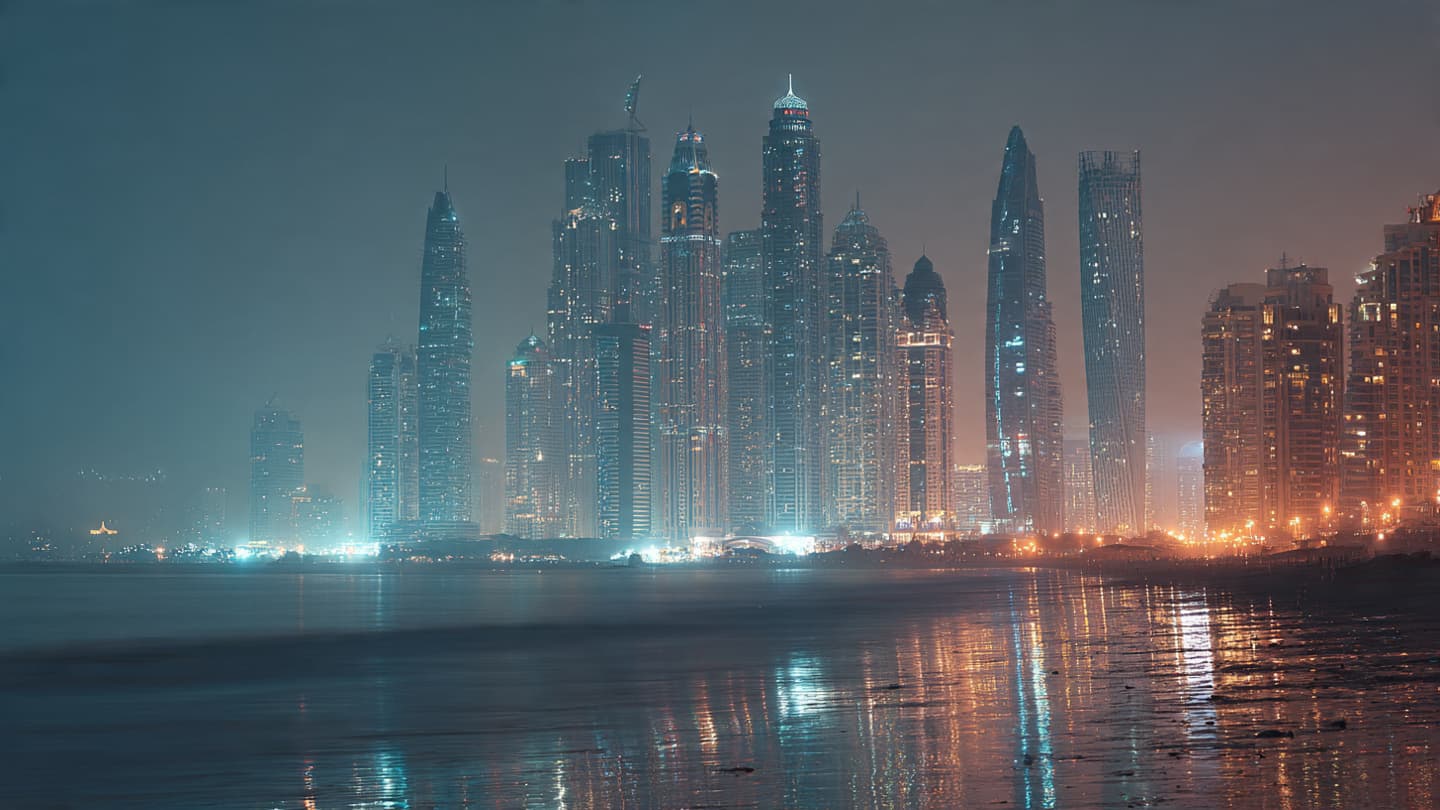
At night, the skyline of Dubai still glows with remarkable confidence. Towers of glass rise above the Gulf like illuminated sails, while traffic flows steadily along wide highways lined with palms and luxury hotels. Restaurants remain crowded late into the evening. Tourists drift through shopping districts beneath cooled air and polished marble. For years, the United Arab Emirates cultivated precisely this image — a place of stability in a region often associated abroad with volatility, a crossroads where finance, tourism, and ambition could move untouched by surrounding storms.
But wars have a way of altering geography emotionally long before they alter it physically.
As tensions tied to the conflict involving Iran continue to ripple across the Middle East, the UAE now finds its carefully maintained image of calm increasingly tested. Though the Emirates have not become a direct battlefield, the broader regional atmosphere — shaped by missile threats, military alerts, disrupted shipping routes, and geopolitical uncertainty — has begun pressing against the sense of insulation the country long projected to investors, expatriates, and travelers.
The UAE occupies a uniquely delicate position in the Gulf. Economically global yet geographically close to Iran, it has spent decades balancing commercial pragmatism, strategic partnerships, and regional diplomacy. Dubai in particular evolved into a symbol of predictability — a city where multinational corporations opened regional headquarters, airlines connected continents, and residents from around the world built lives under the assumption that the turbulence surrounding the Middle East would remain safely distant.
Now, that distance feels less certain.
Regional conflict has heightened anxieties surrounding maritime security in the Gulf, one of the world’s most important corridors for energy exports and global trade. Insurance costs for shipping have fluctuated. Airlines periodically adjust routes based on security assessments. Governments issue travel advisories with carefully measured language. Financial markets, always sensitive to instability, watch the region closely for signs that broader escalation could disrupt commerce or infrastructure.
Yet inside the UAE itself, public life continues with remarkable composure. Office towers remain full. Beaches are crowded at sunset. Construction cranes still move across expanding skylines. The Emirates’ leadership has emphasized continuity and security, seeking to reassure residents and investors that the country remains stable despite mounting regional tensions. This effort reflects not only economic necessity, but the deeper identity the UAE has spent years constructing: modern, open, internationally connected, and resilient.
There is, however, a quieter psychological shift that accompanies nearby conflict even when daily life appears unchanged. In expatriate communities, conversations increasingly touch on contingency plans and regional developments. Families refresh news feeds between ordinary routines. Business leaders assess risks once considered remote. Beneath the smooth surfaces of urban normality, uncertainty begins to circulate softly, almost invisibly.
The UAE’s strategic relationship with the United States further complicates its position. American military assets and personnel remain present across the Gulf region, while the Emirates simultaneously maintain economic and diplomatic channels with a range of regional actors, including Iran itself. This balancing act has long been central to Emirati foreign policy — avoiding direct confrontation while preserving strategic flexibility. In moments of heightened conflict, however, neutrality becomes more difficult to sustain symbolically, even if maintained diplomatically.
Across the Gulf, the memory of previous regional attacks still lingers. Missile and drone strikes targeting oil infrastructure in neighboring countries over recent years demonstrated how quickly regional tensions can penetrate even heavily defended economic centers. The modern Gulf city, despite its futuristic architecture and technological sophistication, remains physically close to some of the world’s most enduring geopolitical fault lines.
And yet the UAE’s resilience has often depended precisely on its ability to continue functioning amid uncertainty. Airports remain among the busiest in the world. Global conferences continue attracting executives and political leaders. Luxury developments rise from the desert at astonishing speed. The country’s confidence has always rested partly on motion itself — constant expansion creating the impression that stability can be engineered through growth, infrastructure, and global integration.
Still, wars reshape atmospheres as much as borders. A city built as a haven becomes more aware of the region surrounding it. The sea lanes connecting Gulf ports to international markets suddenly appear more fragile. Headlines once perceived as distant begin feeling geographically close.
For now, the UAE remains outwardly calm, its skyline unchanged beneath the desert night. But the conflict involving Iran has reminded the region — and the world — that even the most carefully designed sanctuaries exist within larger currents of history and power. Stability, especially in the Gulf, is rarely permanent. It is maintained continuously, negotiated quietly, and tested whenever the horizon darkens.
And so the lights of Dubai continue shimmering against the water, bright and uninterrupted, while beyond the skyline, the wider Middle East shifts uneasily in the heat of another uncertain season.
AI Image Disclaimer: These visuals were generated with AI tools to artistically represent the themes and settings described in the article.
Sources Reuters Associated Press Financial Times Bloomberg Al Jazeera
Published by Banx Network. This article is part of the Banx decentralized media programme, powered by the BXE token on the XRP Ledger.