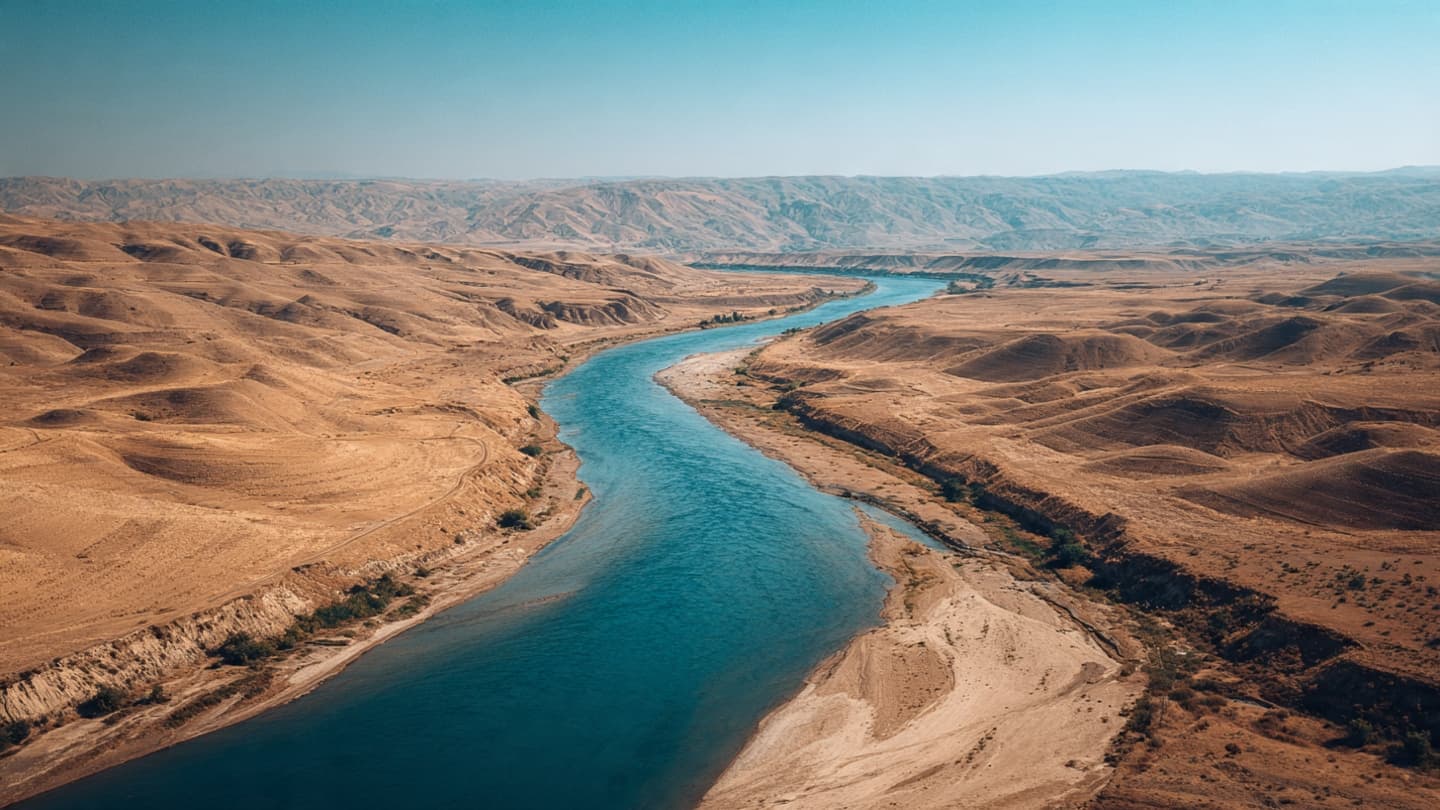
Rivers have always carried more than water. They transport memory, shape civilizations, and quietly record the geological history of Earth itself. Few waterways embody this legacy more profoundly than the Euphrates River, a lifeline that has flowed through human history for thousands of years.
A recent scientific study has shed new light on the ancient origins of the Euphrates River, offering researchers a deeper understanding of how one of the world's most historically significant rivers evolved over millions of years. The findings provide fresh insights into the geological processes that shaped the landscape of the Middle East.
The Euphrates River has long occupied a central place in the story of human civilization. Along with the Tigris River, it sustained the rise of ancient Mesopotamian societies, often described as among humanity's earliest urban cultures.
Using advanced geological analysis, sediment studies, and landscape reconstruction techniques, researchers traced the river's development through different geological periods. The evidence suggests that tectonic activity and long-term climatic shifts played major roles in determining the river's present course.
Scientists explained that understanding the river's ancient formation can help reconstruct environmental conditions that existed millions of years ago. Such knowledge contributes to broader research into Earth's climatic and tectonic history.
The study also highlights the dynamic nature of river systems. Although rivers often appear permanent on human timescales, they can change dramatically over geological eras due to earthquakes, shifting landforms, and climate fluctuations.
Researchers believe that improved knowledge of ancient waterways may also assist archaeologists investigating early human settlements throughout Mesopotamia. River movements frequently influenced where ancient communities established agriculture and trade networks.
Beyond its historical significance, the Euphrates remains an essential source of water for millions of people across modern-day Turkey, Syria, and Iraq. Consequently, understanding its long-term evolution continues to hold practical importance.
The findings underscore how Earth's landscapes remain living archives, preserving stories that connect geological processes with the emergence of civilization itself.
AI Image Disclaimer: The images accompanying this article were generated using artificial intelligence for illustrative and editorial purposes.
Sources Verification Check: Reuters, Nature, Geological Society of America, Science News
Published by Banx Network. This article is part of the Banx decentralized media programme, powered by the BXE token on the XRP Ledger.