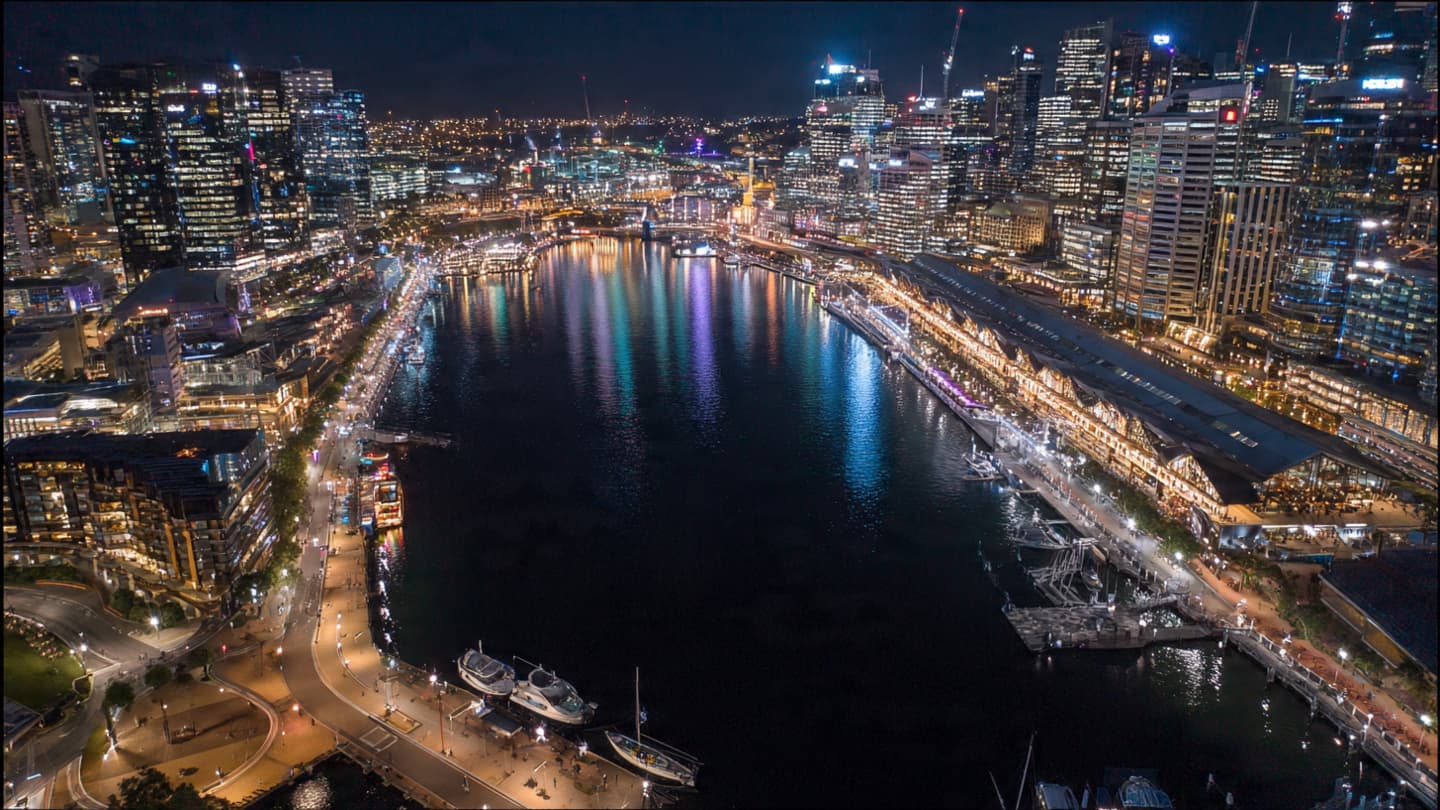
On certain nights, cities do not simply light up—they breathe differently. Sydney, in the season of its annual Vivid festival, usually turns its harbor into a moving canvas where architecture, water, and light dissolve into one another. But on one of those nights, when expectation hung as densely as mist above Darling Harbour, the sky did something unexpected: it faltered.
What was meant to be a coordinated choreography of light—tens of synchronized drones tracing luminous patterns above the water—was interrupted when dozens of them descended unexpectedly into the harbor. Around 83 drones, part of a planned aerial display, reportedly fell into Darling Harbour, prompting an immediate suspension of scheduled shows. The glow that had been meant to dance above the city instead dissolved into concern, and the festival’s rhythm paused mid-breath.
The Vivid Sydney program, known for transforming the city into a living gallery of projection, sound, and engineered light, has long depended on precision. Each drone, a small point of controlled illumination, is part of a larger language spoken in patterns across the sky. But in moments like this, even the most carefully composed systems reveal their fragility. The performance did not simply stop; it unraveled in real time, as technicians and organizers moved quickly to ground remaining operations and assess what had gone wrong.
Around the harbor, the atmosphere shifted in subtle ways. Where there had been anticipation, there was now a quieter kind of attention—people looking not upward for spectacle, but across the water for explanation. The city’s reflective surfaces, usually painted with color and motion, returned briefly to their older self: steel, tide, and night.
Officials moved to cancel subsequent shows as investigations began into the cause of the malfunction. Safety protocols, usually invisible to the public eye, suddenly became the center of the evening’s narrative. The drones themselves—lightweight machines designed to behave like coordinated constellations—had instead become a reminder that even engineered skies depend on delicate balances of software, weather, and timing.
Yet beyond the technical questions, there remained the texture of the moment itself. A festival built on wonder had encountered interruption, and in that interruption, a different kind of stillness emerged. The harbor did not lose its beauty, but it shifted its expression. Light did not disappear; it simply returned to its sources—streetlamps, reflections, the slow pulse of passing boats.
As the night settled further, the cancellation of remaining shows became more than a logistical decision. It marked a pause in a carefully constructed celebration of urban imagination. Investigations were expected to continue into the drone incident, while organizers reassured that safety remained the priority and future performances would be reviewed before resuming.
In the broader arc of the festival, this moment may remain a brief rupture rather than a defining break. Yet it lingers in memory in a particular way: not as spectacle, but as its suspension. A reminder that even in cities most fluent in light, there are nights when silence speaks more clearly than illumination.
AI Image Disclaimer Visuals are AI-generated and intended as conceptual representations.
Sources ABC News Australia, Reuters, The Sydney Morning Herald, BBC News, The Guardian
Published by Banx Network. This article is part of the Banx decentralized media programme, powered by the BXE token on the XRP Ledger.