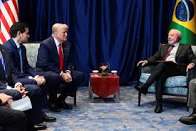
the United States government initiated discussions to label Brazilian drug gangs as terrorist organizations, a proposal significantly influenced by the Bolsonaro political network. The Trump administration's deliberation on this issue highlights rising concerns regarding security in Brazil, a topic of increasing importance to Brazilian voters.
The proposed designation would classify the PCC and CV—two of Brazil's largest criminal organizations—as threats to international stability, thus allowing the U.S. to impose financial restrictions on these groups under counterterrorism laws. Despite their extensive involvement in drug trafficking, their operations primarily target regions outside the U.S., primarily focusing on cocaine distribution to Europe.
Marco Rubio, the U.S. Secretary of State, has actively promoted this designation, asserting that such groups pose significant risks through violent crime and drug trafficking. However, Brazil's Foreign Minister Mauro Vieira has rejected any attempts to classify these organizations as terrorist groups, emphasizing that domestic criminal designations should remain under Brazil's jurisdiction.
Influencing this push is Flávio Bolsonaro, son of former President Jair Bolsonaro, who views such designations as beneficial for his political platform in the upcoming elections. This situation raises concerns about foreign interference in Brazilian electoral processes, particularly given the heightened political tensions since Jair Bolsonaro's imprisonment following his loss to Luiz Inácio Lula da Silva in 2022.
The potential ramifications of this designation are significant. It may empower Brazil's right-wing policies, particularly concerning law enforcement tactics that critics argue could further militarize approaches to crime, exacerbating issues of social inequality. Human rights advocates warn that labeling these gangs as terrorist organizations could lead to increased surveillance and unilateral state powers, undermining civil liberties.
Opponents to the proposal stress the importance of addressing the root causes of gang proliferation, including poverty and systemic inequality, rather than escalating punitive measures. The discourse around the U.S. designation reflects broader debates over the balance between security measures and community well-being, casting shadows over Brazil's political stability as the country approaches the 2026 elections.
In summary, the unfolding situation between the U.S. and Brazil underscores the complex interplay between international security strategies and domestic political landscapes while highlighting the intricate issues surrounding crime, governance, and human rights.
Published by Banx Network. This article is part of the Banx decentralized media programme, powered by the BXE token on the XRP Ledger.