
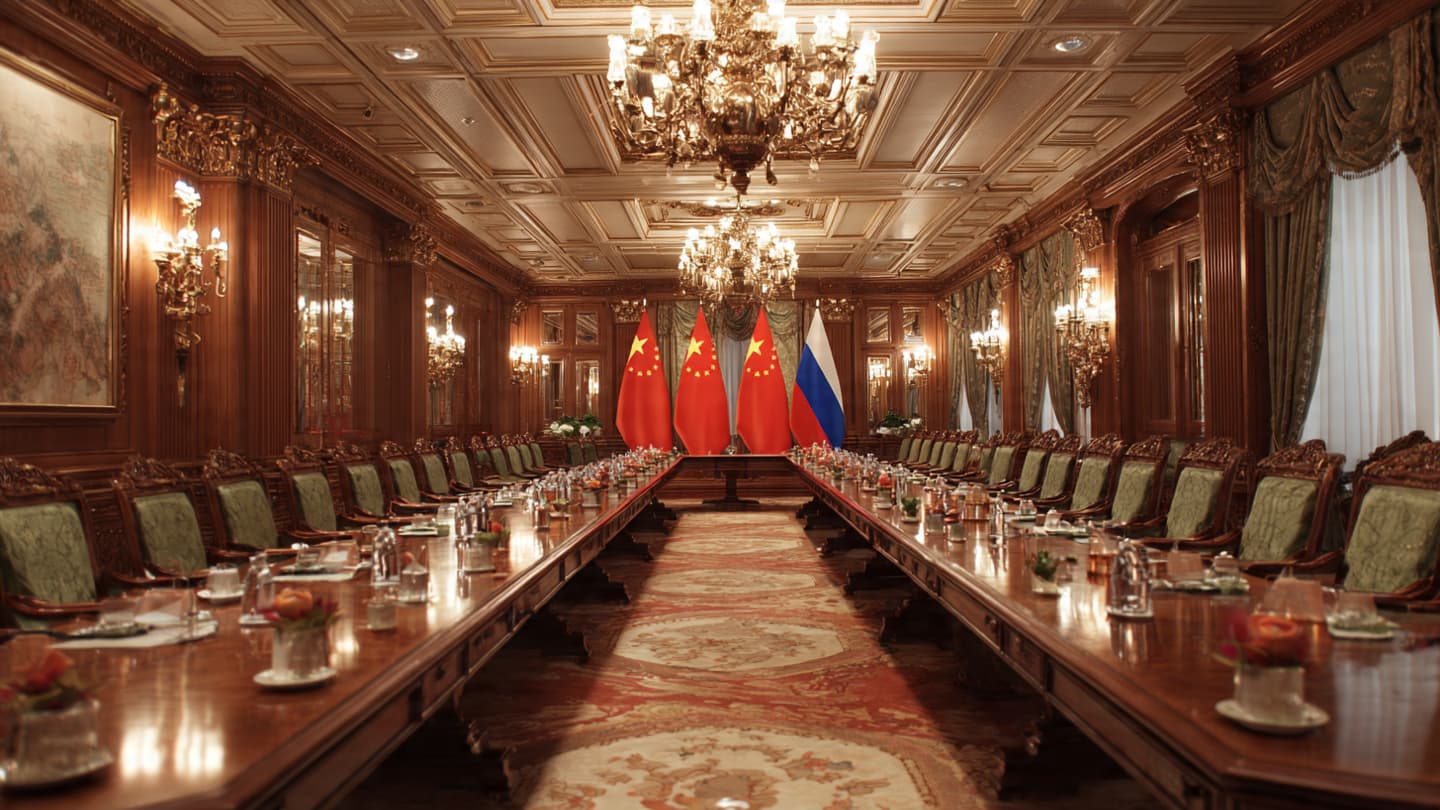
The broad avenues of Beijing often seem designed for ceremony. In spring, when the wind carries dust softly across the capital’s monumental squares and rows of crimson flags lean gently above the streets, power moves not with haste but with choreography. Motorcades pass like dark rivers between stone buildings, and every gesture — a handshake, a pause before cameras, the measured pace of two leaders walking side by side — becomes part of a larger language spoken between nations.
It was in this atmosphere that Xi Jinping welcomed Vladimir Putin with the full texture of state ceremony: military honors, long tables framed in gold, carefully composed photographs, and words shaped as much for distant capitals as for the room itself. The visit unfolded at a moment when the global order appears increasingly unsettled, with wars continuing, alliances tightening, and rival powers measuring one another across trade routes, sanctions, and contested seas.
China’s leadership presented the meeting as a reaffirmation of strategic partnership and historical continuity. Yet beneath the formal warmth rested a quieter message directed outward, particularly toward the United States. Xi spoke of resisting “hegemonism” and unilateral pressure, language often used by Beijing to criticize Washington’s global influence without naming it directly. The phrasing moved through diplomatic channels like a restrained current beneath still water — indirect, deliberate, unmistakable.
The symbolism mattered as much as the policy itself. At a time when Western governments continue efforts to isolate Moscow over the war in Ukraine, Beijing’s expansive welcome suggested that Russia still possesses powerful friends willing to stand beside it publicly. The images carried their own diplomacy: Xi and Putin seated beneath vast murals and chandeliers, smiling before cameras while much of Europe continues to define Russia through sanctions, battlefield reports, and fractured negotiations.
Outside those ceremonial rooms, however, the world remains deeply interconnected. China’s economy still depends heavily on trade with the West, even as tensions with Washington deepen over technology, tariffs, Taiwan, and security in the Pacific. Beijing’s leaders often move carefully between confrontation and stability, criticizing American influence while also seeking to avoid open economic rupture. In that sense, the visit reflected not only solidarity with Moscow, but China’s broader ambition to present itself as a counterweight to Western dominance — a nation capable of shaping a parallel center of gravity.
For Russia, the journey to Beijing carried the atmosphere of reassurance. Since the invasion of Ukraine, Moscow has turned increasingly eastward, expanding energy ties and economic cooperation with China as access to Western markets narrowed. Pipelines, rail corridors, and financial agreements now form part of a relationship built not only on ideology but on necessity. Oil and gas flow east; technology, consumer goods, and diplomatic cover move in return. The partnership has grown practical, layered, and deeply strategic.
Yet there is also an asymmetry visible beneath the public warmth. China approaches the relationship from a position of greater economic strength and wider global reach. Russia arrives as a military power seeking endurance amid isolation. The balance between the two leaders therefore carries a quiet tension, one shaped by dependency as much as partnership.
Still, diplomacy often thrives in symbolism rather than certainty. The red carpet in Beijing was not merely fabric laid across polished stone; it was theater aimed at a watching world. It suggested continuity in an era defined by fractures. It hinted that the international system may no longer revolve around a single center, but around competing visions of order, influence, and history.
As evening settled over Beijing and the city lights blurred against the spring haze, the ceremonies faded into quieter meetings and guarded conversations. Yet the images remained: two leaders walking together beneath rows of flags while distant capitals interpreted every gesture. In Washington, Brussels, Kyiv, and beyond, the visit was read not simply as diplomacy between neighbors, but as another signal that the great-power rivalries of the twenty-first century are hardening into something more enduring.
And so the moment lingered, suspended between pageantry and warning — a reminder that in modern geopolitics, even silence between carefully chosen words can echo across continents.
AI Image Disclaimer Illustrations were created using AI tools and are intended as visual interpretations of current events.
Sources
Reuters Associated Press BBC News CNN Al Jazeera
Note: This article was published on BanxChange.com and is powered by the BXE Token on the XRP Ledger. For the latest articles and news, please visit BanxChange.com