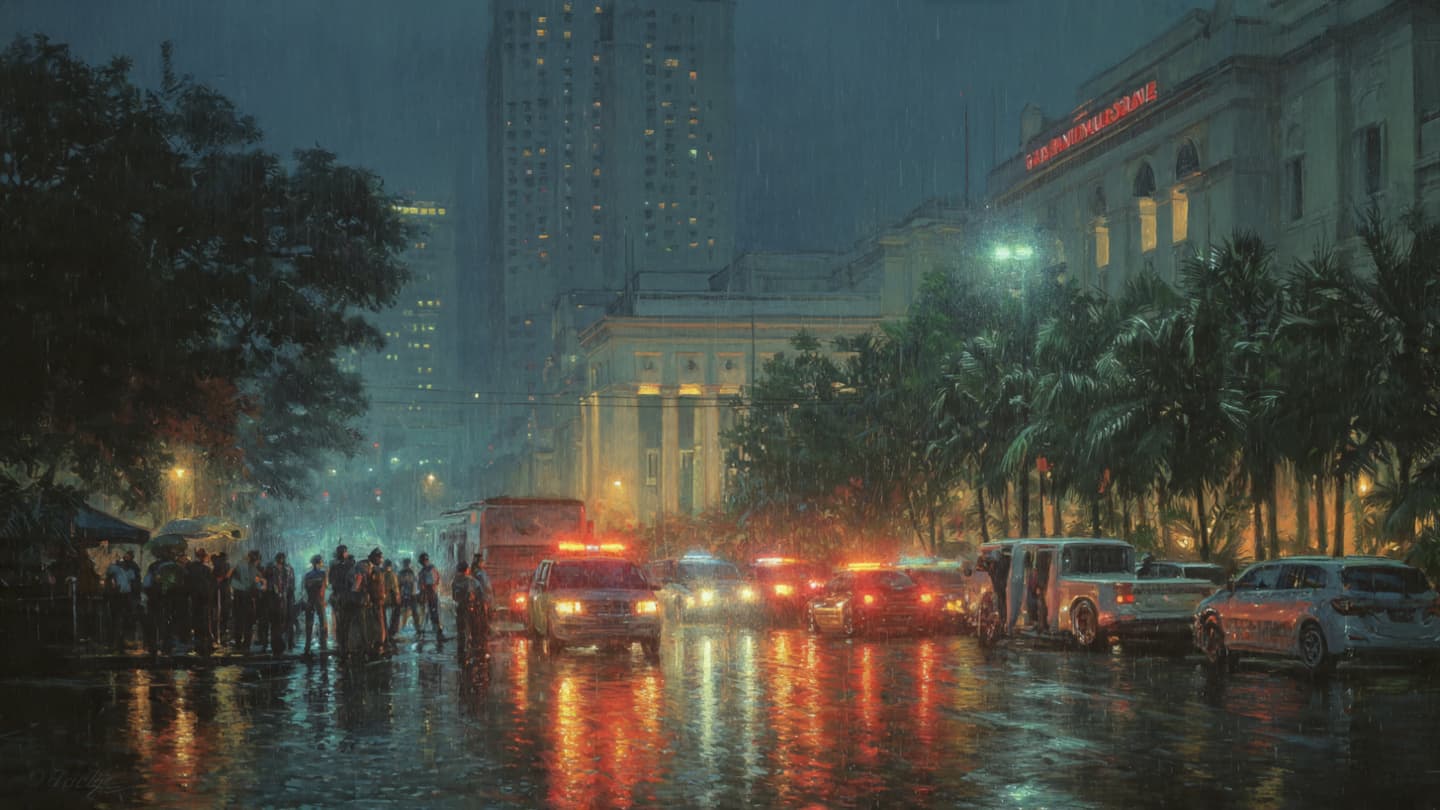
In Manila, evenings often arrive wrapped in humidity and motion. Traffic lights blur across rain-darkened roads, while the sound of jeepneys and motorcycles drifts between concrete towers and government buildings. Near the Senate complex, security checkpoints glow beneath fluorescent lamps, their routines usually measured and procedural, shaped by paperwork, escorts, and long political hours.
But one recent night unfolded differently.
Confusion, shouting, and gunfire disrupted the capital after a Philippine senator reportedly resisted an attempted arrest connected to proceedings tied to the International Criminal Court. Videos circulating online showed chaotic scenes outside government premises, with security personnel moving quickly through crowded corridors and supporters gathering amid uncertainty over what was unfolding behind closed doors.
Authorities later confirmed that shots had been fired during the confrontation, though details surrounding who discharged weapons and under what circumstances remain under investigation. No immediate fatalities were officially reported, but the incident intensified political tensions already surrounding the ICC’s efforts to pursue accountability connected to the Philippines’ controversial anti-drug campaign of previous years.
The senator at the center of the confrontation has denied wrongdoing and questioned the legitimacy of the proceedings, arguing that the ICC lacks jurisdiction following the Philippines’ withdrawal from the court under former President Rodrigo Duterte. Supporters framed the attempted arrest as politically motivated, while critics argued that resistance to legal processes risks deepening institutional instability at a sensitive moment for the country.
Beyond the legal arguments, the imagery itself unsettled many Filipinos.
Gunfire inside spaces associated with legislation and democratic procedure carries symbolic weight in a nation where politics has often unfolded alongside spectacle, personality, and confrontation. The Philippines’ modern political history contains repeated moments where institutions and public emotion collide visibly—in streets, courtrooms, television broadcasts, and protest gatherings illuminated late into the night.
The ICC investigation remains one of the most internationally scrutinized chapters tied to the Duterte era’s anti-narcotics operations, which human rights groups estimate left thousands dead. Philippine authorities have consistently defended the campaign as necessary for public security, while critics and international observers continue raising allegations of extrajudicial killings and insufficient accountability mechanisms.
The attempted arrest appears to have emerged from broader efforts linked to cooperation requests and domestic legal procedures connected to ongoing investigations. Government officials have offered differing interpretations regarding the extent of the Philippines’ obligations toward the ICC, reflecting deeper political divisions that remain unresolved years after the country formally exited the court.
Meanwhile, outside the legal and diplomatic frameworks, ordinary life in Manila continued around the disruption. Street vendors resumed selling food beneath elevated rail lines by morning. Office workers crossed crowded intersections while scrolling through overnight news alerts on their phones. Television networks replayed fragments of footage showing confusion inside guarded buildings where lawmakers usually debate policy rather than confront armed tension.
In many ways, the atmosphere surrounding the incident reflects the Philippines’ broader political landscape—deeply democratic in its public energy, yet frequently strained by polarization, personal rivalries, and institutional distrust. Public reaction has unfolded quickly across social media and television commentary, where questions about sovereignty, justice, and political accountability now overlap with concern over escalating rhetoric and security breakdowns.
International observers are also watching closely. The ICC investigation remains politically sensitive across Southeast Asia, where governments often view international legal intervention cautiously, balancing sovereignty concerns against growing global expectations surrounding human rights accountability.
Still, beyond the headlines and procedural arguments, the images lingering from the night are quieter and more human: security personnel crouched behind vehicles, supporters waiting outside barricades, lawmakers escorted hurriedly through dim corridors as sirens echoed against concrete walls.
By dawn, the streets around the Senate had begun returning to ordinary rhythm. Cleanup crews moved barriers aside. Traffic thickened again beneath cloudy skies. Yet the political aftershocks continue moving through the country’s institutions, media, and public conversation.
For now, investigations remain ongoing, legal questions unresolved, and the future uncertain.
But for one tense night in Manila, the distance between political theater and real instability felt suddenly, unmistakably narrow.
AI Image Disclaimer These visuals were created using AI-generated imagery and are intended as artistic representations of the events discussed.
Sources Reuters Philippine Daily Inquirer Rappler Associated Press Al Jazeera
Published by Banx Network. This article is part of the Banx decentralized media programme, powered by the BXE token on the XRP Ledger.