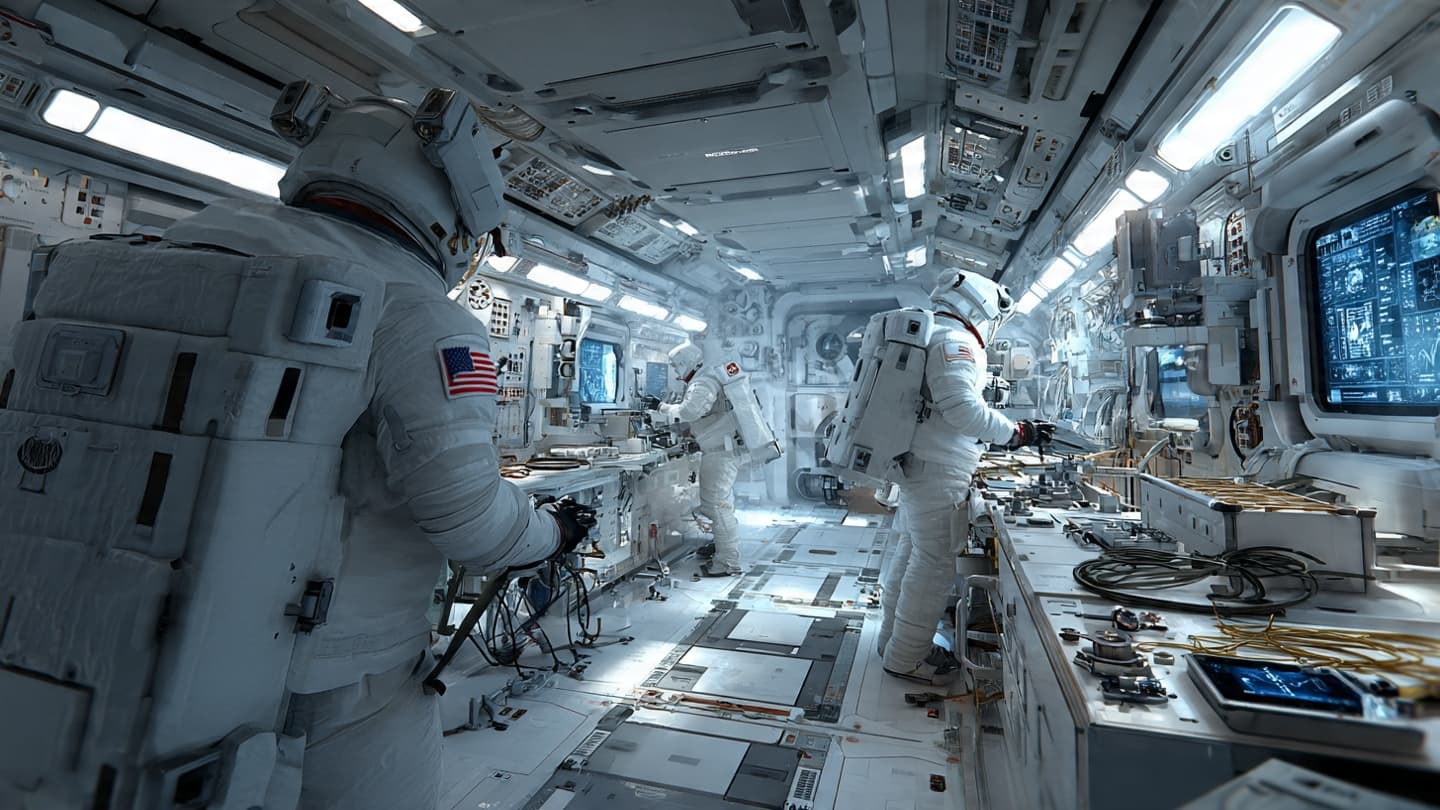
Far above Earth, where gravity loosens its familiar grip, laboratories aboard the International Space Station continue to explore questions that have intrigued scientists for generations. In this quiet environment orbiting the planet, researchers are uncovering behaviors of matter that are difficult—sometimes impossible—to observe on Earth.
NASA scientists working with the Cold Atom Laboratory aboard the International Space Station have successfully produced and studied an unusual quantum state of matter under microgravity conditions. The achievement offers researchers a rare opportunity to examine fundamental physical processes with unprecedented precision.
The Cold Atom Laboratory, installed on the ISS in 2018, cools atoms to temperatures only fractions of a degree above absolute zero. At such extremely low temperatures, atoms begin to display collective quantum behaviors that differ significantly from ordinary matter.
Researchers explained that microgravity aboard the station allows ultracold atom experiments to continue for longer periods than would be possible on Earth. Without the constant pull of gravity, scientists can observe quantum interactions in greater detail and with fewer disturbances.
The newly studied quantum state may contribute to a deeper understanding of phenomena such as superfluidity, quantum mechanics, and the fundamental forces governing matter. Scientists believe these experiments could eventually improve precision technologies used on Earth.
Beyond theoretical physics, research involving ultracold atoms has practical implications. Quantum studies may support advances in navigation systems, highly accurate clocks, gravitational measurements, and future space exploration technologies.
NASA officials emphasized that the International Space Station continues to serve as an important scientific platform, enabling experiments that take advantage of the unique conditions found in orbit.
As humanity expands its scientific presence in space, discoveries emerging from laboratories aboard the ISS continue to demonstrate how exploration beyond Earth can illuminate some of nature's most profound mysteries.
AI-generated image disclaimer: The images accompanying this article were generated using artificial intelligence to illustrate scientific concepts and are not actual mission photographs.
Source Verification Check: NASA, ScienceDaily, Nature, Phys.org
Published by Banx Network. This article is part of the Banx decentralized media programme, powered by the BXE token on the XRP Ledger.