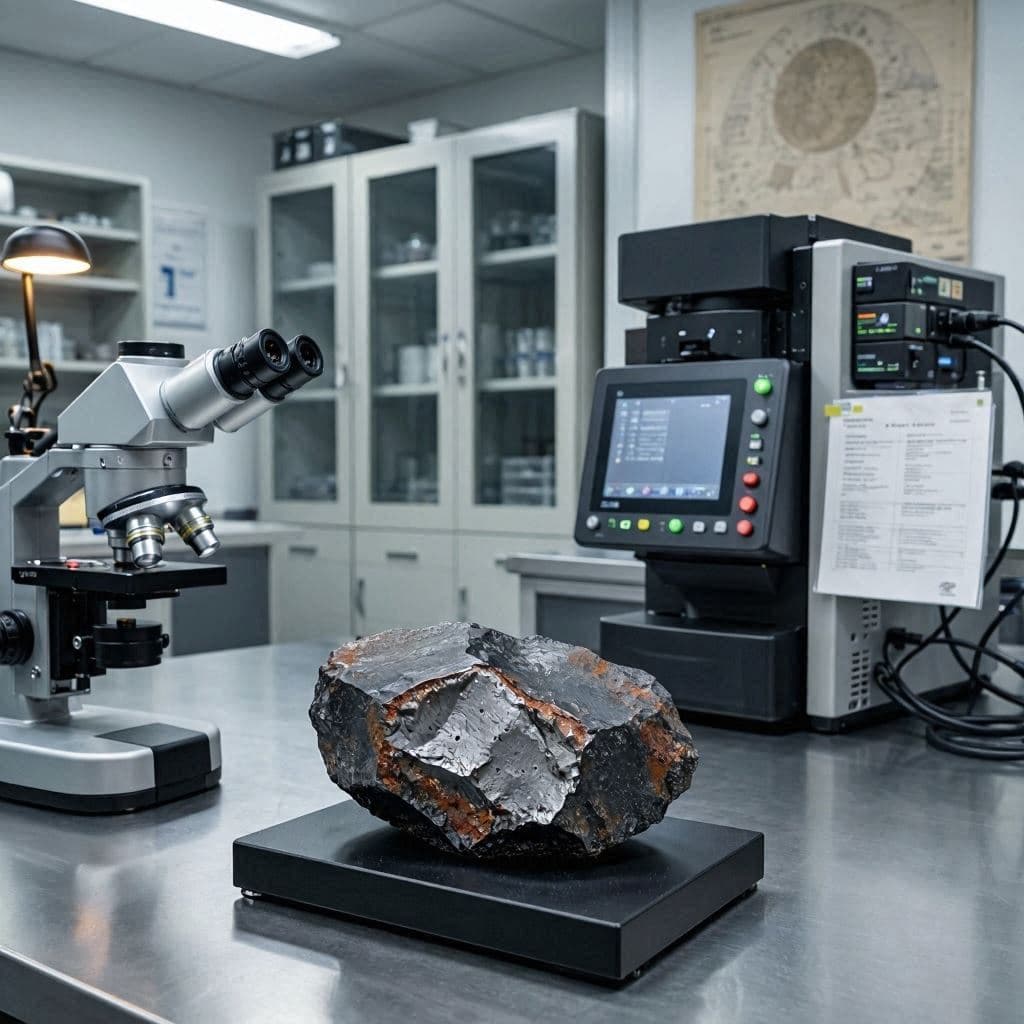
Some discoveries arrive after years of careful planning, while others appear without warning. On a quiet summer day in New Jersey, a meteorite crashed through the roof of a home, leaving behind more than a damaged ceiling. Two years later, scientists say the rare space rock has become an extraordinary scientific record, preserving chemical compounds that may help explain how the building blocks of life were distributed across the early solar system.
The meteorite, now known as Hillsborough, entered Earth's atmosphere on July 16, 2024, producing a bright daytime fireball and a sonic boom heard across parts of New York and New Jersey. A fragment weighing more than two pounds crashed through the roof of a home in Hillsborough Township before landing inside a bedroom. The homeowner quickly collected the fragments using gloves and sealed them in clean containers, helping preserve the specimen in remarkably pristine condition.
Researchers from the SETI Institute, NASA's Ames Research Center, and several international institutions recently published an analysis in the journal Science Advances. Their study found that the meteorite contains a diverse collection of extraterrestrial amino acids and other organic compounds, along with evidence of ancient salty fluids that once circulated inside its parent asteroid. These findings suggest the meteorite experienced chemical processes previously unknown for this class of primitive asteroid.
Amino acids are among the fundamental building blocks of proteins, making their presence in meteorites especially significant for scientists studying the origin of life. Researchers emphasized that the discovery does not indicate evidence of extraterrestrial life itself. Instead, it supports the idea that asteroids may have delivered important prebiotic molecules to the early Earth billions of years ago, contributing to the chemical ingredients necessary for life to emerge.
Scientists also identified complex magnesium-bearing organic compounds and mineral signatures indicating that concentrated briny water once altered the meteorite's parent body. Such chemical interactions may have encouraged the formation and preservation of organic molecules long before the meteorite eventually broke away and traveled through space toward Earth.
The Hillsborough meteorite belongs to the rare CM1/2 carbonaceous chondrite group, among the most chemically primitive materials available for scientific study. Because the fragments were recovered almost immediately after impact, researchers were able to examine delicate compounds that are often lost when meteorites remain exposed to rain, soil, or human contamination for extended periods.
The findings also complement NASA's broader efforts to understand the history of water and organic chemistry throughout the solar system. By comparing meteorites such as Hillsborough with samples returned from asteroid missions, researchers hope to build a clearer picture of how primitive asteroids evolved and transported life's chemical ingredients across planetary bodies.
Although the meteorite's arrival was unexpected, its scientific value continues to grow. Researchers say Hillsborough provides one of the clearest opportunities yet to study ancient asteroid chemistry in an exceptionally well-preserved sample, offering fresh insight into questions that have fascinated scientists for generations about the origins of our solar system and the ingredients that eventually made life possible on Earth.
AI Image Disclaimer: The accompanying illustrations were generated using artificial intelligence to visually represent the scientific findings described in this article and are not authentic photographs of the research.
Sources (verified):
NASA SETI Institute Science Advances Popular Science The Independent
Published by Banx Network. This article is part of the Banx decentralized media programme, powered by the BXE token on the XRP Ledger.