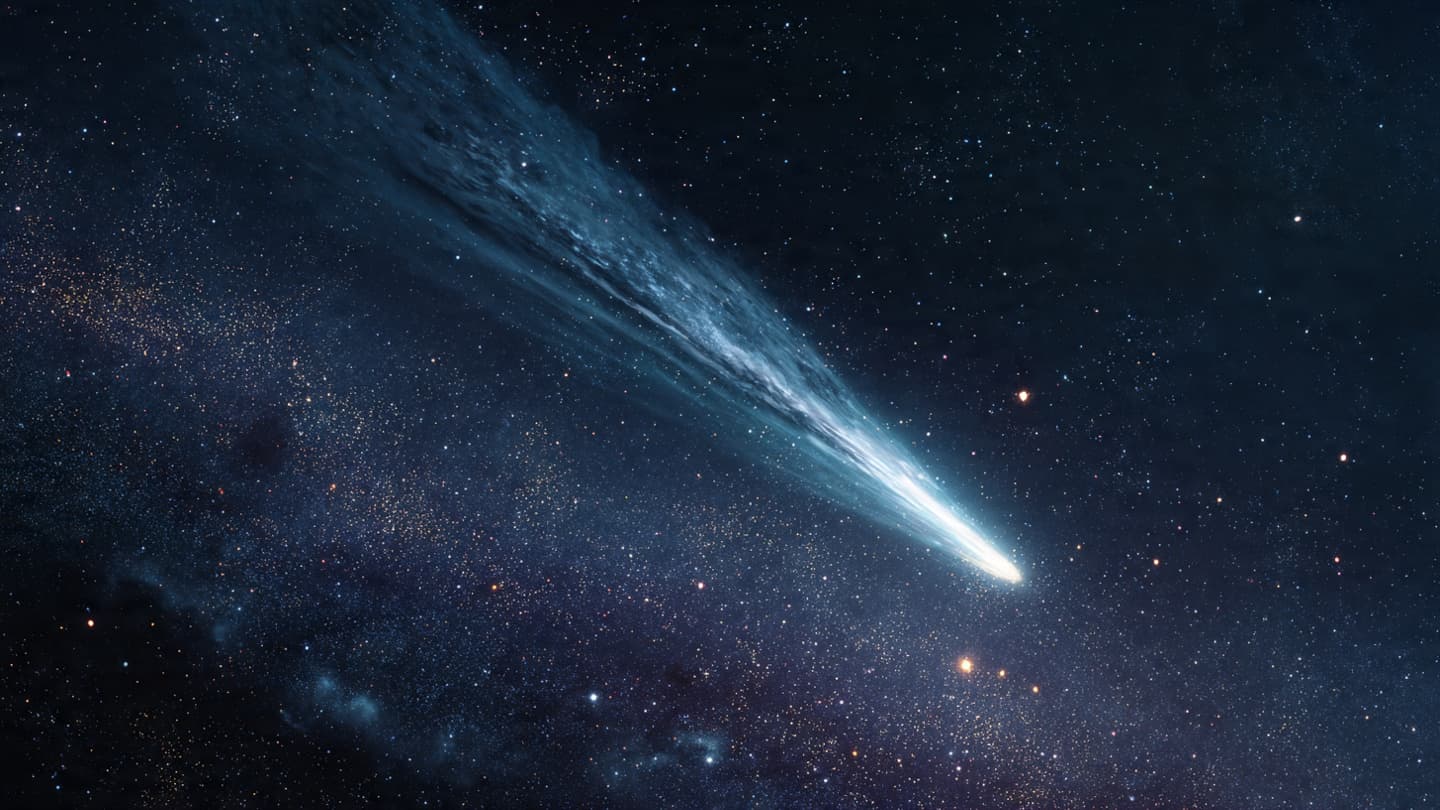
Far beyond Earth’s atmosphere, comets travel through space like frozen archives of cosmic history. Some belong to our solar system, circling the Sun over immense stretches of time. Others arrive from far more distant regions of the galaxy. One such object, known as 3I/ATLAS, is now attracting scientific attention after researchers identified unusual water chemistry unlike anything previously observed nearby.
Astronomers studying the comet say early observations suggest the presence of rare molecular characteristics within its water composition. The findings may offer valuable insight into how planetary systems form beyond our own solar neighborhood, as well as how water behaves under different cosmic environments.
The object is classified as an interstellar comet, meaning it likely originated outside the solar system before passing through it. Such visitors remain exceptionally rare. Only a small number have ever been detected, making each one an important opportunity for scientists seeking to understand the broader structure of the galaxy.
Researchers used advanced telescopes and spectroscopic analysis to study the comet’s chemical signature as it traveled through space. By examining how light interacts with gases and ice surrounding the object, scientists can identify specific molecular patterns that reveal details about composition and origin.
The unusual water chemistry identified in 3I/ATLAS may indicate that conditions in distant star systems differ more dramatically than previously understood. Some experts believe the discovery could eventually improve understanding of how water — a fundamental ingredient for life on Earth — forms and evolves across the universe.
Scientists caution, however, that research remains ongoing. Additional observations and peer-reviewed studies will be needed before broader conclusions can be confirmed. Space research often progresses carefully, especially when dealing with rare objects that provide only brief observation windows.
The discovery has nonetheless generated excitement within the astronomy community. Interstellar objects offer rare opportunities to study material formed around other stars without leaving our solar system. In many ways, researchers describe them as natural messengers carrying chemical information across immense cosmic distances.
Public fascination with deep-space exploration has also continued growing alongside advances in telescope technology. Modern observatories now allow astronomers to detect and analyze distant objects with precision that would have seemed impossible only decades ago. Each new discovery contributes another small piece to humanity’s evolving understanding of the cosmos.
As 3I/ATLAS continues its journey through space, scientists around the world remain focused on gathering as much data as possible. Though the comet may eventually disappear into the darkness beyond observation, the questions it leaves behind could shape astronomical research for years to come.
AI Image Disclaimer: Visual elements included with this article may contain AI-generated scientific illustrations for educational and editorial purposes.
Sources: ScienceDaily, NASA, European Space Agency, Nature Astronomy
Published by Banx Network. This article is part of the Banx decentralized media programme, powered by the BXE token on the XRP Ledger.