Some journeys are measured not in miles, but in generations. In 1977, as audiences lined up to watch Star Wars for the first time, a spacecraft no larger than a compact car quietly began a voyage that would outlast many of the people who sent it skyward. Nearly half a century later, that traveler, Voyager 1, continues its solitary passage through the darkness between the stars.
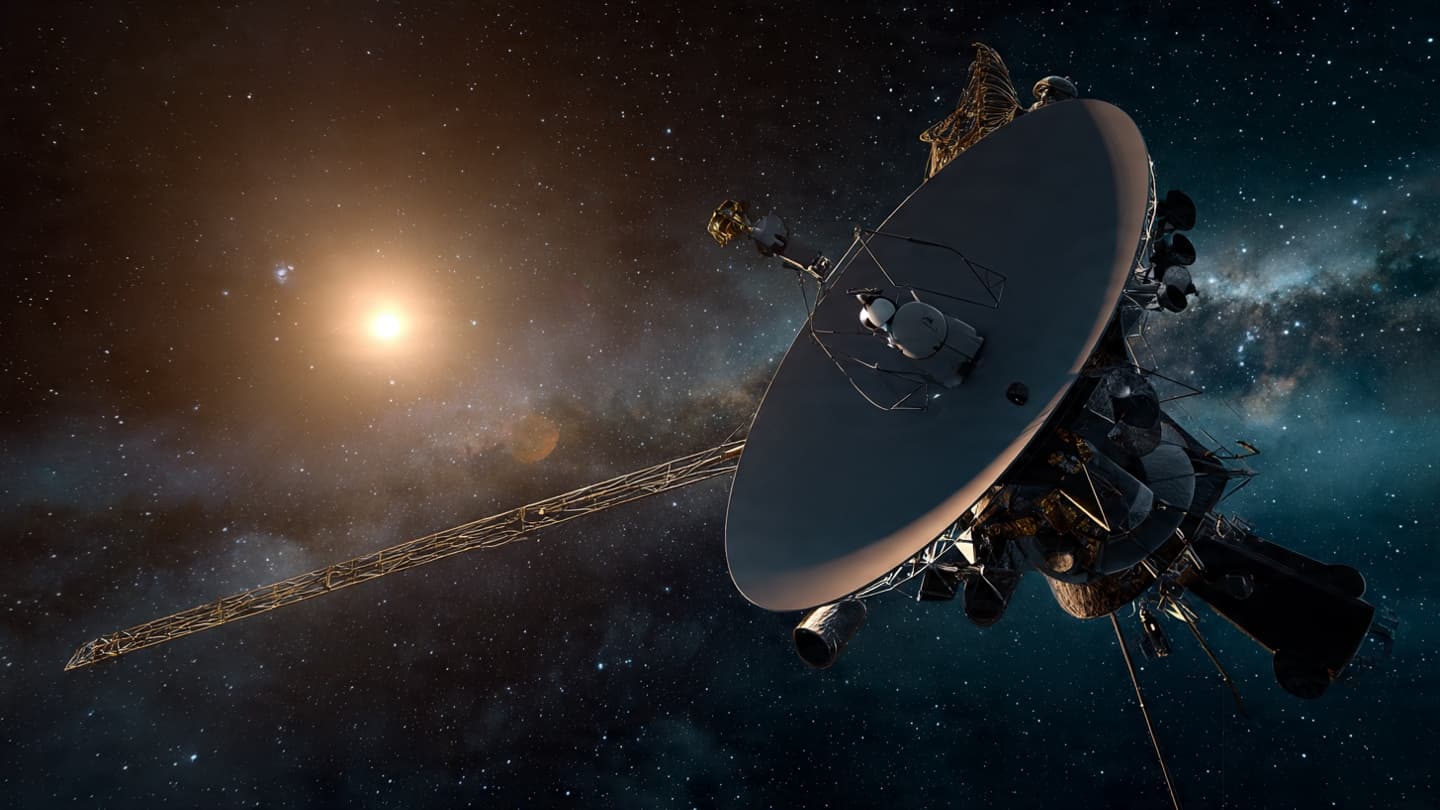
Launched by NASA on September 5, 1977, Voyager 1 was originally intended to explore Jupiter and Saturn during a mission expected to last only a few years. Instead, the spacecraft exceeded every expectation, becoming humanity's most distant human-made object. It crossed into interstellar space in 2012 and continues to transmit scientific data back to Earth.
Voyager 1 is currently traveling at roughly 38,000 miles per hour and is now more than 15 billion miles from Earth. The spacecraft has journeyed far beyond the orbit of Pluto, venturing into a region where the Sun's influence gradually fades into the broader environment of interstellar space.
The enormous distance means radio signals sent at the speed of light now require more than 23 hours to reach the spacecraft. By late 2026, engineers expect that one-way communication delays will extend to approximately 24 hours, meaning a complete exchange between Earth and Voyager will take two full days.
Many of the original engineers and scientists who designed Voyager have since retired or passed away. Yet new generations of mission controllers at NASA's Jet Propulsion Laboratory continue to maintain the spacecraft, preserving one of humanity's longest-running scientific endeavors.
Keeping Voyager operational has required increasingly careful management. As its plutonium power source slowly weakens, engineers have gradually turned off scientific instruments and onboard systems to conserve energy and extend the mission for as long as possible.
Despite its age and limited power, Voyager 1 still provides unique measurements of interstellar particles, magnetic fields, and cosmic radiation—observations impossible to obtain closer to Earth. Scientists regard these data as invaluable for understanding the boundary between our solar system and the wider galaxy.
As Voyager 1 continues outward, it carries not only instruments and circuitry, but also a reminder of human curiosity. In the vast silence of interstellar space, a machine built in the 1970s still whispers home.
AI Image Disclaimer: The images accompanying this article are AI-generated artistic interpretations intended solely for illustration.
Sources (verification check): NASA, ScienceDaily, Britannica, Reuters
Published by Banx Network. This article is part of the Banx decentralized media programme, powered by the BXE token on the XRP Ledger.