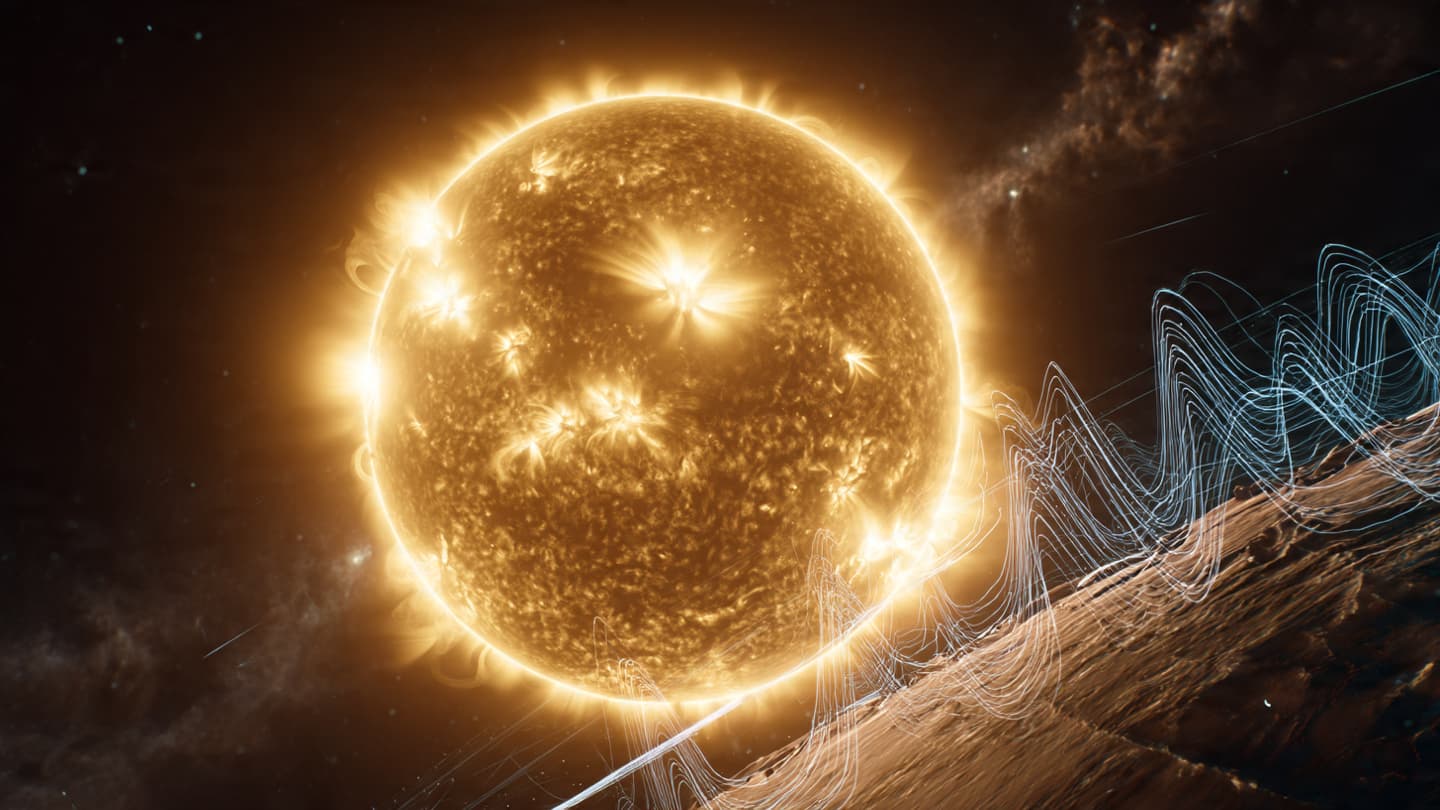
The Sun, so familiar in daylight and yet so difficult to fully understand, continues to remind scientists that even the nearest star carries mysteries hidden beneath its brightness. Recently, astronomers reported that the Sun emitted an unusual radio signal continuously for 19 days, drawing attention from researchers seeking to better understand solar behavior and its effects on Earth.
The signal was detected through radio astronomy observations designed to monitor solar activity. Unlike visible sunlight, radio emissions reveal energetic processes occurring within the Sun’s atmosphere, particularly around magnetic disturbances and plasma movement. Such observations help scientists study conditions that are otherwise difficult to see directly.
Researchers emphasized that unusual radio bursts are not entirely uncommon. The Sun regularly produces flares, storms, and magnetic eruptions capable of generating electromagnetic signals across multiple wavelengths. What attracted particular interest in this case was the signal’s persistence and repeating pattern over an extended period.
According to scientists, the radio emission appeared linked to a long-lasting active region on the Sun’s surface. Active regions are areas where magnetic fields become highly concentrated, sometimes leading to solar flares and coronal mass ejections. The newly observed signal may reflect interactions between magnetic energy and charged particles moving through the solar atmosphere.
Solar radio signals are more than scientific curiosities. They can influence communication systems, satellite operations, and navigation technologies on Earth. Monitoring solar activity has therefore become increasingly important as modern societies depend more heavily on digital infrastructure and space-based systems.
The event also illustrates how solar science has entered a period of expanded observation. Modern radio telescopes and space observatories now allow researchers to monitor the Sun with far greater sensitivity than in previous decades. Small variations in solar behavior that once passed unnoticed can now be studied in detail.
Scientists noted that many questions remain unresolved. While the broad source of the signal appears connected to magnetic activity, researchers continue analyzing why the emission maintained unusual consistency for nearly three weeks. Such investigations may contribute to improved understanding of solar cycles and space weather forecasting.
Beyond its technical significance, the discovery serves as another reminder that the Sun is not a static object but a dynamic and evolving star. Its surface shifts constantly through processes shaped by heat, magnetism, and immense internal forces operating across vast scales.
Astronomers are expected to continue monitoring similar radio emissions in future solar cycles as part of broader international efforts to improve understanding of the Sun’s long-term behavior and its influence throughout the solar system.
AI Image Disclaimer: Certain visual representations included with this article were produced using AI-generated imagery assistance.
Sources: Reuters, SpaceWeather.com, Live Science, Nature
Published by Banx Network. This article is part of the Banx decentralized media programme, powered by the BXE token on the XRP Ledger.