Some discoveries arrive like a sudden flash of light. Others emerge slowly, after decades of patient observation, unanswered questions, and persistent curiosity. Deep within the heart of the Milky Way, astronomers have spent more than half a century searching for evidence of a phenomenon that theory predicted should exist. Now, that long search appears to have reached a remarkable conclusion.
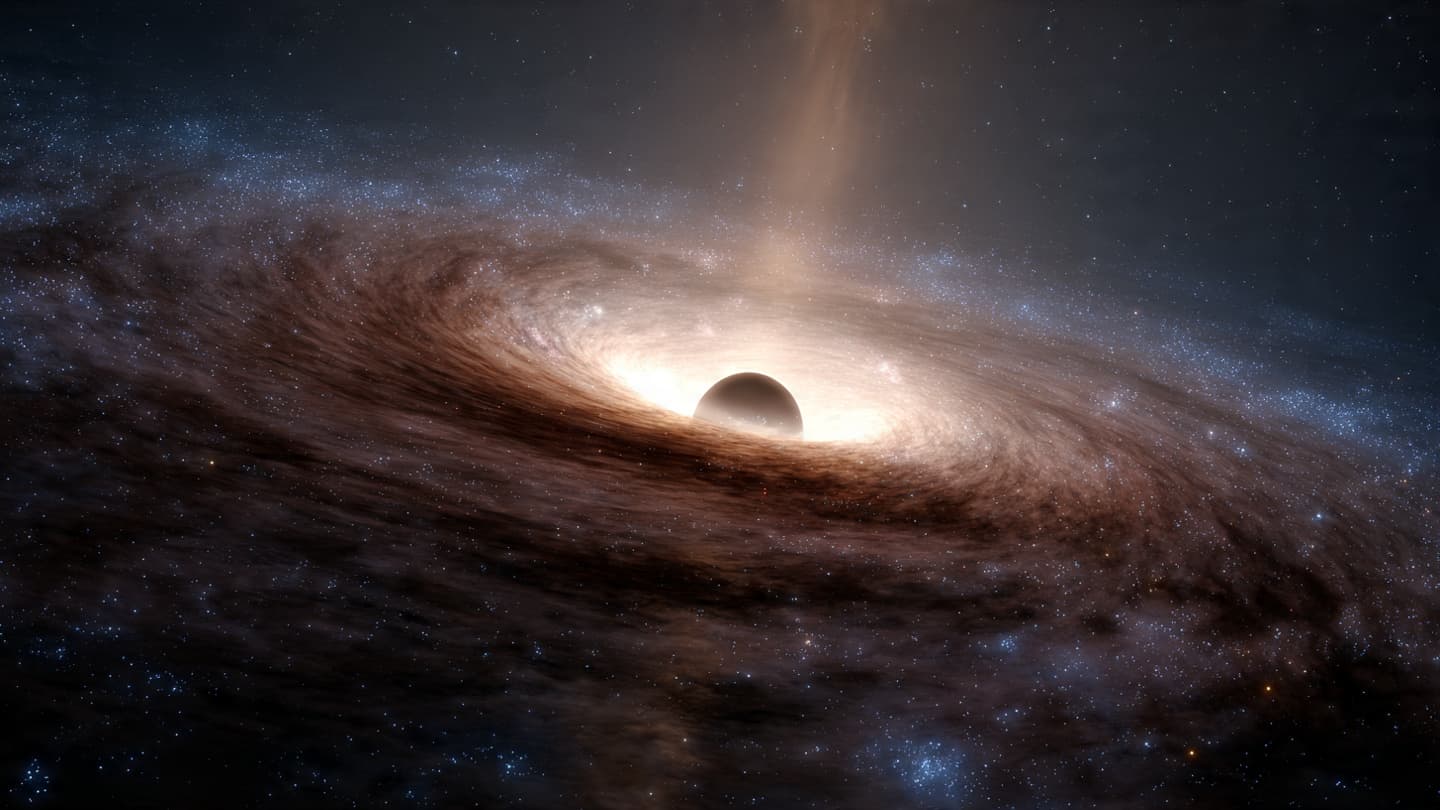
At the center of our galaxy lies the supermassive black hole known as Sagittarius A*. For decades, scientists have understood that active black holes should produce powerful winds or jets as they interact with surrounding matter. Yet despite extensive observations, direct evidence of such a wind around the Milky Way's central black hole remained elusive.
Using years of highly detailed observations from the Atacama Large Millimeter/submillimeter Array (ALMA) in Chile, researchers constructed the most detailed map yet of cold molecular gas surrounding Sagittarius A*. The unprecedented clarity allowed them to identify structures that had previously remained hidden.
Among the most significant findings was a large cone-shaped cavity extending away from the black hole. Scientists determined that the most plausible explanation for this feature is a hot wind powerful enough to push away or heat surrounding cold gas, leaving behind a distinct empty region.
Researchers noted that nearby stars also produce stellar winds, but calculations suggest these would not be sufficient to create a cavity of the observed scale. The energy required points instead to an outflow generated by the black hole itself.
The discovery is important because black-hole winds play a central role in galaxy evolution. They can influence star formation, regulate the movement of gas, and affect the long-term development of entire galactic systems. Understanding these processes in our own galaxy offers a valuable opportunity for comparison with more distant galaxies.
The finding also highlights how advances in observational technology continue to transform astronomy. Features once hidden behind layers of gas, dust, and interference can now be examined with increasing precision, revealing details that previous generations of scientists could only theorize about.
While many mysteries remain surrounding Sagittarius A*, the identification of this long-sought wind represents a significant step forward. It offers a clearer picture of how the Milky Way's central black hole interacts with its surroundings and contributes to the broader dynamics of the galaxy.
After decades of searching, astronomers now have compelling evidence that the Milky Way's black hole is not entirely quiet. Instead, it appears to be breathing a subtle but powerful wind into the surrounding cosmic environment.
AI Image Disclaimer: The images accompanying this article are AI-generated visual representations inspired by scientific observations and research findings.
Sources Verified:
Northwestern University ALMA Observatory The Astrophysical Journal Letters NASA Chandra X-ray Observatory
Published by Banx Network. This article is part of the Banx decentralized media programme, powered by the BXE token on the XRP Ledger.