
For years, mysterious repeating radio signals arriving from deep space have echoed through astronomy like distant footsteps in a darkened hall. They appeared, disappeared, and returned again, inviting speculation while resisting explanation. Now, researchers believe they have finally identified the source of at least one of these enigmatic cosmic messages.
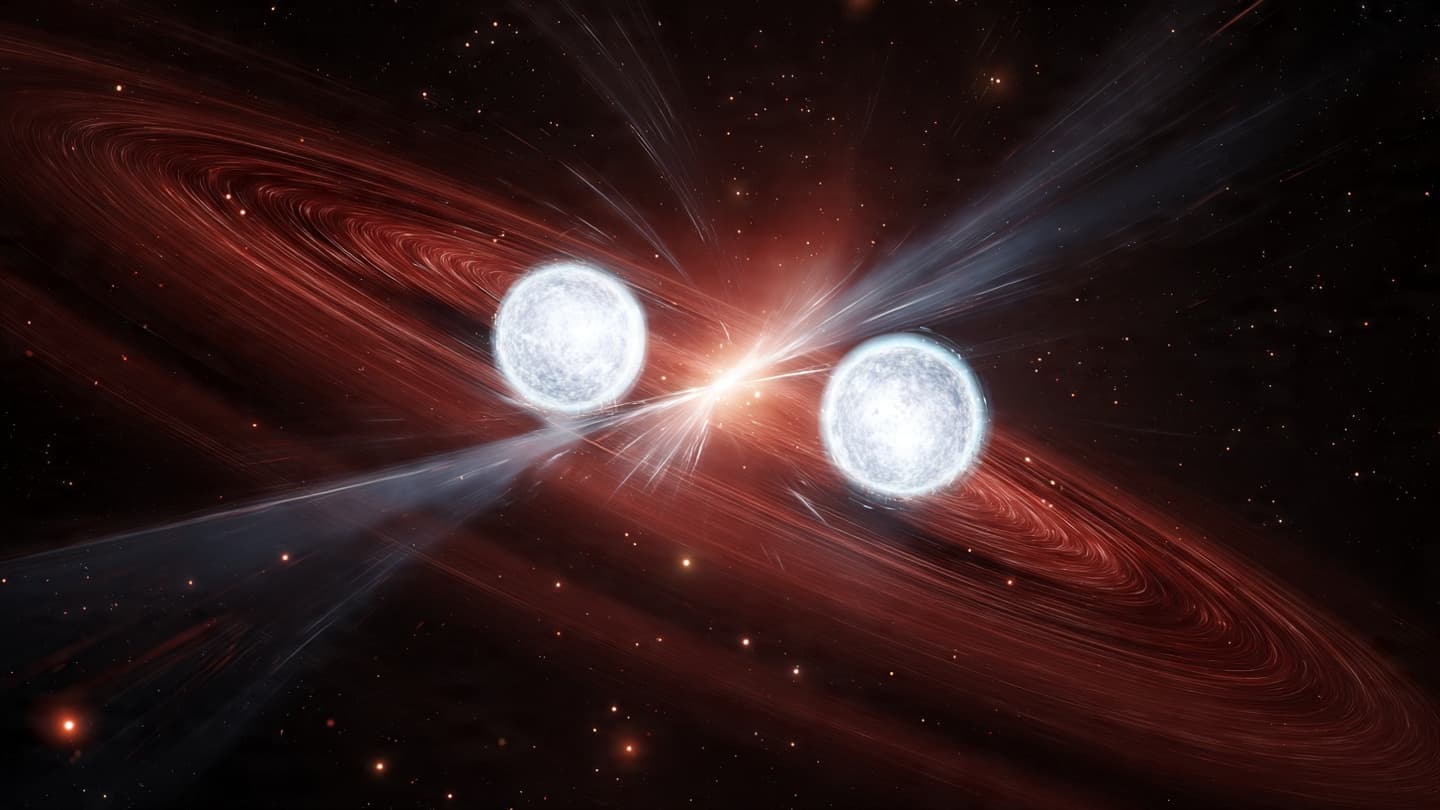
An international team led by researchers from the University of Sydney has traced a long-period repeating radio signal, known as ASKAP J1745-5051, to a binary star system consisting of a highly magnetic white dwarf and a red dwarf companion. The findings provide the clearest explanation yet for a class of phenomena known as long-period radio transients.
Astronomers used observations from the Australian Square Kilometre Array Pathfinder telescope, along with X-ray measurements from China's Einstein Probe mission, to study the unusual object. The combined observations revealed both intense radio bursts and accompanying X-ray emissions.
Researchers concluded that the white dwarf is drawing material from its companion star. Interactions between the stars' magnetic fields appear to generate the repeating bursts detected on Earth. The system completes an orbit approximately every 1.4 hours, matching the timing of the radio pulses.
Long-period radio transients were first identified only a few years ago and have puzzled astronomers because their behavior differs from traditional pulsars and other known radio sources. Before this discovery, some researchers suspected magnetars or other exotic stellar remnants.
Scientists caution that not all repeating radio signals necessarily originate from identical systems. However, the newly identified source offers an important framework for interpreting future observations.
Researchers have described the discovery as a potential "Rosetta Stone" for understanding similar signals elsewhere in the galaxy. Continued observations may determine whether other long-period transients share the same origins.
As telescopes grow increasingly sensitive, the universe continues to reveal that many mysteries are not silent forever. Some simply wait for the right instruments—and enough patience—to be understood.
AI Image Disclaimer: All accompanying visuals are AI-generated interpretations intended for illustrative purposes only.
Sources (verification check): Wired, Nature Astronomy, University of Sydney, Space.com
Published by Banx Network. This article is part of the Banx decentralized media programme, powered by the BXE token on the XRP Ledger.



