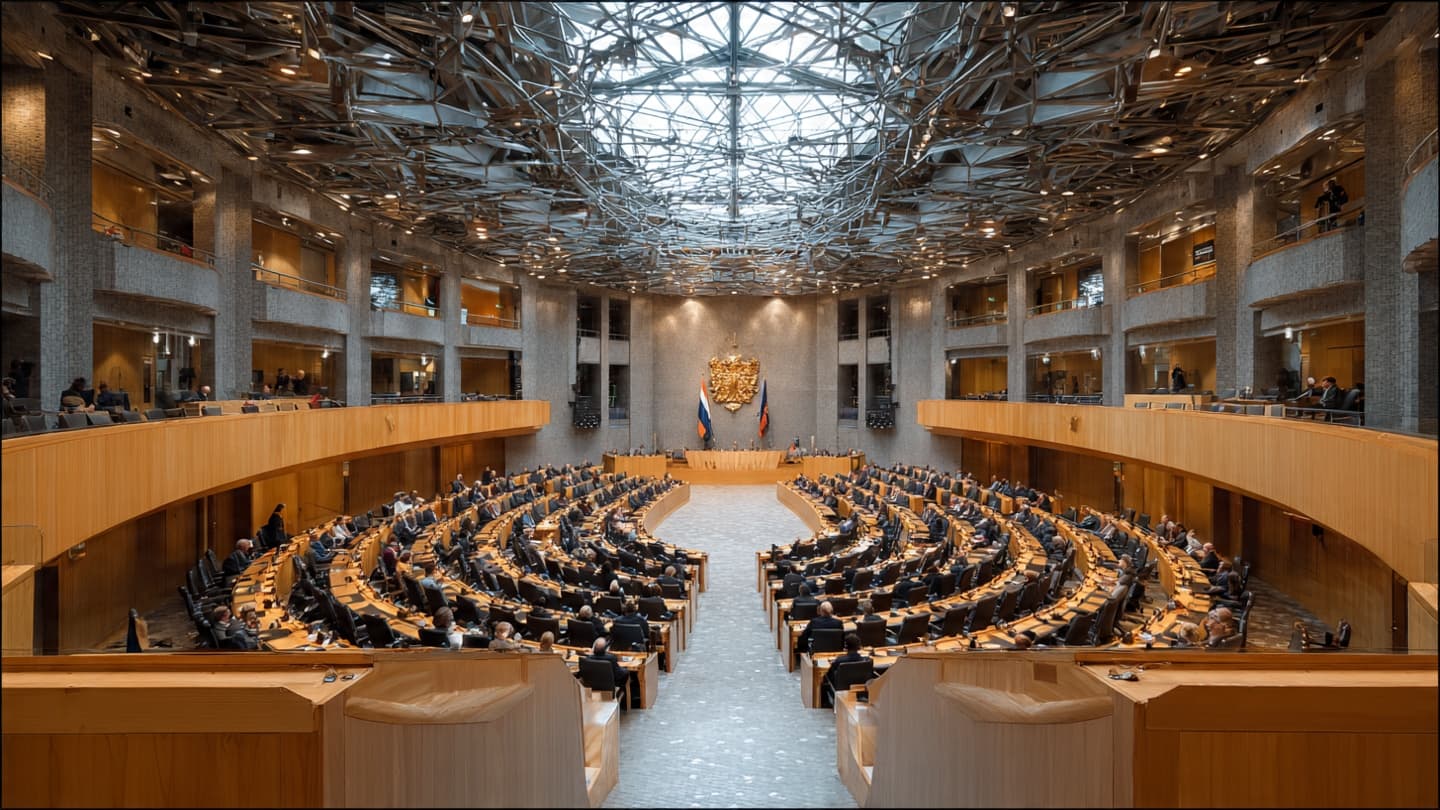
Governance is often imagined as a structure built on stability, yet in practice it can resemble a bridge suspended over shifting ground. In the Netherlands, the formation of a new minority government has placed that image into sharper focus, as political leaders begin navigating a parliamentary environment defined by limited majorities and constant negotiation.
The government’s formation followed a period of extended political discussions, reflecting a landscape where consensus is no longer easily achieved. Instead of broad coalitions, the current arrangement depends on selective support from multiple parties, each carrying its own priorities and constraints.
Within parliament, this structure creates a dynamic where every policy proposal requires careful negotiation. Legislation is not simply passed or rejected; it is adjusted, reshaped, and rebalanced to maintain enough support to move forward. This process slows decision-making but also encourages compromise at nearly every stage.
Supporters of the arrangement argue that minority governance can encourage greater accountability, as no single bloc holds dominant control. Critics, however, point to the risk of instability, where even small shifts in parliamentary support can disrupt policy continuity and delay long-term planning.
Public response has been measured, reflecting both caution and curiosity. Many citizens are familiar with coalition politics, yet a minority government introduces a different level of unpredictability. Questions about housing, infrastructure, and economic planning remain central to public discussion.
Political observers note that this structure places significant responsibility on negotiation skills and institutional flexibility. Rather than relying on fixed majorities, governance becomes an ongoing process of alignment, where dialogue is as important as legislation itself.
Despite the challenges, early indications suggest that institutions remain functional, even under pressure. Parliamentary committees continue their work, and key policy discussions proceed, albeit with greater complexity and slower timelines.
As the Netherlands adapts to this new political configuration, the government operates in a space defined not by certainty, but by continuous adjustment. It is a system that reflects both the difficulties and possibilities of modern parliamentary democracy.
AI IMAGE DISCLAIMER Illustrations were produced with AI and serve as conceptual depictions.
SOURCE CHECK Reuters, DutchNews, NL Times, NOS, Euronews
Published by Banx Network. This article is part of the Banx decentralized media programme, powered by the BXE token on the XRP Ledger.
.jpg&w=3840&q=75 "US Declares Drought Disaster for Parts of Puerto Rico as Dry Conditions Persist")