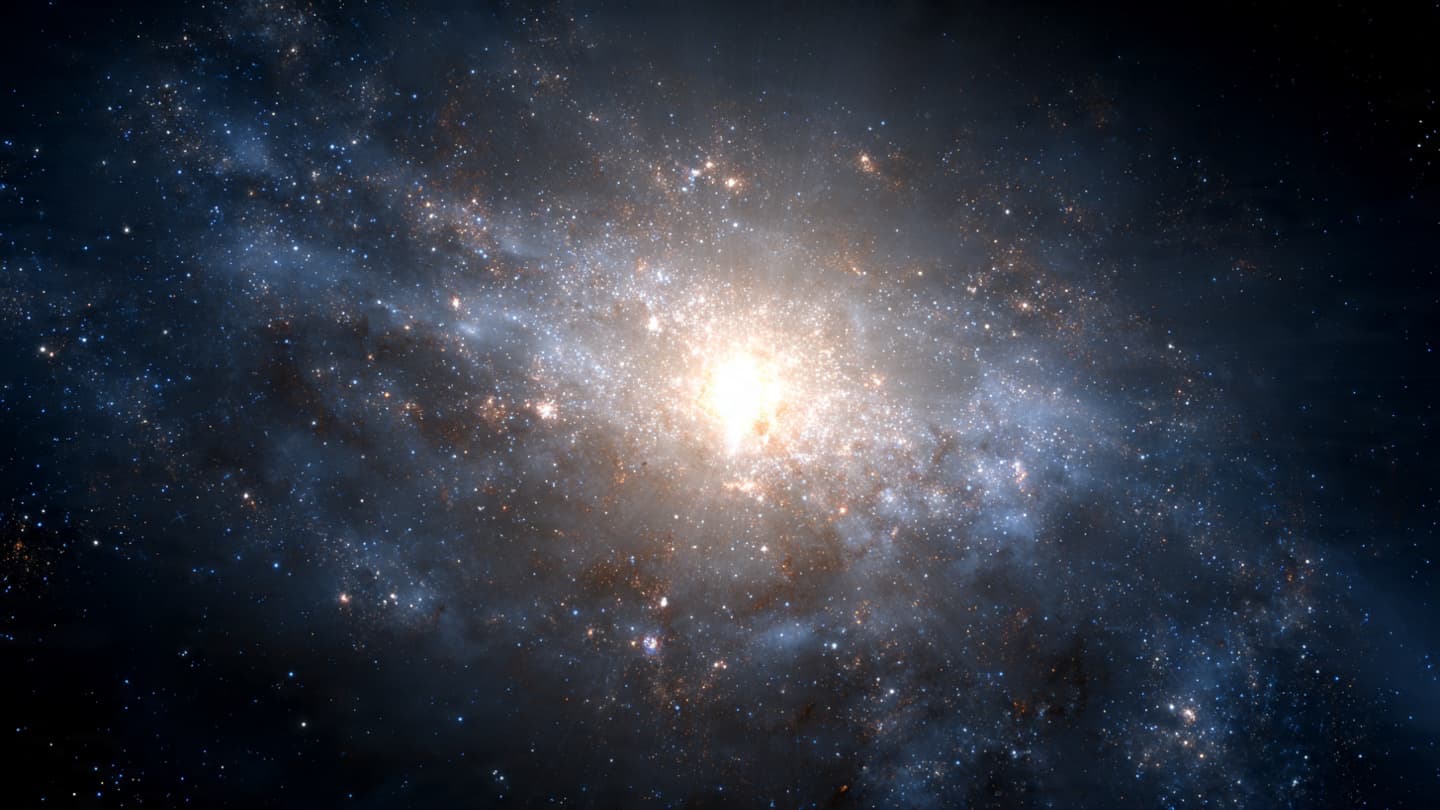
The night sky has long invited humanity to wonder. Across centuries, civilizations have looked upward in search of meaning, navigation, and knowledge. Today, modern observatories continue that tradition, capturing distant events that help scientists understand how the universe evolves. One such event is the recently observed Type Ic supernova known as SN 2026gzf.
Astronomers from several international institutions have begun detailed studies of SN 2026gzf, a stellar explosion classified as a Type Ic supernova. These events occur when massive stars exhaust their nuclear fuel and undergo catastrophic collapse, releasing enormous amounts of energy.
The newly observed supernova attracted scientific attention because early observations suggest unusual geometric characteristics within the explosion. Researchers employed spectropolarimetry, a sophisticated observational technique, to analyze how light emitted by the explosion is polarized.
By studying polarization patterns, astronomers can infer the shape and structure of material ejected during the explosion. Initial findings indicate that SN 2026gzf may exhibit asymmetrical features, offering valuable insight into the physical mechanisms that govern stellar deaths.
Type Ic supernovae are particularly significant because they originate from stars that have lost much of their outer hydrogen and helium layers before exploding. Understanding these events can help researchers refine theoretical models of stellar evolution.
Supernovae also play a crucial role in cosmic history. The heavy elements produced during these explosions, including iron, calcium, and other materials, eventually become incorporated into new stars, planets, and potentially life itself.
Researchers emphasize that continued observations will be necessary to fully understand SN 2026gzf. As the supernova evolves, astronomers will gather additional data using both ground-based and space-based observatories.
The study highlights how advances in observational technology are enabling scientists to investigate cosmic phenomena with increasing precision. Each newly observed supernova contributes another piece to the broader puzzle of how stars live and die.
Although SN 2026gzf exists millions of light-years away, its light now provides astronomers with an opportunity to deepen humanity's understanding of the universe and the processes that shape it.
AI Image Disclaimer: Some illustrations accompanying this article were generated using artificial intelligence to visually depict astronomical phenomena.
Sources Verified: arXiv, Nature Astronomy, Reuters, European Southern Observatory, Science News
Published by Banx Network. This article is part of the Banx decentralized media programme, powered by the BXE token on the XRP Ledger.