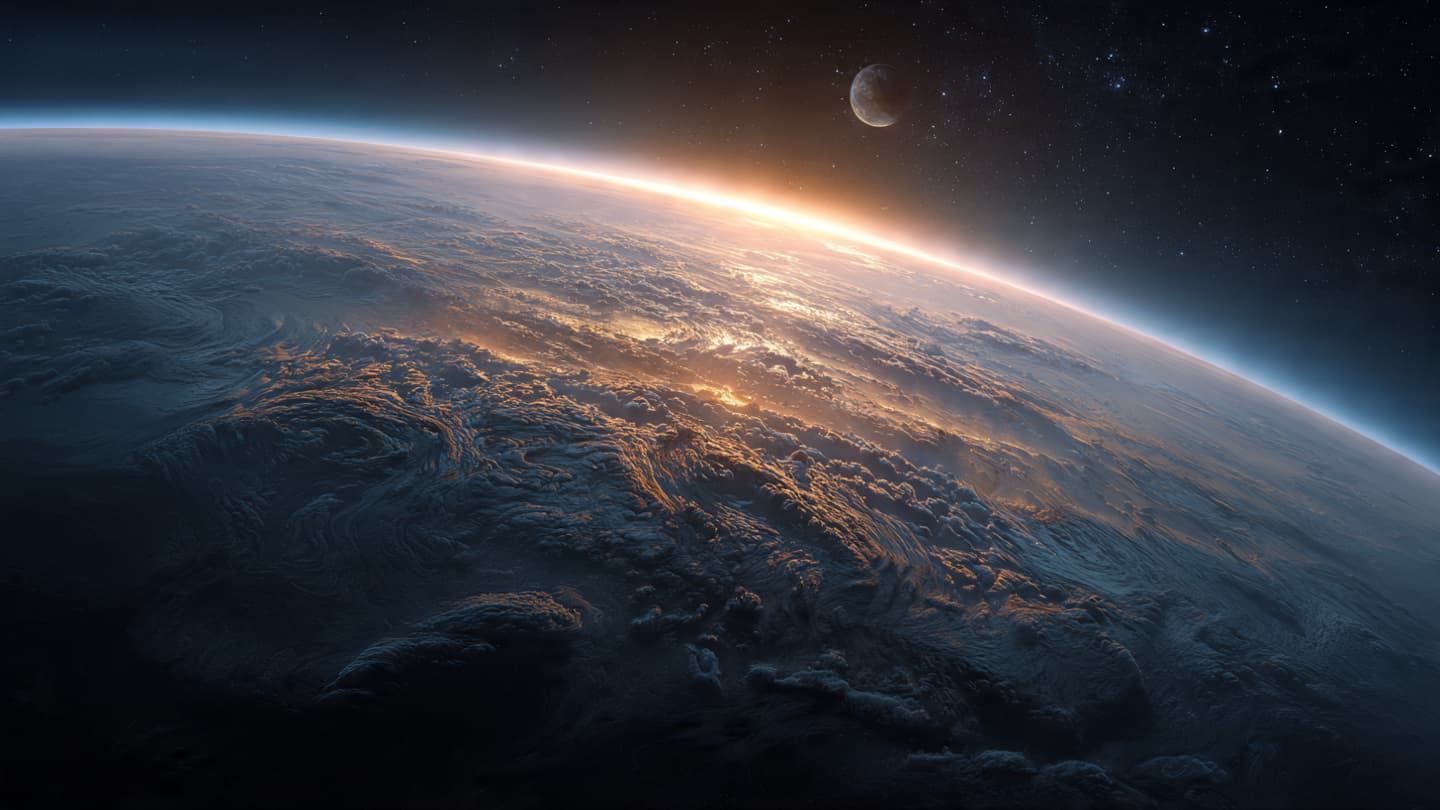
Across the vast silence between stars, distant planets have long appeared to humanity as blurred ideas rather than living worlds. They shimmer faintly in telescope data, like lanterns glimpsed through fog, carrying hints of storms, heat, and unfamiliar skies. Now, new observations from the are offering something remarkably intimate: a look at morning weather patterns on a planet nearly 690 light-years from Earth.
The discovery centers on an exoplanet whose atmosphere appears filled with clouds made of mineral particles resembling fine sand. Using Webb’s infrared instruments, astronomers traced temperature differences and atmospheric behavior across the planet’s surface, allowing researchers to observe how cloud formations changed as daylight emerged across one hemisphere.
For years, scientists studying exoplanets have relied on atmospheric readings gathered during planetary transits and thermal measurements. These techniques helped build models explaining chemical compositions, temperatures, and cloud structures. Yet the latest observations suggest many earlier interpretations may have carried a significant distortion.
Researchers involved in the study say previous atmospheric readings may have underestimated or misread cloud interference by as much as a factor of 100. In practical terms, that means thick mineral clouds may have obscured important signals scientists believed represented the true chemistry of distant atmospheres.
The findings do not invalidate earlier exoplanet research, but they encourage a more cautious understanding of how atmospheric data is interpreted. In astronomy, even tiny measurement biases can ripple outward through years of scientific assumptions, much like a slight shift in a compass gradually changing the course of a long voyage.
The sand-like clouds themselves are also drawing attention. Unlike Earth’s water vapor clouds, many giant exoplanets appear hot enough for silicate materials and metals to circulate through their atmospheres. Under such conditions, particles resembling microscopic grains of sand may drift through alien skies in ways unlike anything seen in the solar system.
Scientists believe the Webb telescope’s sensitivity is allowing them to separate temperature patterns, cloud coverage, and chemical signatures with unprecedented clarity. This level of detail may help researchers better classify exoplanets and understand how planetary climates behave under extreme heat and pressure.
Beyond the technical implications, the study also reflects a quiet transformation in astronomy itself. A generation ago, exoplanets were mostly theoretical possibilities. Today, scientists are beginning to map weather systems, atmospheric layers, and even day-to-night transitions on worlds impossibly far away from Earth.
Researchers say additional Webb observations are already planned for similar planets. As more atmospheric data becomes available, astronomers hope to refine existing models and build a clearer understanding of how diverse planetary systems evolve across the galaxy.
AI Image Disclaimer: Some visuals associated with this article were created through AI-assisted image generation for illustrative presentation.
Sources: NASA, ESA, Nature Astronomy, Space.com
Published by Banx Network. This article is part of the Banx decentralized media programme, powered by the BXE token on the XRP Ledger.