Long before highways crossed Texas and cities stretched across the horizon, much of the region lay beneath a warm inland sea. In those ancient waters, predators moved through shadowed depths with quiet authority, shaping marine ecosystems millions of years before humanity would uncover their remains in stone.
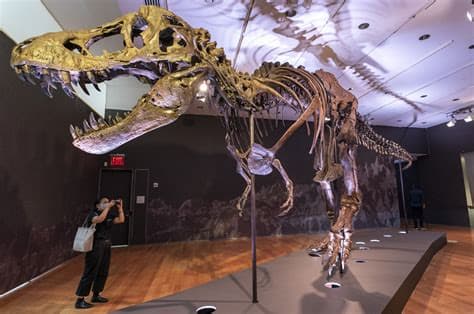
Now, fossil discoveries from Texas are drawing attention to a newly identified massive mosasaur, a marine reptile researchers say may have occupied a role similar to that of a Tyrannosaurus rex in prehistoric oceans. The fossil evidence suggests the enormous predator stood near the top of the marine food chain during the late Cretaceous period.
Mosasaurs were not dinosaurs in the technical sense, though they lived alongside them. These marine reptiles evolved into highly efficient ocean hunters, with streamlined bodies, powerful tails, and jaws adapted for capturing large prey. Some species reached lengths exceeding 40 feet, dominating ancient seas much as large terrestrial predators ruled land environments.
Researchers studying the Texas fossils say the newly examined remains reveal features indicating exceptional size and strength. Paleontologists believe the creature likely preyed upon fish, ammonites, smaller marine reptiles, and other organisms inhabiting the vast inland waters that once divided parts of North America.
The comparison to T. rex reflects ecological position more than direct similarity. Just as Tyrannosaurus occupied the apex predator role on land, giant mosasaurs appear to have filled a comparable role beneath the ocean surface. Their presence shaped entire marine ecosystems through predation and competition.
Scientists involved in the research note that fossil discoveries from Texas continue to provide important insight into the prehistoric geography of North America. During the late Cretaceous period, rising sea levels created enormous shallow seas that transformed much of the continent into interconnected marine environments rich with diverse life.
Advances in fossil imaging and reconstruction technology are also helping paleontologists better understand how these creatures moved and hunted. Detailed analysis of skull structures, tooth patterns, and bone composition allows researchers to infer feeding behaviors and evolutionary relationships with greater accuracy than in previous decades.
Public fascination with large prehistoric predators remains strong partly because such discoveries connect imagination with scientific evidence. Massive marine reptiles evoke a world that feels almost mythological, yet every fossil fragment offers tangible proof that these animals once lived within Earth’s changing ecosystems.
Researchers say additional excavation and study of the Texas fossil beds may reveal further information about mosasaur diversity and evolution. Each new discovery contributes to a broader understanding of how ancient oceans supported some of the most formidable predators in planetary history.
AI Image Disclaimer: Illustrations accompanying this report include AI-generated imagery created for visual interpretation purposes.
Sources: Smithsonian Magazine, Live Science, Nature, Texas Monthly
Published by Banx Network. This article is part of the Banx decentralized media programme, powered by the BXE token on the XRP Ledger.