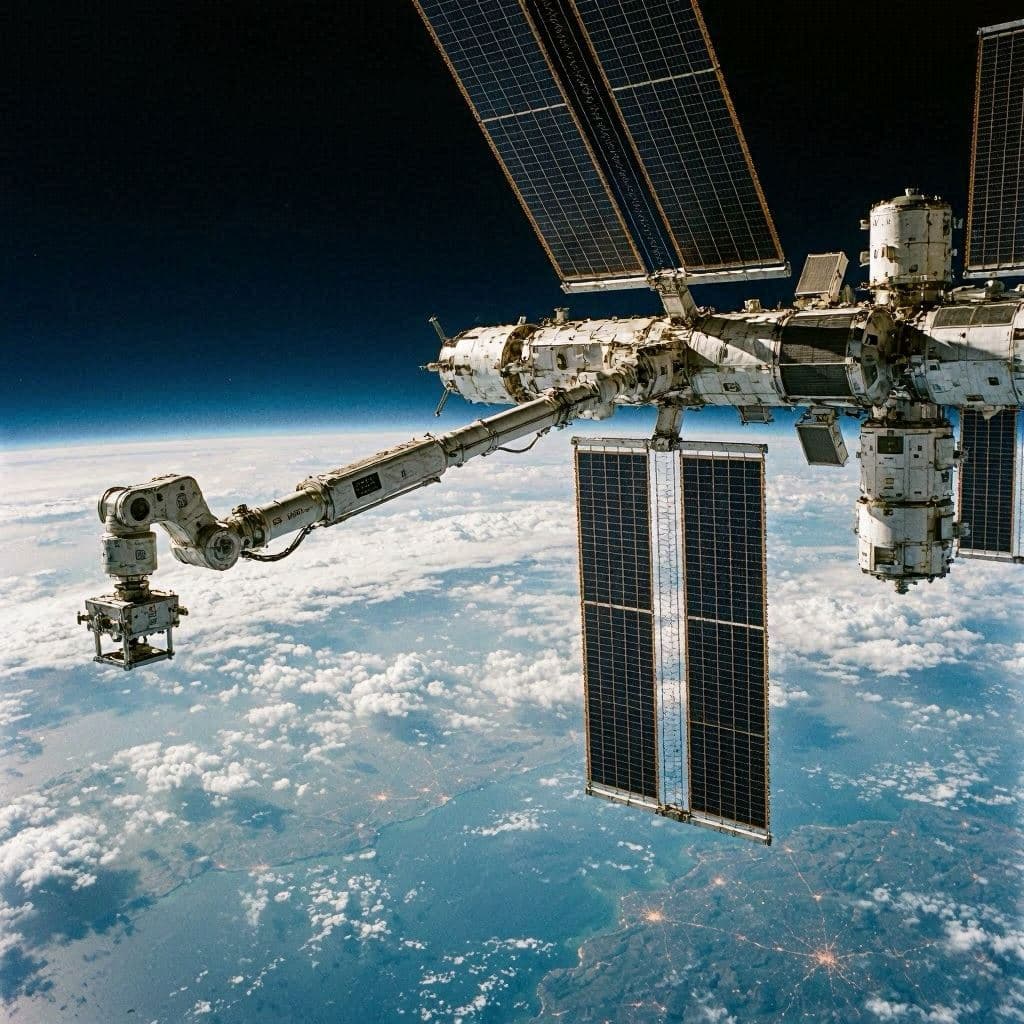
In the microgravity environment of the International Space Station (ISS), maintenance is not merely a chore but a critical act of survival. Recently, astronauts undertook a delicate task akin to surgery, repairing a malfunctioning component of the station’s robotic arm, known as Canadarm2. This intricate operation highlights the ingenuity and precision required to keep complex machinery functioning in the harsh conditions of space, where every tool and movement must be carefully calculated.
The Canadarm2 is essential for the station’s operations, used to berth visiting spacecraft, move cargo, and assist with spacewalks. When a joint or sensor fails, it can compromise the safety and efficiency of the entire outpost. The recent issue required the crew to replace a specific latching end effector, a device that allows the arm to grasp objects. This task demanded a high level of dexterity and coordination, performed while floating in a pressurized module or during a spacewalk.
The term "operate" is apt, as the procedure involved removing panels, disconnecting cables, and installing new hardware with surgical care. Astronauts trained extensively on Earth using virtual reality and physical mockups to prepare for this moment. Their ability to adapt to unexpected challenges is a testament to the rigorous selection and training processes that define human spaceflight. It is a blend of technical skill and calm under pressure.
This repair also underscores the importance of international cooperation. The Canadarm2 is a contribution from the Canadian Space Agency, illustrating how different nations contribute specialized technologies to the shared endeavor of the ISS. The success of the mission relies on the seamless integration of these components and the collaborative spirit of the crews who maintain them. It is a model of global partnership in science and engineering.
For the public, watching astronauts perform such tasks offers a glimpse into the reality of living in space. It demystifies the technology, showing that even advanced robots require human touch and intervention. These moments of problem-solving are often more engaging than routine operations, as they reveal the human element behind the machinery. They remind us that space exploration is a hands-on endeavor.
The successful repair ensures that the ISS can continue its scientific mission without interruption. Experiments in biology, physics, and Earth observation rely on the station’s stability and capabilities. By fixing the arm, the crew has protected years of research and investment, ensuring that the flow of knowledge from orbit to Earth remains uninterrupted. It is a small victory with significant implications.
As we look toward future missions to the Moon and Mars, the skills demonstrated in this repair will be invaluable. Deep space exploration will require even greater self-reliance, as immediate support from Earth will not be possible. The ability to fix and adapt equipment in situ will be a cornerstone of sustainable space exploration. This event serves as a practice run for those future challenges.
In the end, the "operation" on the robot arm is a symbol of resilience. It shows that when things break, we have the capacity to fix them, even in the most hostile environments. It is a tribute to the engineers who designed the hardware and the astronauts who keep it running, working together to push the boundaries of human achievement.
AI Image Disclaimer: Please note that any images associated with this article are AI-generated interpretations intended for illustrative purposes only and do not represent actual footage of the specific repair mission.
Sources: NASA Canadian Space Agency SpaceNews Ars Technica Reuters
Published by Banx Network. This article is part of the Banx decentralized media programme, powered by the BXE token on the XRP Ledger.