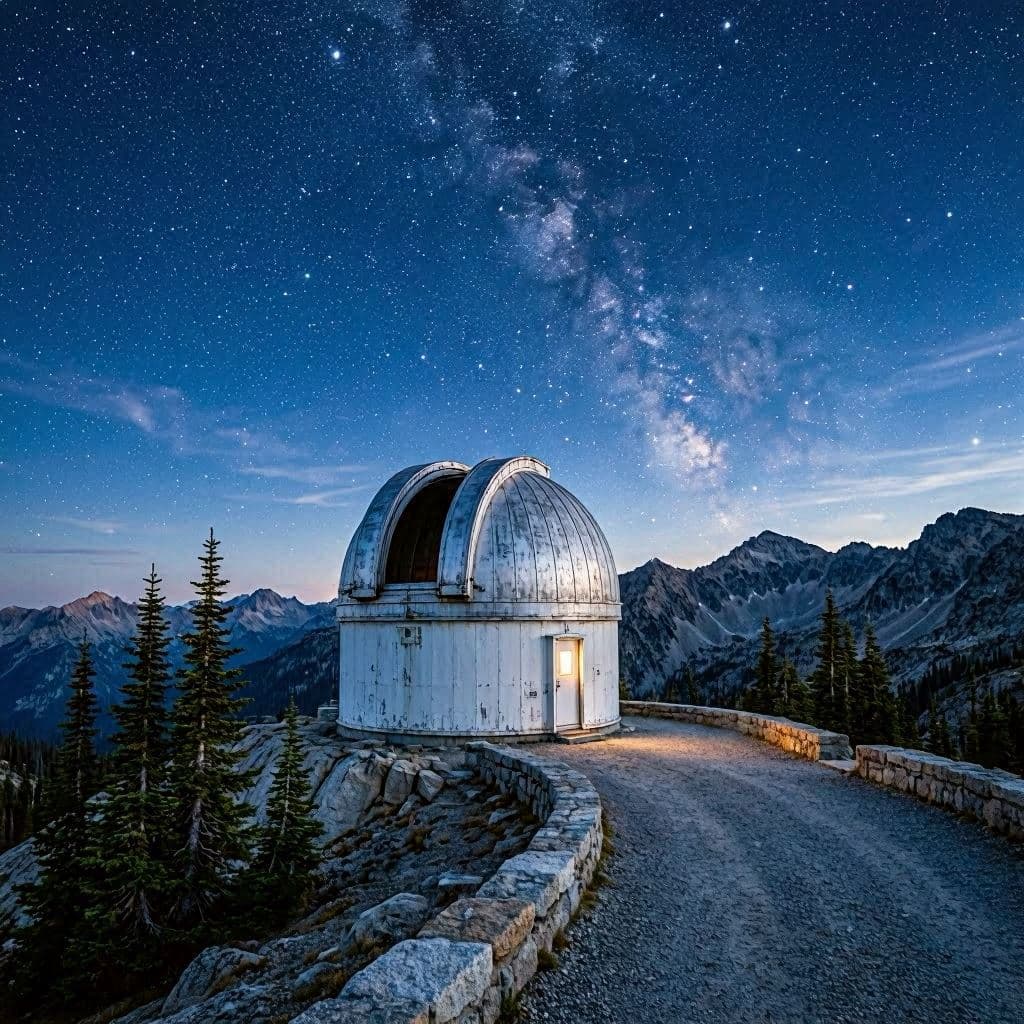
For centuries, humanity has looked to the stars as static points of light, fixed in a celestial tapestry that changes only over millennia. We have viewed the universe as a photograph, a frozen moment in time. But a new era of astronomy is dawning, one that promises to transform our view from a still image into a living, breathing film. The Vera C. Rubin Observatory, perched high in the Chilean Andes, is preparing to launch the Legacy Survey of Space and Time (LSST), an endeavor so vast and dynamic that scientists have dubbed it "the greatest cosmic movie ever made."
This historic telescope is not designed merely to capture deep, static images of distant galaxies. Instead, it will scan the entire visible sky every few nights for ten years. This relentless pace will generate a time-lapse record of the southern sky, capturing changes that were previously invisible to us. From the slow drift of asteroids to the sudden, violent explosion of supernovae, the observatory will document the universe in motion, revealing a cosmos that is far more active and transient than we once imagined.
The scale of the data is difficult to comprehend. Over the course of the survey, the telescope is expected to generate petabytes of information, cataloging billions of stars and galaxies. This digital archive will allow astronomers to track the movement of objects within our own solar system with unprecedented precision, potentially identifying hazardous near-Earth asteroids long before they pose a threat. It is a planetary defense system wrapped in a scientific instrument.
Beyond our cosmic neighborhood, the survey will shed light on some of the most profound mysteries of physics: dark matter and dark energy. By observing how the distribution of galaxies changes over time, scientists hope to map the invisible scaffolding of the universe and understand the force driving its accelerated expansion. The "movie" will not just show us what is there, but how the structure of reality itself evolves.
The technological marvel behind this project is the largest digital camera ever constructed, boasting 3.2 gigapixels. Each image it captures is so detailed that it could resolve a golf ball from dozens of miles away. Yet, the true power lies not in the resolution of a single shot, but in the accumulation of thousands of them. It is the repetition, the constant watching, that will reveal the hidden rhythms of the heavens.
For the scientific community, this marks a shift from targeted observation to broad, continuous monitoring. Instead of pointing a telescope at a specific object of interest, researchers will be able to query the archive for any change that occurred in the sky on a given night. This democratizes discovery, allowing unexpected phenomena to be found by anyone with the curiosity to look. It transforms astronomy from a hunt for specific targets into a harvest of surprises.
As the observatory prepares to open its eye to the sky, there is a sense of anticipation akin to waiting for the curtain to rise on a grand performance. We are about to witness the universe not as a backdrop, but as a protagonist. The static night sky is giving way to a dynamic narrative, full of plot twists and character arcs written in gravity and light.
In the end, the Rubin Observatory offers us more than data; it offers a new perspective. It invites us to see the cosmos as a place of constant becoming, where change is the only constant. As the first frames of this cosmic movie begin to roll, we are reminded that we are not just observers of a static scene, but participants in an unfolding story of infinite complexity and beauty.
AI Image Disclaimer: The visual representations included in this article are generated by artificial intelligence to illustrate thematic concepts and do not depict actual images from the Vera C. Rubin Observatory.
Sources: National Science Foundation SLAC National Accelerator Laboratory Space.com Scientific American The New York Times
Published by Banx Network. This article is part of the Banx decentralized media programme, powered by the BXE token on the XRP Ledger.