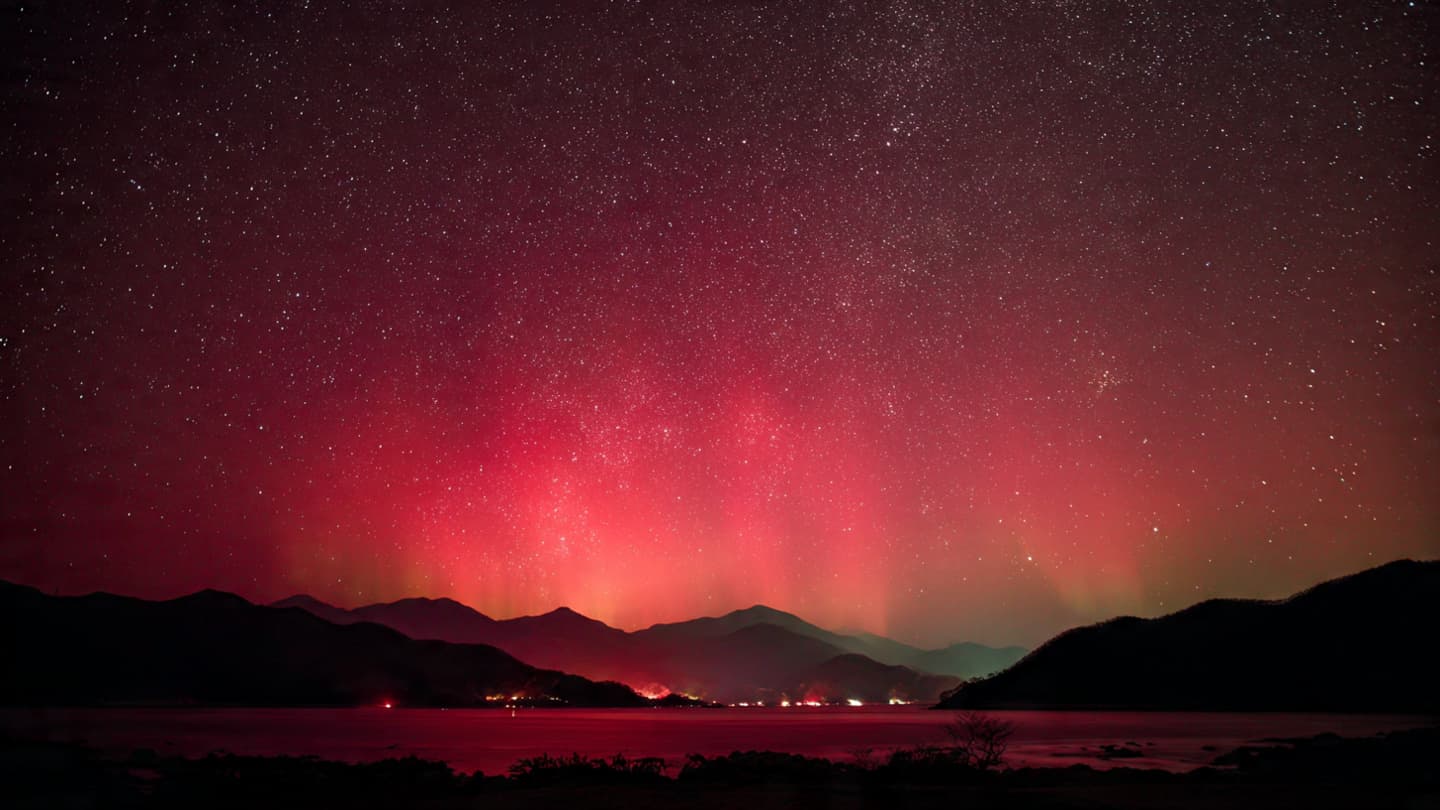
For centuries, unusual lights in the sky have inspired wonder, myth, and scientific curiosity. Across northern regions of the world, auroras often appear as flowing curtains of green and blue light moving silently through the darkness. Yet over Japan recently, researchers observed a rare red aurora reaching unexpectedly high into Earth’s upper atmosphere, drawing attention from both scientists and the public.
The phenomenon was linked to increased solar activity interacting with Earth’s magnetic field. Scientists studying the event explained that the red coloration and unusual altitude suggest energetic particles reached atmospheric layers far higher than typical auroral displays.
Auroras occur when charged particles from the Sun collide with gases in Earth’s atmosphere. Different colors emerge depending on altitude and atmospheric composition. Green auroras usually form lower in the atmosphere, while red auroras often appear at much greater heights under specific geomagnetic conditions.
Researchers used satellite observations and ground-based imaging systems to analyze the event. Preliminary findings indicate that the aurora extended into parts of the thermosphere, one of the uppermost layers of Earth’s atmosphere where interactions between solar radiation and atmospheric particles become increasingly complex.
The event arrives during a period of heightened solar activity associated with the Sun’s natural eleven-year cycle. During solar maximum phases, eruptions such as solar flares and coronal mass ejections become more frequent, increasing the likelihood of geomagnetic storms affecting Earth.
Space weather events can influence more than visual phenomena alone. Strong solar activity may affect satellite systems, radio communication, navigation signals, and electrical infrastructure. Scientists therefore monitor solar conditions closely to better understand and predict potential technological impacts.
Japan’s observation networks have become increasingly sophisticated in recent years, allowing researchers to study atmospheric events with greater precision. Advances in imaging technology and satellite coordination now provide scientists with detailed information about interactions occurring high above Earth’s surface.
Public fascination with auroras has also grown through photography and social media, where rare atmospheric events quickly attract international attention. Images of the crimson sky over Japan circulated widely online, blending scientific interest with visual wonder.
As researchers continue analyzing the rare aurora, the event serves as another reminder that Earth’s atmosphere remains deeply connected to activity unfolding millions of miles away on the Sun. Even in an age of advanced science, the sky continues offering moments that feel both measurable and mysterious at the same time.
AI Image Disclaimer: Some visuals connected to this article are AI-generated interpretations inspired by atmospheric and space-weather research.
Sources ScienceDaily Reuters Japan Meteorological Agency NASA
Published by Banx Network. This article is part of the Banx decentralized media programme, powered by the BXE token on the XRP Ledger.