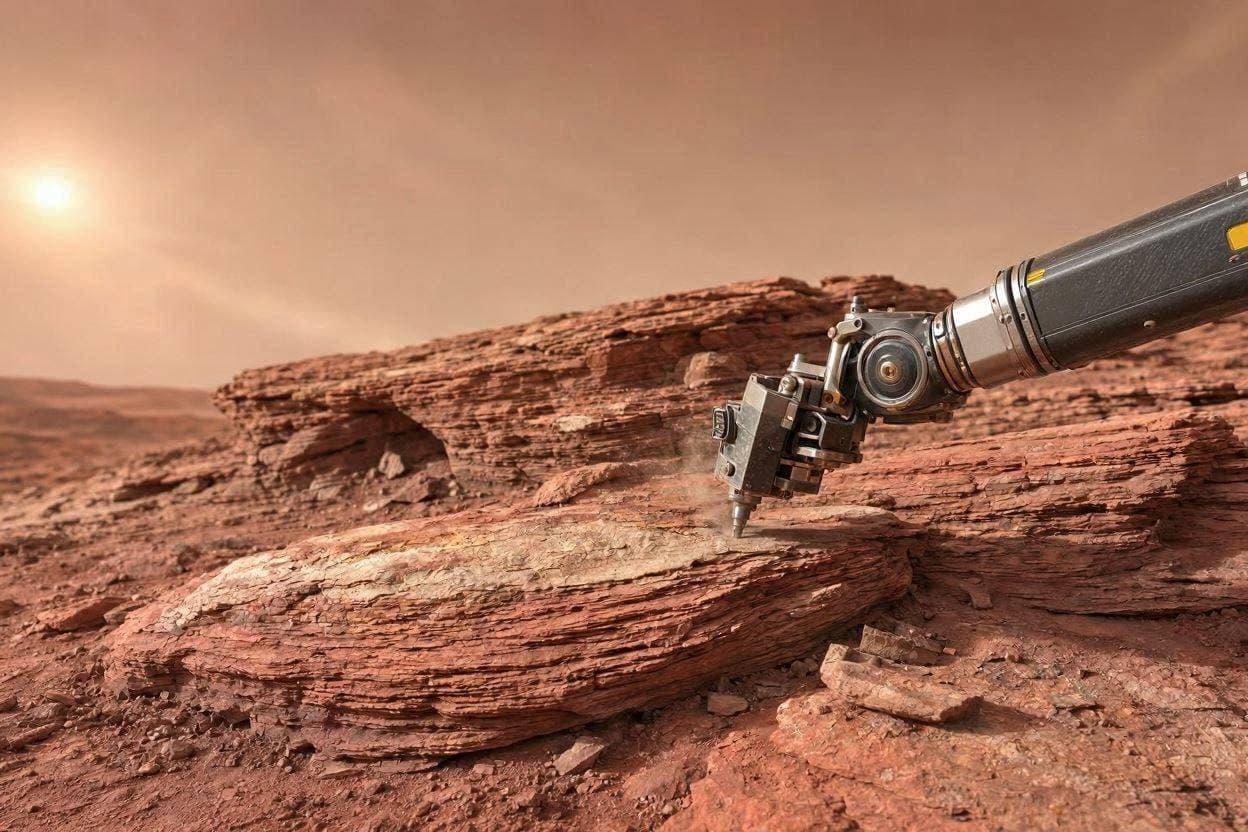
Opening: In the quiet, rust-colored expanse of Jezero Crater, where ancient river deltas once fanned out into a long-vanished lake, a small robotic geologist has been patiently reading the stone. For years, NASA’s Perseverance rover has traversed this desolate landscape, its wheels leaving faint tracks in the regolith, searching for whispers of a time when Mars might have been hospitable to life. The recent discovery of complex organic carbon within these sedimentary rocks is not merely a data point; it is a profound echo from the past, inviting us to listen more closely to the story written in the mudstone.
Body: The detection of intact organic molecules in the Bright Angel formation marks a significant deepening of our understanding of Martian chemistry. These are not simple compounds but complex structures that have survived billions of years of radiation and geological stress. The rover’s sophisticated instruments, including SHERLOC and PIXL, have allowed scientists to map these organic signatures with unprecedented detail, revealing how they are intertwined with specific minerals that formed in water. This association suggests that the organic matter was preserved in a environment that was once wet and potentially habitable.
What makes this finding particularly compelling is the context in which these molecules were found. They reside within mudstones that were deposited in a calm, low-energy aquatic environment, ideal for preserving delicate chemical structures. The presence of these organics alongside sulfate minerals indicates a shift in the planet’s climate, a transition from wetter to drier conditions that locked these chemical clues away from the harsh surface environment. It is a testament to the resilience of chemistry, even on a world that has lost its atmosphere and water.
Scientists are careful to note that organic carbon is not synonymous with life. These molecules can be formed through non-biological processes, such as volcanic activity or interactions between rock and water. However, their complexity and preservation state raise intriguing questions about their origin. Are they the remnants of ancient microbial life, or are they the product of abiotic synthesis that occurred in the early solar system? The distinction is subtle, yet it lies at the heart of astrobiology’s greatest quest.
The Perseverance rover’s ability to analyze these samples in situ provides a crucial layer of verification that previous missions could not achieve. By examining the texture and composition of the rocks at a microscopic level, researchers can rule out contamination and confirm that the organics are indeed indigenous to Mars. This meticulous process of elimination and confirmation is slow, but it is necessary to build a case that can withstand the rigorous scrutiny of the scientific community.
As the rover continues its journey, it carries with it the hope of returning these samples to Earth. The Mars Sample Return campaign, though facing logistical and budgetary challenges, remains the ultimate goal for definitive analysis. Until then, Perseverance acts as our eyes and hands on the Red Planet, carefully selecting and documenting the most promising candidates for future study. Each scan, each drill core, adds another piece to the puzzle of Martian history.
This discovery also highlights the importance of persistent exploration. It was not a single measurement but a cumulative body of evidence gathered over months of detailed surveying that revealed the significance of the Bright Angel formation. The patience of the mission team and the durability of the rover have allowed for a depth of analysis that transforms vague hints into concrete scientific findings. It is a reminder that great discoveries often require time, precision, and an unwavering commitment to the question at hand.
Closing: The presence of complex organic carbon on Mars does not confirm life, but it confirms that the ingredients for life were present and preserved in a way that allows us to study them. As Perseverance continues its work, it invites us to remain curious and humble, recognizing that every grain of Martian dust may hold a secret waiting to be understood. The search continues, guided by data and driven by the enduring human desire to know if we are alone in the universe.
AI Image Disclaimer: The accompanying visual representations are AI-generated illustrations designed to evoke the atmospheric conditions of Jezero Crater and should not be considered actual photographic evidence.
Sources: NASA Jet Propulsion Laboratory, Nature Astronomy, Science Advances, Reuters, Chemical & Engineering News
Published by Banx Network. This article is part of the Banx decentralized media programme, powered by the BXE token on the XRP Ledger.