The universe often reveals its complexity in unexpected arrangements, as though celestial bodies were engaged in an intricate dance choreographed over millions of years. A newly studied system discovered with NASA's Transiting Exoplanet Survey Satellite, or TESS, has added another remarkable step to that cosmic performance.
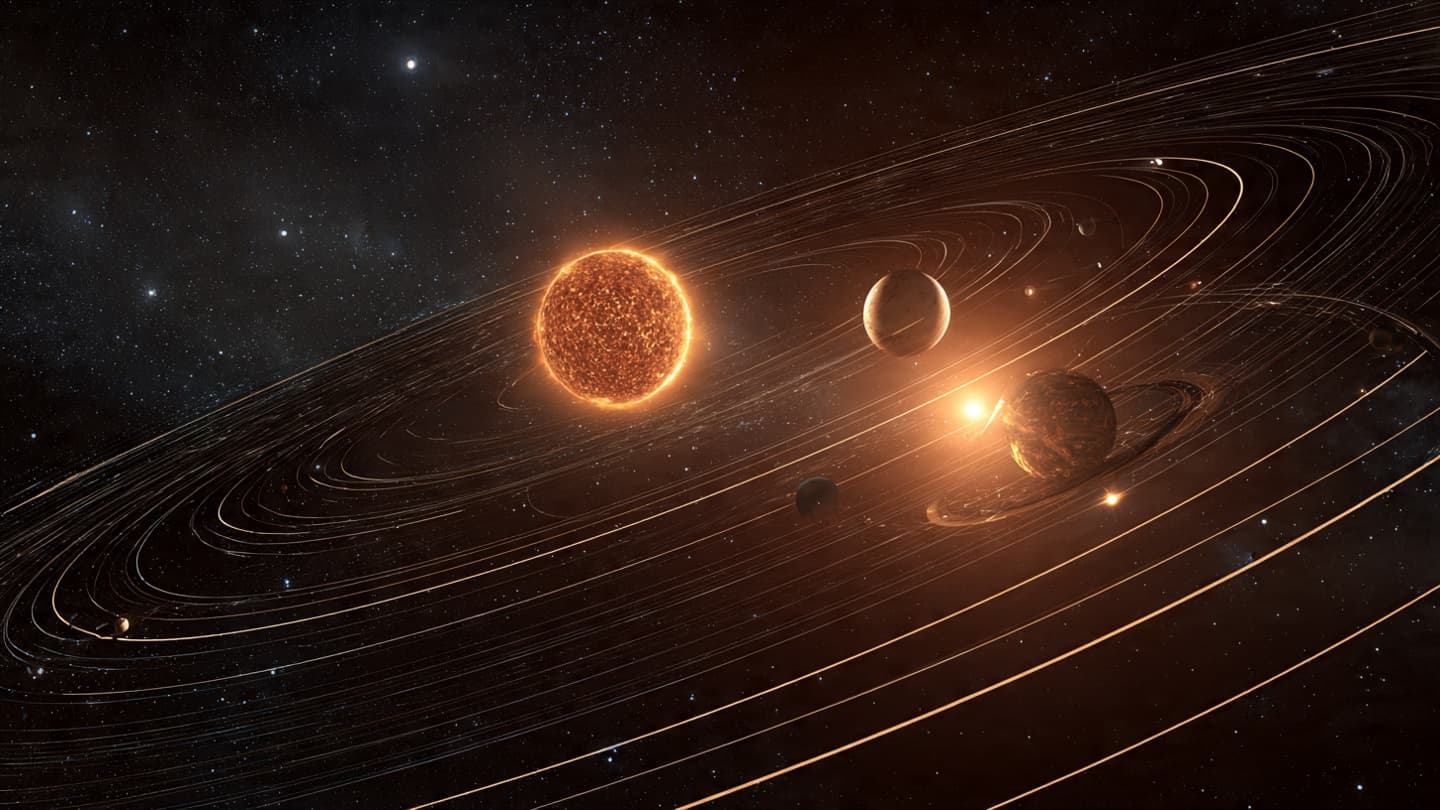
Astronomers have identified an unusual three-body system in which a brown dwarf follows an exceptionally long eight-year orbit around a pair of planets. The discovery challenges conventional expectations about how planetary systems form and evolve.
Brown dwarfs occupy an intermediate category between planets and stars. They possess more mass than giant planets but lack sufficient mass to sustain the nuclear fusion that powers ordinary stars.
According to researchers, the newly identified brown dwarf exerts significant gravitational influence on the two planets orbiting the same star. Over time, those gravitational interactions appear to distort, or warp, the planets' orbital paths.
The system was initially detected using observations from NASA's TESS mission, which searches for exoplanets by monitoring subtle changes in stellar brightness. Additional observations from ground-based observatories helped confirm the system's unusual architecture.
Scientists describe the configuration as rare because massive companions such as brown dwarfs are seldom found in stable arrangements alongside multiple planets. The discovery therefore offers researchers an important opportunity to test models of planetary system formation.
Studying these interactions may help astronomers understand how gravitational forces shape planetary orbits over billions of years, both within distant systems and potentially within our own cosmic neighborhood.
Researchers expect continued observations to reveal additional details about the system, further expanding understanding of the diverse arrangements that exist among stars and their companions.
AI Image Disclaimer: The accompanying images are AI-generated artistic representations intended for illustrative purposes.
Sources: NASA, The Astrophysical Journal, Space.com, TESS Mission Team
Published by Banx Network. This article is part of the Banx decentralized media programme, powered by the BXE token on the XRP Ledger.